Mediterranean Weather in April: A Complete Travel Guide
Contents
More travelers are waking up to April as the smart shoulder for exploring southern Europe, swapping the July crush for thinner foot traffic and hotel rates that don’t make you wince. That trend is good news. The bad news: weather maps and cruise brochures still paint the whole basin with one brushstroke, as if Palermo and Marseille share a thermostat. They don’t. The key is to stop thinking of the region as a single block—Aegean islands and the Costa del Sol are not the same season. In April, the real question isn’t ‘is it warm’ but ‘where is the wind coming from’—that dictates whether you’re in a t-shirt or needing a fleece. The sea is best treated as a ‘look but don’t jump in’ situation, and it is wise to plan outdoor activities around midday warmth rather than all-day expectations.
Key Takeaways
- Daytime highs typically land between 16°C and 22°C, but the real story is wind—Mistral, Sirocco, and Levante can flip a forecast in an hour, so a fleece is never optional.
- The sea remains a chilly 15–18°C across most of the basin; sunbathing on a sheltered beach is doable, but open-water swimming is strictly for wetsuit evangelists.
- Western regions like Andalusia and the Côte d’Azur see more passing rain showers than eastern Greece and Turkey, yet all pockets bask in 8–9 hours of daylight—ideal for long midday hikes or café terraces.
The Mediterranean Isn’t One Climate Block
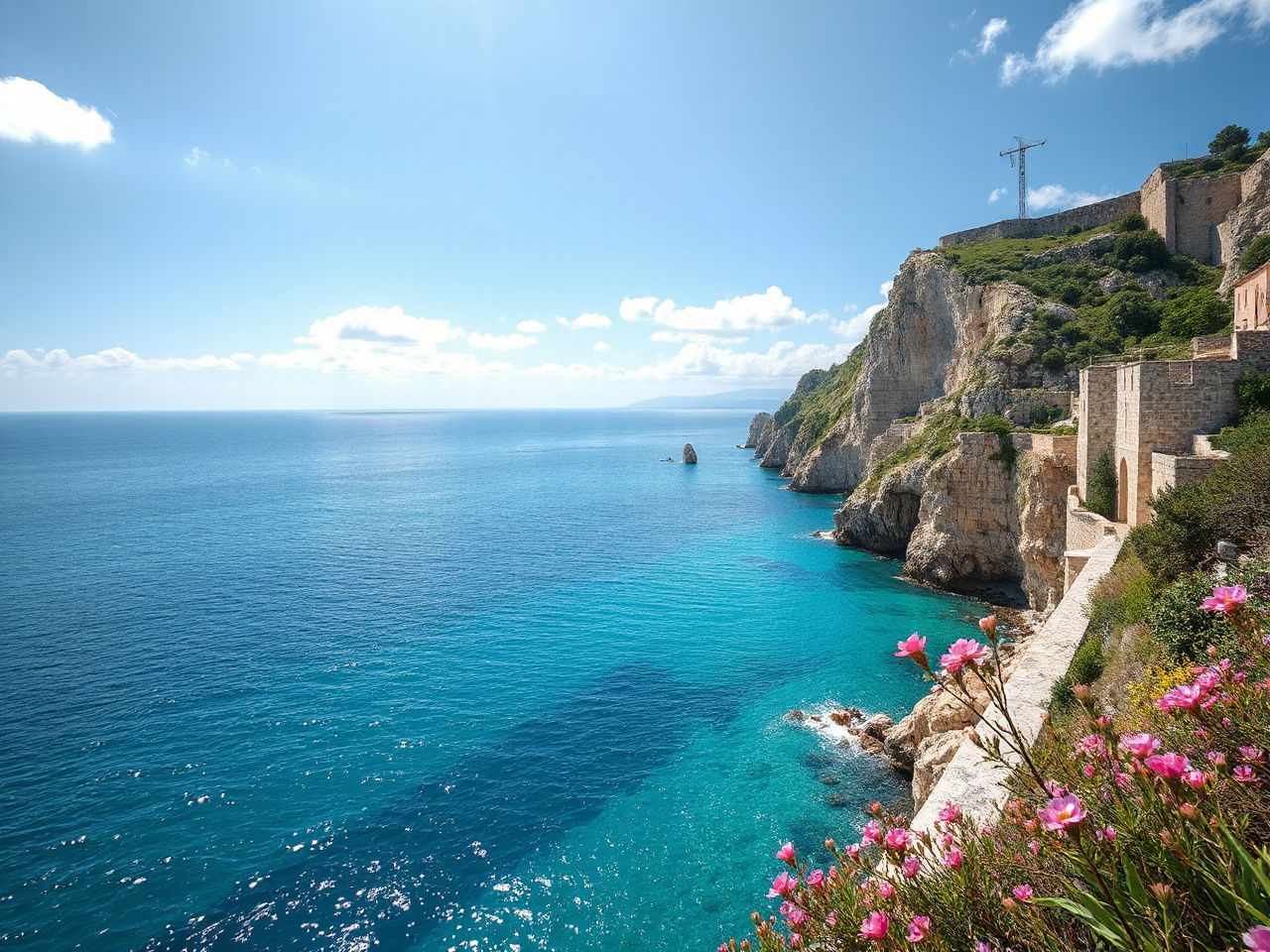
Brochures love a sweeping statement—”enjoy the Mediterranean spring”—as if the whole 46,000-kilometer coastline wakes up in a uniform haze of gentle warmth. In truth, the Mediterranean in April is a collection of microclimates shaped by geography that my motorcycle has taught me to read at a glance. The western basin, churned by the Alboran Sea and the Gulf of Lions, stays decisively cooler than the eastern Aegean. Head to Málaga and you might peel off a jacket by 2 p.m. in a wind-sheltered square; stand on a Naxos ridgeline the same week and a steady north wind will have you cinching every zip.
The Mediterranean’s western basin, from the Costa del Sol to the Ligurian Sea, is consistently cooler and windier than the eastern Aegean in April. Copernicus climate bulletins confirm that sea surface temperature anomalies often split the basin in two during early spring. While the Ligurian coast near Genoa might hover at 15°C, Rhodes can brush 18°C. Those three degrees separate a bracing, toe-dip-only morning from a genuinely pleasant—if brief—afternoon plunge.
Temperature ranges for a beach day versus sightseeing diverge sharply. Coastal towns that face south and have a bit of hill protection—think Altea on the Costa Blanca or the hidden coves of western Crete—can hit 22°C by early afternoon, enough for sunbathing in a wind-free pocket. An hour inland, visiting hilltop monasteries or riding serpentine roads, you’ll drop back to 10–12°C once the sun slides behind a range. Layering is not a suggestion; it’s a survival tactic for anyone who wants to be outside from breakfast espresso to late dinner.
Rain in April is not the steady drizzle of London; it arrives in short, punchy fronts that sweep through quickly. Barcelona, Nice, and Athens all average 4 to 6 rainy days in the month, but those numbers hide the real texture. A passing system can dump 20 millimeters in an hour, turning cobbled streets into rivers, then vanish by the time you’ve finished a gelato. Western ports like Barcelona see more of these Atlantic-driven fronts, while Athens and the Cyclades lean on scattered showers that tend to miss the islands altogether. April in the Mediterranean delivers 8 to 9 hours of daily sunshine, but a passing front can dump 30 mm of rain in a single afternoon.
The ‘false summer’ phenomenon catches nearly every first-timer. A day might open with a cloudless, 22°C high that has everyone in sandals and linen. By 7 p.m., with a katabatic breeze sliding down from the mountains, you’ll be shivering on a terrace wishing you’d packed a packable down jacket. April loves to tease, and the only defense is having a mid-layer ready inside a daypack—no matter how blue the morning sky looks.
Wind Rules the Calendar: What I’ve Learned Chasing the Sun
If you take one piece of advice from my misadventures, make it this: the forecast temperature is the sidekick, the wind direction is the villain. The Mistral in southern France, the Sirocco blowing off North Africa, and the Levante through the Strait of Gibraltar all appear with little warning in April and can dominate conditions for two or three days straight. I once exited a ferry in Bastia to a Mistral gust of 70 km/h—clear skies, brilliant sun, but walking upright demanded a lean angle I normally reserve for cornering on a dirt bike. The official temperature was 17°C. It felt like 8°C.
This is why the sea state for boat trips or ferry crossings isn’t something you infer from a temperature app. The Gulf of Lions, swept by the Mistral, can throw up a short, steep chop that turns a catamaran crossing into a queasy endurance test even in mild air. A Sirocco event brings warm, dust-laden wind that spikes the mercury into the mid-20s but coats every outdoor surface with fine Sahara grit. The Levante in the Strait and Alboran Sea produces persistent easterlies that make the water lumpy and keep the beach a windswept affair. If you’re planning a cruise routing through open-water stretches, check the Météo-France marine forecasts for the western basin and the Hellenic National Meteorological Service for the east. Calmest crossings in April typically run in the Ionian and southern Adriatic, where island shielding cuts the fetch.
Which Mediterranean islands dodge the worst of the wind in April? Crete and Rhodes, thanks to their size and southern latitude, often sit in a more protected pocket, especially their southern coasts. The Balearic Islands, by contrast, can be entirely exposed—Mallorca’s Tramuntana range funnels fierce northwesterlies, and Menorca sits squarely in the path of any low pressure scudding east from the Atlantic. The Greek Cyclades, famously wind-scoured in summer, already start to feel the seasonal Meltemi by late April, though not yet at full blast. If you want the highest chance of glassy, turquoise coves and dry café terraces, aim for the Turkish Turquoise Coast around Kaş or the leeward side of Crete’s Amari Valley.
From the Saddle: What April Really Feels Like Outdoors
I don’t trust travel writing that hasn’t been tested by a helmet visor splattered with rain or a chain stiff with road dust. Hiking and cycling along the Mediterranean coast in April are, to my mind, the peak months for effort-to-reward ratio. Trails that will be dust-choked and sun-blasted by June are still springy underfoot, the maquis bushes are humming with bees, and you’re not sharing the path with a conga line of tour buses. The air temperature for climbing—whether powering up the corniche roads of the Côte d’Azur or grinding over Crete’s Lefka Ori—rests in the ideal 12–18°C range, cool enough to wick sweat but warm enough that descents don’t chill you to the bone.
Sunshine hours run 8 to 9 daily, which means a dawn start still gets you soft, low-angle light for photography, and you’ve got until nearly 7:30 p.m. before daylight fades. Yet, I carry a rain shell on every ride, no matter how spotless the horizon. The Ligurian Sea can conjure a squall that turns the Italian Riviera’s switchbacks into a slick, leaf-strewn ribbon in twenty minutes. For those arriving by ship, certain shore excursions in April offer empty trails and wildflower blooms that summer tourists never see—the Anaga mountains of Tenerife or the coastal footpaths of Cinque Terre are, in this month, nearly private.
Swimming, though, is a different matter. Sea surface temperatures in April are still a brisk 15–18°C across most of the basin. The Mediterranean Sea doesn’t reach comfortable swimming levels until late May in all but the warmest southern pockets (the Gulf of Gabès off Tunisia can sneak above 18°C earlier, but that’s a narrow band). That means a quick dip is doable—exhilarating, even—but anything longer requires a wetsuit or a heated pool. I treat the April sea as a visual backdrop: spectacular for a cliffside picnic, lousy for a lazy float session. Beach bars and outdoor cafés are a mixed bag in early April. Easter 2026 falls on April 5, which often triggers a wave of openings, but many seasonal businesses in quieter locales won’t fully crank up until the last week of the month. By late April, you’ll find sun loungers appearing on the Greek and Turkish shores, though the water is still strictly for the hardy.
Packing for this seesaw requires less volume than you think. A lightweight merino base, a long-sleeve shirt for sun, a fleece or active insulation jacket, and a packable waterproof shell will cover 90% of scenarios. One pair of trousers that dries quickly, one pair of shorts for the midday warm slot. I stash a thin buff and summer-weight gloves—if you’re on two wheels, wind chill at 60 km/h can strip all the warmth from your hands even on a 20°C afternoon. Footwear: a trail-running shoe with enough tread for wet limestone, no heavy hiking boots unless you’re tackling snow-melt trails at altitude on Crete’s White Mountains. The biggest packing error I see is treating a Mediterranean April trip like a tropical getaway; leave the sarong at home and bring a second layer you’d actually use.
A Regional Cheat Sheet: Spain to Turkey
Spain’s Mediterranean arc—from the Costa del Sol up to Catalonia—is a tale of two winds. The Levante can blast the Strait with easterlies that keep the Alboran Sea rough, while the Costa Brava often enjoys a gentler sea breeze. Málaga and Valencia bask in 18–22°C daytime highs, but nights still dip to 9–11°C. Barcelona in April gets about 6 days of rain, often short but heavy. The Balearic Islands sit right in the path of alternating fronts; Mallorca’s north coast gets the brunt of the Tramuntana wind, while the south-facing Cala d’Or can be idyllic. If you’re set on a cruise, choosing an itinerary that hugs the more sheltered Adriatic coast or Greek islands can smooth out the roughest sea days; our 2026 Mediterranean cruise picks highlight routes with fewer open-water passages.
Southern France and the Côte d’Azur live under the Mistral’s shadow. Nice and Cannes can string together four or five days of flawless sunshine, but when the Mistral roars, it scours the sky and the sea simultaneously. April daytime highs hover near 17–19°C, but a Mistral day can make a sheltered harbor terrace feel ten degrees warmer than an exposed beach. The Ligurian coast toward Genoa catches similar patterns with added moisture, making the Italian Riviera gloriously green—and prone to pop-up showers. Tuscany’s Argentario coast and the islands of Elba offer a bit more protection; their mountain spines break the wind, creating microclimates that feel a month ahead.
Italy’s long coastline spans too many climate zones to generalize, but the Amalfi Coast and Sorrento Peninsula in April deliver a photographer’s dream: sharp light, lemon blossoms scenting the air, and daytime highs around 18°C. Rain comes in swift, theatrical downpours that clear as fast as they arrive. Further south, Puglia and the Salento peninsula begin to feel warmer, sometimes hitting 21°C, and the Ionian shore is noticeably calmer than the Adriatic. Sicily and Sardinia split the difference: Sardinia catches the Mistral’s tail, while Sicily’s south coast can already feel like early summer, though sea temps remain stubbornly cold.
Greece and the Aegean open April with a cautious smile. The southern Greek islands—Crete, Rhodes, Karpathos—often deliver the most reliably sunny days in the eastern basin, with highs reaching 20–22°C and sea temperatures ticking toward 18°C by month’s end. The Cyclades (Santorini, Naxos, Mykonos) are wildcards: stunningly beautiful but exposed to the early-season Meltemi, which can whip up whitecaps and gust through the island’s cobbled lanes. Athens sees about 4 rainy days and enjoys long, bright afternoons; the Acropolis in April, before the crowds choke the paths, is one of the great urban hiking experiences in Europe. For a slower pace, a Mediterranean river cruise through sheltered inland waterways can sidestep the Aegean’s unpredictability entirely while still delivering the spring bloom.
Turkey’s Turquoise Coast often runs the warmest swaths of the eastern Mediterranean in April. Antalya and the Lycian peninsula can see 21–24°C on a sunny afternoon, with sea temperatures near 18°C. The Beydağları Mountains still trap enough cool air to make early mornings crisp, and a sudden Sirocco can spike the mercury to 26°C for a day before a front knocks it back. The Çeşme peninsula near İzmir feels windier, more akin to the central Aegean, while the Kaş–Kalkan stretch offers some of the most reliable still mornings I’ve ever woken up beside. April often brings ‘false summer’ days where highs reach 22°C but lows drop to 10°C, so layering is non-negotiable.
Across all these pockets, one truth holds: the Mediterranean in April demands you watch the sky, not just the calendar. Outdoor cafés open later in the month, but you’ll find taverna chairs stacked inside until Easter week passes, and beach bars won’t fully set up until the last days of April. The shoulder season reward—nearly empty archaeological sites, hoteliers who still have time to chat, and prices that haven’t yet doubled—is ample, but only if you pack a fleece and respect the wind.
Frequently Asked Questions
Is April warm enough to sunbathe in the Mediterranean?
On a wind-sheltered south-facing beach, yes—22°C afternoons with clear skies make sunbathing comfortable, especially midday. But don’t expect summer-level heat; you’ll often need a long-sleeved layer for the shade. Coastal stretches like the Costa del Sol or southern Crete provide the best odds for t-shirt weather, while exposed Cycladic islands can feel much cooler.
Should I expect cold water for swimming?
Definitely. Most of the Mediterranean sea surface temperature hovers between 15°C and 18°C in April, which is bracing even for experienced open-water swimmers. A short dip is possible, but extended swimming really calls for a wetsuit. The southern Turkish coast and the Gulf of Gabès sometimes nudge toward 18°C earlier, but the vast majority of beaches remain too cold for casual floating.
Do I need a jacket in the evenings even if days feel warm?
Absolutely. Once the sun drops, coastal valleys funnel cool air seaward, and temperatures routinely fall to 10–12°C. A lightweight insulated jacket, fleece, or packable down layer is essential for alfresco dinners. I’ve lost count of the evenings I’ve been grateful for a simple mid-layer stashed in my daypack after a 22°C afternoon had me convinced I’d packed too warm.
How reliable is the weather for hiking or cycling along the coast?
For active pursuits, April is exceptionally reliable if you plan around the midday window and carry rain protection. Hiking routes from the Cinque Terre to Crete’s gorges are firm and flower-strewn, and cycling the Catalan or Turkish coast feels sublime at 12–18°C. The real wildcard is wind: a Mistral or Meltemi gust can make exposed ridgelines challenging, so check local forecasts daily.
What’s the best way to pack for shifting conditions in April?
Pack fewer items but more layers. A merino base, a lightweight fleece, a windproof or waterproof shell, and quick-dry trousers form the core. Include sun protection (the April sun is already strong, with UV indices reaching 6–7) and a packable rain jacket. Skip heavy parkas, but never skip an extra layer for evenings; a buff and light gloves are invaluable if you’ll be on a motorcycle or scooter.