The Best Mediterranean Cruises for 2026
Contents
There is no honest ranked list of the best Mediterranean cruises for 2026. “Best” here is not a property of a ship. It is a property of three things you choose before you open a deck plan: which of the region’s cruising loops you sail, which month you sail it, and whether the ports on that itinerary let your ship tie up to a quay or force it to anchor offshore and run tenders. Those choices decide how much of the Mediterranean you actually set foot on.
They matter more in 2026 because the region’s busiest ports have spent two seasons writing rules. Barcelona is cutting its cruise terminals from seven to five. Cannes has capped how many passengers may come ashore in a day. Greece charges a landing fee four times higher at Santorini and Mykonos than anywhere else. Venice has not taken a large ship into its historic center since 2021. This guide works that decision in order — region, season, berth — and shows you how to check an itinerary against official port sources.
Key takeaways
- Itineraries split into three loops: the western basin, the eastern basin and Aegean, and the Adriatic. Ships rarely do more than one well in a week.
- Greece’s cruise levy marks the real season: peak June 1 to September 30, shoulder in April, May and October, low November through March.
- The western basin gives you alongside berths and long inland transfers. The eastern basin puts you at the doorstep of the sight, then makes you reach it by tender.
- Santorini has no cruise dock at all. Kotor and Mykonos can go either way on the day.
- An itinerary that says “Venice” probably means Marghera or Ravenna. Check before you book flights.
The Mediterranean is three cruising regions, not one
The western basin is the Spanish coast and Balearics, the French Riviera, Tyrrhenian Italy, and Sicily and Malta. Barcelona and Civitavecchia — the Port of Rome — are its heavyweight turnaround ports, and most seven-night western itineraries are built around one of them. Calls sit close enough together for long port days, but the famous cities are inland.
The eastern basin is Piraeus and the Aegean islands, with a Turkish call at Kuşadası for Ephesus and, on longer runs, the Dodecanese. This is the region people picture when they say “Greek islands,” and it is where the most restrictive port rules now apply.
The Adriatic is often sold under the eastern heading but behaves differently. It strings together Dubrovnik, Kotor, Split and Corfu, with embarkation now spread across Ravenna, Marghera and the northern Adriatic rather than central Venice. The old towns sit close to the water and the sea legs are short.
The season, and what each month buys you
Greece has effectively published the Mediterranean’s season definition in tax form. Under Law 5162/2024, in force since July 1, 2025, cruise passengers pay a fee at the point of disembarkation that steps with the calendar: peak from June 1 to September 30, shoulder in April, May and October, low from November 1 to March 31. At Santorini and Mykonos that is €20 per passenger in peak, €12 in shoulder and €4 in low season. At every other Greek port it is €5, €3 and €1.
Read it as a demand curve. April, May and October are when the ships are running, the ports are open and the crush is smaller. June through September brings the warmest sea, the longest queues and the highest fees. There is a weather argument for the shoulder too: the Etesian winds, known in Greece as the meltemi, blow across the Aegean from about mid-May to mid-September, strengthen through the afternoon and can reach force 7 to 8. That is a tender problem, not a comfort problem, and tender ports are where itineraries break.
Alongside or by tender: the difference that decides your day
A ship berthed alongside lets you walk off from the moment the gangway clears until the last call, at your own pace. A ship at anchor runs a boat service that is rationed, weather-dependent and cancelable at the master’s discretion. On a nine-hour call the difference can be two hours.
| Port | Region | Getting ashore | What that means |
|---|---|---|---|
| Civitavecchia (for Rome) | Western | Alongside | Free in-port shuttle, then 45 minutes to 1h20 by train to Rome |
| Barcelona | Western | Alongside, Moll Adossat | Terminals drop from seven to five; Barcelona South closes end of 2026 |
| Cannes | Western | Anchor and tender | Ships stay offshore; 6,000 cruise passengers a day maximum |
| Villefranche-sur-Mer | Western | Anchor and tender | Around a hundred calls a year; tenders land at Place Wilson |
| Valletta | Central | Alongside | Eight quays at roughly 11 m depth; anchorage as overflow |
| Piraeus (for Athens) | Eastern | Alongside | About 2,800 m of quay, 12 km from central Athens |
| Santorini | Eastern | Tender only | No dock; tenders land at Skala, then cable car or 587 steps |
| Mykonos | Eastern | Either | Old port in Chora, new port 3.5 km north at Tourlos |
| Kuşadası (for Ephesus) | Eastern | Alongside | Eight quays, 1,297 m, ships to 370 m; Ephesus 30 minutes away |
| Dubrovnik (Gruž) | Adriatic | Alongside | Seven quays, 1,455 m, draft to 11 m; 2 km to the Old Town |
| Kotor | Adriatic | Either | One 168 m berth plus 120 m, and three anchorages |
Pro tip
At an anchorage port the ship’s own excursions get the first boats. Going ashore independently at Santorini or Cannes on a multi-ship day, assume you are in the second or third wave and plan a shorter day than the published port hours suggest. If anyone in your party uses a wheelchair, ask the line in writing whether tenders can be operated for them at that port; the answer is usually conditional on sea state.
Western versus eastern: transfer time against tender risk
The western basin trades convenience at the quay for distance to the sight. Civitavecchia berths ships alongside and runs a free shuttle inside the port, and it is still about 45 miles from Rome, so most of a Rome day goes to getting there and back. Ports serving Tuscany and Provence work the same way: an easy walk off, then hours of ground transport.
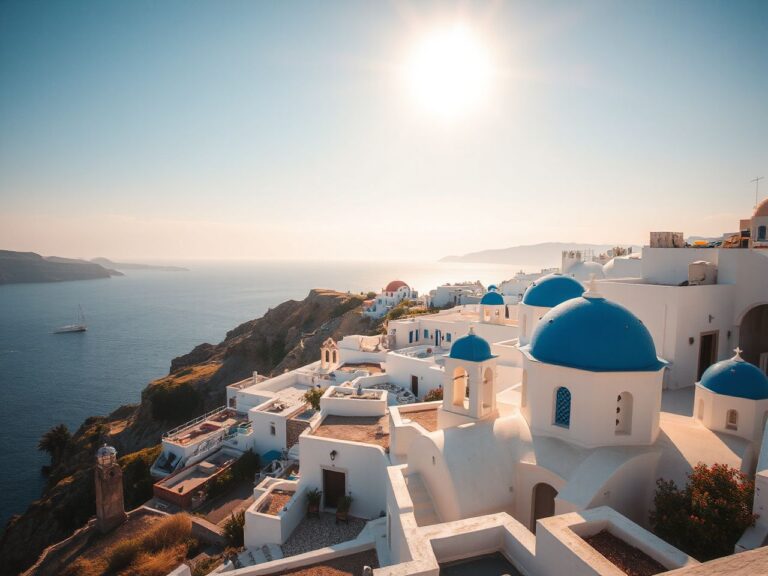
The eastern basin inverts it. Piraeus is a rare eastern port with real quay capacity, 12 km from central Athens. But the islands you booked the cruise for are the ones with no berth. Santorini has no cruise dock; everyone arrives by tender at Skala and then queues for the cable car that the Loula and Evangelos Nomikos Foundation runs up to Fira, or climbs the 587 steps. Mykonos operates two ports, and which you use depends on your ship and the day.
The Adriatic is the compromise most people never shop for. Dubrovnik has seven quays and 1,455 meters of berthing line with the Old Town about 2 km away, and Kuşadası puts a 370-meter ship alongside within half an hour of Ephesus. If tender queues are your objection to the east and bus time your objection to the west, that coast is where the arithmetic lands best.
The 2026 rules that reshape your itinerary
Barcelona City Council and the Port of Barcelona have agreed to cut cruise terminals on the Moll Adossat quay from seven to five, backed by €185 million of public-private investment. Barcelona South closes at the end of 2026 and terminal C is demolished, with a replacement built from 2027. Fewer terminals means fewer simultaneous ships and several seasons of disruption.
Cannes has gone further: a ceiling of 6,000 cruise passengers ashore per day, fewer calls by ships carrying more than 3,000 passengers, one large ship in the bay per day, and calls capped at 34 in 2026 and 31 in 2027, moving toward a 1,300-passenger maximum per ship by 2030. Cannes has no cruise berth — ships sit offshore in state waters — so this limits tenders, not docking.
In Greece, alongside the levy, the government has worked with individual islands on daily arrival limits, Santorini’s stated target being no more than 8,000 cruise passengers in a day. In Italy, the decree effective August 1, 2021 still bars ships over 25,000 tons, longer than 590 feet or taller than 115 feet from St Mark’s and the Giudecca Canal, sending them to the industrial port of Marghera. Some lines moved the whole itinerary, and the Ravenna Cruise Terminal at Porto Corsini, 10 to 12 km from Ravenna’s center, now handles Adriatic sailings that once left Venice.
Common mistake
Booking flights into Venice because the itinerary says Venice. Large ships have not embarked in the historic center since August 2021, and your ship may be at Marghera or at Porto Corsini near Ravenna — a different city and a different airport. Confirm the embarkation terminal on your cruise documents, not the itinerary headline, before you buy anything non-refundable.
How to check an itinerary before you pay
- Look up every port on the port authority’s own site. Berth counts, quay lengths and draft limits are published.
- Compare those limits to your ship’s length and draft. A 370-meter ship fits Kuşadası; the same ship has nothing to tie to at Santorini.
- Check how many ships are scheduled that day. At an anchorage, tender capacity is shared.
- Measure berth to sight, not port name to sight. Rome is 45 miles from its cruise port.
- Add the landing fees — €20 per person per island at Santorini and Mykonos in peak season.
- For any fixed commitment ashore, get the line’s tender and mobility policy in writing first.
Frequently asked questions
When is the best month for a Mediterranean cruise?
April, May and October sit in the shoulder band Greece’s own fee schedule recognizes: lower landing charges, thinner crowds, less pressure on daily caps. June to September brings the warmest sea and the highest fees, and in the Aegean overlaps the Etesian winds.
Which is better, a western or an eastern itinerary?
Neither in the abstract. Western itineraries dock alongside more often but leave you an hour or more from the headline city. Eastern itineraries put you next to the sight but depend on tenders. Pick western if long transfers do not bother you, eastern if you would rather walk off into the destination and accept the boat queue.
Which Mediterranean ports are tender ports?
Santorini has no cruise dock and is tender-only. Cannes and Villefranche-sur-Mer are anchorages. Kotor and Mykonos can be either, depending on ship size and whether the berth is taken. Barcelona, Civitavecchia, Piraeus, Valletta, Dubrovnik and Kuşadası berth ships alongside.
Do I pay Greece’s cruise passenger fee separately?
It is charged at the point of disembarkation under Law 5162/2024 and is not subject to VAT. Cruise lines remit it and recover it through fares or onboard charges, so check how your line itemizes it rather than assuming it is included.
Can large cruise ships still visit Venice?
Not through the historic center. Since August 1, 2021, ships over 25,000 tons, longer than 590 feet or taller than 115 feet have been barred from St Mark’s Basin and the Giudecca Canal and directed to Marghera. Several Adriatic itineraries now embark at Ravenna’s Porto Corsini terminal instead.
How do I reach Rome from a Civitavecchia call?
The port runs a free shuttle from the cruise terminal to the pedestrian gates, and from Civitavecchia station the train to Rome takes 45 minutes to 1 hour 20 depending on the service. Budget the round trip against your all-aboard time before going independently.