Fall Capsule Wardrobe: The Complete Guide for 2026
Contents
I was four hours into a mountain pass ride when the temperature dropped twenty degrees in forty minutes. My jacket had an ASTM-rated membrane, my boots carried CE-level protection, but it was the thin merino base layer next to my skin that kept me functional. That ride was a reminder: a system works only when every layer is chosen for what it does, not just how it looks. I treat a fall capsule wardrobe less as a list of items and more as a system of interchangeable pieces that handle the temperature swings of autumn. The key is to focus on fabrics that regulate heat—like merino and cashmere—and to choose a color palette that lets every top pair with every bottom, so the capsule feels larger than its actual item count. I also emphasize that a fall capsule is not just about buying new things but about editing what you already own to suit the season’s specific unpredictability.
Key Takeaways
- A fall capsule wardrobe is a modular system of 15–20 pieces, not a static shopping list, built so every top works with every bottom.
- Fabric certifications like GOTS and OEKO-TEX Standard 100 act as independent safety ratings—relying on them avoids garments that fail under real-world conditions.
- Natural fibers such as merino wool and cashmere need specific pest protection and airflow-based storage to prevent moth damage and maintain performance season after season.
The System, Not the Shopping List
A fall capsule wardrobe fails when it is approached as a collection of pretty items rather than a functioning unit. You do not need more pieces. You need a set where each piece multiplies the others. I start by counting how many unique outfits a capsule can produce. If you have 6 tops and 5 bottoms that all mix, that is 30 distinct combinations. Add a lightweight coat, a structured jacket, and two pairs of shoes that bridge the whole range, and the number jumps past 120. That is more than enough for the entire season.
Most riders understand this concept from gear selection. A touring jacket that only zips to one specific pair of pants limits everything else you own. Interoperability is not a nice-to-have; it is what keeps you from carrying three different luggage systems. A fall capsule built on a cohesive color palette—mostly neutrals with one or two accent shades—unlocks the same kind of cross-compatibility. Camel, charcoal, navy, cream, and a deep oxblood or forest green will almost always work together. Without that color discipline, piece count rises and versatility drops sharply.
How many pieces does a fall capsule actually need? Between 15 and 20 items, excluding underwear and workout clothes. This count includes outerwear, shoes, and any daily bag. More than that, and the system loses the ease it was supposed to create. Fewer than 12, and you risk wearing the same combination three times a week, which pushes laundry cycles into territory that damages fibers faster. A well-planned capsule spreads wear evenly across every item.

Fabric Certification: The Safety Ratings of Clothing
In motorcycle gear, nobody trusts a helmet because the graphic design looks fast. We check the back for the ECE 22.06 sticker because that independent test tells us what will happen when it matters. Clothing deserves the same scrutiny. Fall fabrics sit against your skin for twelve hours some days, often under another layer that traps heat and moisture. Textile certifications are the only objective way to know you are not wearing a garment loaded with chemical residues that can irritate skin or degrade unpredictably over time.
OEKO-TEX Standard 100 certification tests every component—fabric, thread, buttons, zippers—for substances known to harm human health. GOTS (Global Organic Textile Standard) goes further, covering both ecological and social criteria from raw fiber to finished product. The Responsible Wool Standard (RWS) verifies that wool comes from farms with progressive land management and animal welfare practices. When I build a fall capsule, I look for these labels the same way I inspect a Snell or DOT mark on a helmet visor. If a brand cannot produce a certification, I pass. There is always another garment that did the testing.
Natural fibers like merino wool and cashmere dominate fall capsules for good reason. Merino pulls moisture away from the skin while trapping warmth even when damp, a property that makes it the base layer standard in endurance riding gear. Cashmere provides roughly three times the insulating power of sheep’s wool by weight, but it loses shape under abrasion. That is why a cashmere layer works best as a mid-layer, not under a backpack strap. A woven wool coat in gabardine or Harris Tweed, meanwhile, blocks wind and resists light rain without the chemical fluorocarbon treatments found in many technical shells. Gabardine is a tightly woven worsted fabric whose steep twill line sheds water naturally. Harris Tweed, protected by an Act of Parliament, is handwoven in the Outer Hebrides and carries an inherent durability that synthetic imitations never match.
What fabrics keep you warm indoors without overheating? Merino wool with a weight of 180 to 200 grams per square meter is light enough to wear under a blazer yet warm enough for a crisp morning. Cashmere-cotton blends breathe better than pure cashmere while still regulating temperature. The worst choice is acrylic, which traps heat and moisture both, leaving you clammy within minutes of stepping inside. Acrylic also pills into hard little balls that never shed, permanently reducing the garment’s surface integrity.
The Interchangeable Color Matrix
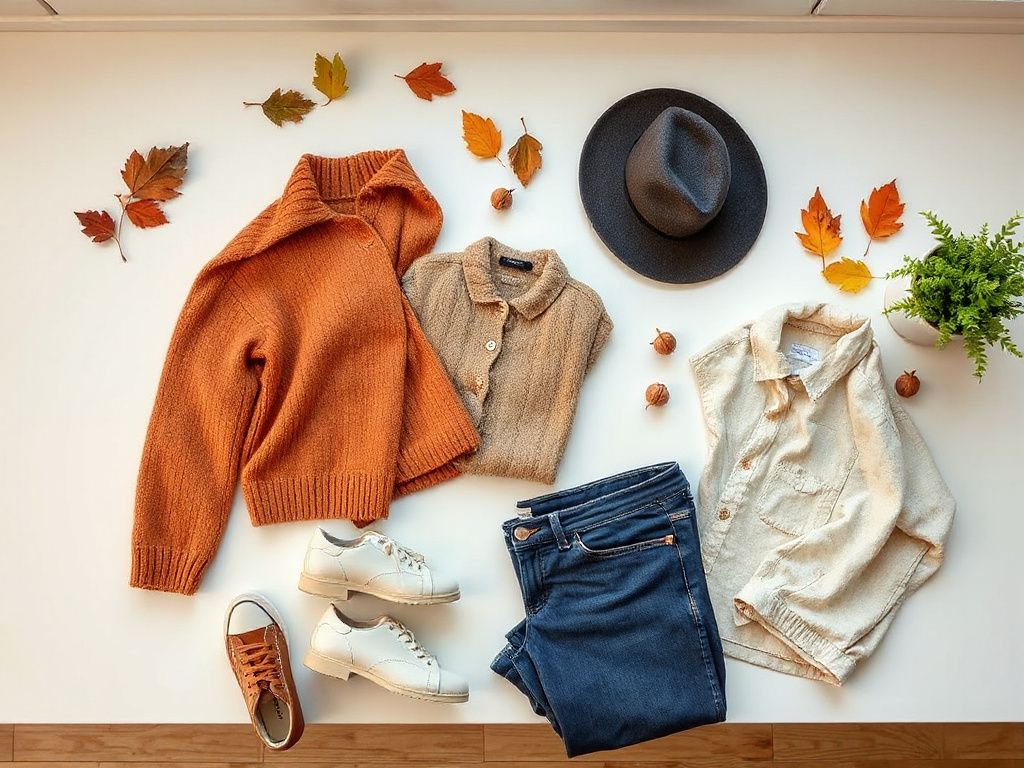
A capsule’s true value comes from a deliberately restricted color palette. Without it, the math of combinations collapses. I use a three-tier system: two neutral bases, one mid-tone bridge color, and one accent. For fall, that often translates to camel and charcoal as bases, navy as the bridge, and a deep burnt sienna or olive as the accent. Every top and bottom exists in either a base or bridge shade. The accent appears only in one or two lightweight knits or a silk scarf, pieces that overlay without overpowering.
A camel trench coat, for example, pairs with jeans, tailored wool trousers, and a midi skirt equally. The same coat over a charcoal crewneck and navy trousers reads as intentional without matching exactly. If the coat were burgundy, that versatility would halve immediately. Neutral colors anchor the capsule; accent colors bring it life. Getting this ratio wrong is the single biggest reason people believe capsules feel boring. A capsule with 80% neutral and 20% accent pieces never feels repetitive because the accent shifts visual weight every time it is added or removed.
Can you mix summer items into fall capsules? Absolutely, and doing so stretches the system across seasons. A white linen button-down worn under a cashmere crewneck adds texture without bulk. The rule is that the summer piece must be a solid neutral, and its fabric must be thin enough to layer under fall-weight wool without bunching. A silk camisole under a blazer, a cotton poplin shirt under a chunky knit—these are legitimate crossover pieces. What does not work is trying to force a tropical-weight floral print into an autumn palette. The visual discord breaks the cohesion that makes a capsule easy to use each morning.
For anyone wondering about the difference between a trench coat and a mac coat for fall, it is significant enough to affect capsule planning. A trench coat traditionally has a double-breasted front, shoulder epaulets, cuff straps, and a storm flap, all originally functional for military officers. It is cut from gabardine and has a removable wool lining option. A mac coat, short for Mackintosh, is a single-breasted, minimalist raincoat made from rubberized cotton. A trench works as a true fall layering piece over sweaters; a mac is a rain shell first, insulation second. In a capsule, the trench earns its hanger space better because it transitions from cool morning to warmer afternoon simply by unbuckling the belt and rolling the cuffs. A mac stays closed until you take it off entirely.
Building Your Fall Capsule: A Modular Approach
Start by auditing your existing wardrobe against the color palette and certification criteria. Understanding clothing basics helps you distinguish between pieces worth keeping and those that only add noise. Bag up anything that does not fit the palette or lacks a fiber content label with a recognized standard. Then identify the gaps—most people overbuy tops and underinvest in the one thing that transforms the whole system: a properly layered outer shell.
Phase 1: The Foundation
Choose 3 to 4 tops that sit directly on skin. Two merino crewnecks in neutral bases, one cashmere-blend turtleneck in the bridge color, and one cotton-modal long-sleeve tee. Next, 2 to 3 bottoms: one structured wide-leg trouser in wool gabardine, one dark-wash straight-leg jean, and optionally a midi slip skirt in a mid-weight satin or heavy silk. Each bottom must physically drape in a way that matches the silhouette of every top—a chunky cropped sweater will look odd over a fluid slip skirt unless the skirt has enough weight to anchor the proportion. Test combinations in front of a mirror before committing.
Phase 2: The Thermal Mid-Layer
This is the workhorse that prevents the need for a bulky coat indoors. One cashmere cardigan, open-front, in a base neutral, worn over either a tee or a button-down. One heavier gauge wool sweater, perhaps a fisherman rib or cable knit, reserved for days when the temperature stays below 50°F (10°C). The mid-layer should never be tight—trapped air between fabric layers does the insulating, not the fabric thickness itself. Two thin fine-gauge sweaters layered over each other insulate better than one thick cable knit because they create multiple dead air pockets, and they can be removed one at a time as the day warms.
Phase 3: The Outer Shell and Shoes
One wool-blend coat in a base neutral, ideally a camel hair or wool-cashmere blend that hits mid-thigh. This length covers both trousers and skirts without cutting the leg line awkwardly. A trench coat in cotton gabardine serves as the wind-and-rain layer. If you live in a dry climate, the wool coat alone might suffice, but fall is unpredictable enough that a weather-resistant shell prevents the capsule from collapsing on the first wet morning. For shoes, one pair of leather Chelsea boots with a low block heel handles jeans, trousers, and skirts identically. One pair of leather loafers or minimalist sneakers in a matching tone covers milder days. Tall boots are not a necessity unless your region drops below freezing by October; they tend to overheat the foot indoors and restrict the ankle, which creates a different silhouette silhouette that makes midi skirts look heavier.
Phase 4: The Accessory Buffer
A silk square scarf and a wool-blend wrap add layering options without adding hangers. Silk at the neck blocks drafts against the carotid arteries and jugular veins, where heat loss is disproportionately high, while a wool wrap worn across the shoulders mimics the effect of a short cape indoors. Both pieces weigh under a pound combined and store flat. That is the kind of efficiency I appreciate after years of packing motorcycle saddlebags with bulky layers that do one thing only.
Caring for the Capsule: Maintenance as Reliability
Neglecting care undoes every efficiency a capsule creates. Wool and cashmere demand specific handling, and the consequences of ignoring it are not cosmetic—they are structural. Moth larvae consume the protein in wool fibers. Once the fiber is broken, the hole cannot be invisibly mended without reweaving, and that small hole quickly becomes a run. Storage in airtight cotton garment bags, with cedar blocks replaced every six months, is the barrier method that works. Lavender sachets repel adult moths but do not kill eggs, so they complement cedar, not replace it.
Washing instructions for blends are often counterintuitive. A wool-silk blend marked “dry clean only” might be hand-washable in cold water with a pH-neutral wool wash, but the silk content will lose about 15% of its strength when wet, making agitation the real risk—not the water itself. A pure cashmere sweater labeled “hand wash” should be submerged without rubbing, soaked for fifteen minutes, then rolled in a towel to remove moisture before drying flat on a mesh rack. Wringing cashmere while wet stretches the fibers beyond recovery, permanently altering the garment’s dimensions. The first sign of mishandling is sleeves that grow an inch and a half or a hem that ripples.
Natural fibers degrade faster in direct sunlight and high heat. Drying wool in a machine dryer on any setting exposes the scales to temperatures that cause them to lock together in an irreversible process called felting. A merino baselayer that enters the dryer a size medium can exit fitting a slim ten-year-old. Felting cannot be undone. The garment’s thermal properties remain, but the fit is gone. This is avoidable with a simple flat drying rack that folds down to the size of a slim briefcase. Spending $25 on a mesh drying rack and keeping it near the laundry area protects thousands of dollars of woolens over a decade.
How often do items need replacing? A merino base layer worn twice a week and properly cared for should last three to four seasons before pilling becomes noticeable at friction points like under the arms. A well-made cashmere sweater, brushed only once per season with a cashmere comb to remove pill balls, can last a decade. Jeans in a rigid cotton denim without elastane hold their shape indefinitely, gaining character rather than wearing out. The fastest turnover happens with cotton modal tees, which lose colour vibrancy after roughly 30 washes even in cold water. Budget to replace those every other fall.
The Layering Sequence That Prevents Bulk
Layering without looking bulky requires paying attention to the order and cut of each piece. The base layer must be thin and close-fitting. A merino crew with a fabric weight of 180 gsm slides under a button-down without creating drag lines. The mid-layer, like a cashmere cardigan, should be cut with set-in sleeves rather than drop shoulders, because drop shoulders add visual width where arms meet torso. The outermost coat needs enough ease across the back to allow full shoulder rotation—a minimum of 4 inches of ease measured loosely over the thickest mid-layer combination. That extra space is invisible when standing but prevents that stuffed-sausage look when sitting or reaching.
A common layering error is wearing a chunky knit under a tailored blazer. The blazer’s armhole is cut high and fitted; forcing a thick wool layer underneath pulls the fabric into diagonal stress lines from underarm to collarbone. The fix is either a thin knit or replacing the blazer with a more relaxed cut like a knit blazer or an unlined wool coat. The silhouette must remain clean. When the silhouette breaks down, the entire outfit looks smaller and cheaper regardless of the fabric quality.
Dealing with fall weather that swings from warm to cold in one day comes down to three removable layers maximum. A base layer, a cardigan or light knit that opens fully down the front, and a coat that can be carried over the arm. If you need four or more pieces to stay comfortable, one of them is the wrong weight. A heavier coat will always beat two flimsy layers because it creates one decisive thermal barrier instead of several that each trap moisture differently.
Frequently Asked Questions
How many pieces do I actually need for a fall capsule wardrobe?
Aim for 15 to 20 pieces, including outerwear and shoes. This count gives you roughly 100 to 140 outfit combinations without repetition. Less than 12 pieces forces you into laundry rhythms that degrade wool fibers faster, while more than 25 dilutes the quick-decision benefit that a capsule provides.
Should I include a coat in a fall capsule or wait for winter?
Include at least one wool coat and one rain-capable shell like a gabardine trench. Fall weather shifts between dry crispness and damp chill within hours. A coat that handles both eliminates the need to carry an extra layer, and a wool coat layered over a cashmere sweater covers temperatures from 40 °F up to 60 °F comfortably.
What are the best neutral colours for a fall capsule that go with everything?
Camel, charcoal, navy, and cream form a reliable base. These four shades intermix completely, and adding one accent color like deep rust or olive green introduces variation without breaking the color matrix. Avoid black as a base if the rest of your palette includes warm-toned browns; cool black clashes subtly with camel and rust, reducing true mixability.
How do I care for wool and cashmere to make them last?
Store them in breathable cotton bags with cedar blocks, replace the cedar every six months, and wash only after four to five wears unless visibly soiled. Hand wash with a wool-specific pH-neutral soap, never wring, and dry flat on a mesh rack away from direct heat. Cashmere benefits from a once-a-season gentle combing to remove pills before they harden.
Can I mix and match items from my summer wardrobe to stretch my fall capsule?
Yes, but only solid neutral pieces in thin fabrics that layer smoothly under knits. A silk camisole under a cardigan, a linen button-down under a crewneck—these add texture without visual weight. Avoid summer prints and pastels; they disrupt the autumn palette and make layering look accidental instead of intentional.
What is the best way to prevent moth damage in woolens?
Physical barriers work best. Store wool and cashmere in airtight cotton garment bags during the off-season. Insert fresh cedar blocks or hang cedar rings every six months. Lavender sachets repel adult moths but do not kill larvae, so pair them with a thorough pre-storage cleaning to remove skin oils and food particles that attract pests.