Free Camping in Missouri: The Complete Beginner’s Guide
Contents
Southern Missouri offers routes through green shaded areas and gravel roads deep in the Ozarks, with pine-scented night air and quiet engine ticks as it cools. Such travel highlights the appeal of exploring remote areas without cost.
Free camping in Missouri isn’t a secret, exactly, but it does require knowing where public land actually allows you to sleep without a fee. The state has far more opportunity than most riders realize, especially if you slow down enough to look. For anyone on a motorcycle, in a van, or carrying a backpack, Missouri’s free camping rules are clear once you understand the two main agencies involved.
Key Takeaways
- Mark Twain National Forest allows dispersed camping almost anywhere unless posted, with a 14-day stay limit.
- Missouri Department of Conservation (MDC) areas often require designated campsites and some ban camping entirely — always check first.
- Missouri state parks are not free; they charge fees, so don’t assume all public land works the same.
- Pack out all trash, check fire restrictions by season, and treat every free campsite as if no one else will ever clean it.
Why Missouri Works for Free Camping
The practical approach to free camping in Missouri comes down to sticking to National Forest and MDC land, and checking each area’s specific regulations before heading out. When I first started riding through the state, I made the exact mistake a lot of new campers make: I assumed all public land meant free camping. A state park ranger near Elephant Rocks set me straight. State parks charge fees, and they have gates, quiet hours, and reservation systems.
That experience taught me the real distinction. Mark Twain National Forest operates under US Forest Service rules, which allow dispersed camping almost anywhere unless specifically posted otherwise. The Missouri Department of Conservation, on the other hand, manages hundreds of conservation areas, but many require you to camp only in designated sites, and some do not allow camping at all.
So the first rule of free camping in Missouri is simple: know which agency owns the land you’re standing on. That one piece of knowledge saves you a knock on the tent at 2 a.m. and an awkward conversation with a conservation agent.
Where to Camp for Free in Missouri
Mark Twain National Forest Dispersed Camping
Mark Twain National Forest covers about 1.5 million acres across southern and central Missouri, split into several non-contiguous units. The forest service explicitly allows dispersed camping, which means camping outside of developed campgrounds, for free. There is no permit required for dispersed camping on the forest, and you can stay up to 14 consecutive days in one spot.
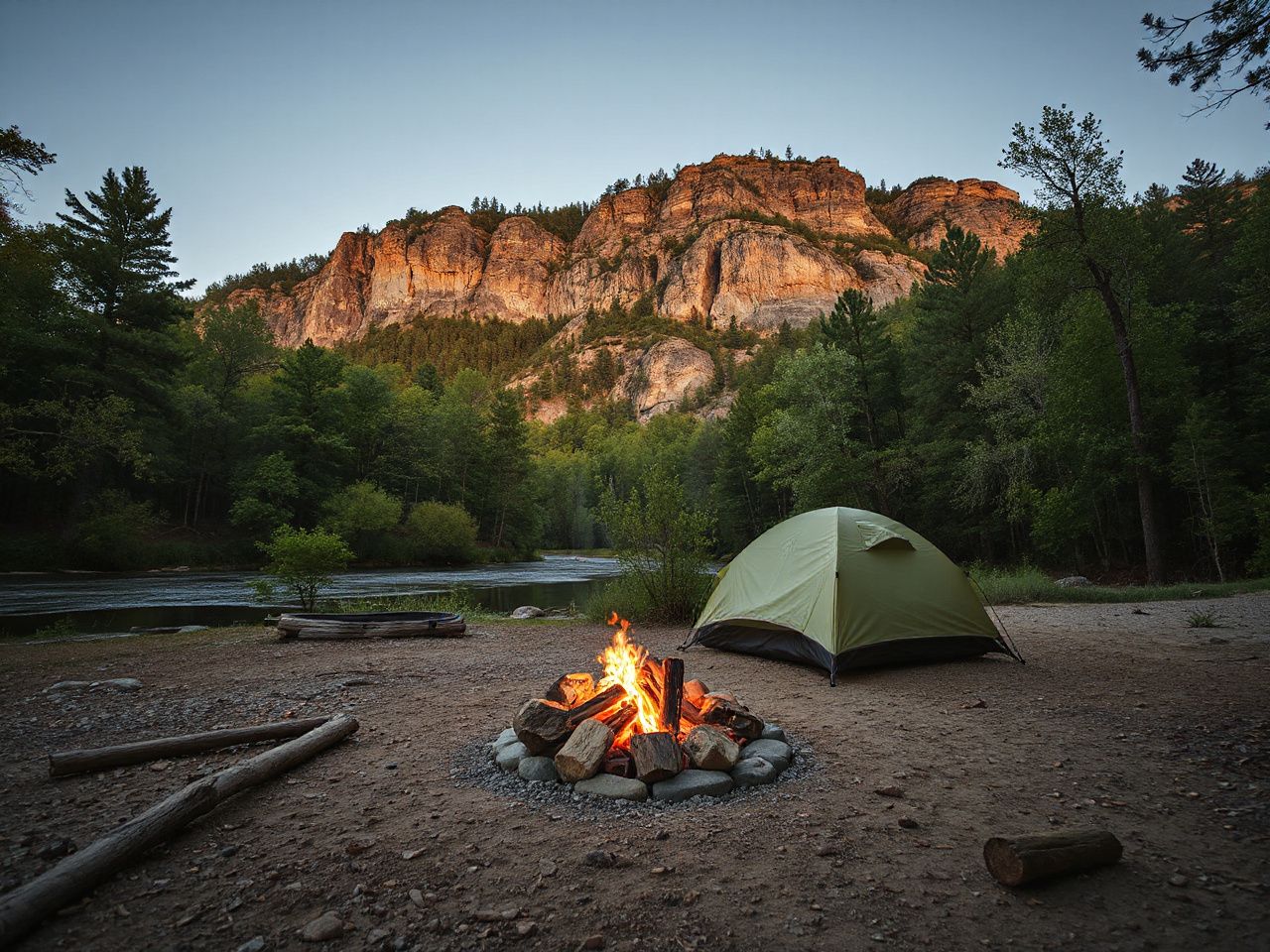
From a motorcycle saddle, the forest roads feel made for slow travel. Gravel routes wind through oak-hickory woods, past creek crossings, and up ridgelines. I’ve pulled off onto a logging spur, set a small camp a hundred feet from the road, and listened to nothing but insects. The key is to look for previously used sites — flat spots with a fire ring of stones — to minimize your impact.
Missouri Department of Conservation Areas
MDC land is trickier. The Missouri Department of Conservation manages over 1,000 conservation areas, and camping policies vary wildly. Some areas, like Peck Ranch Conservation Area in the eastern Ozarks, allow primitive camping at designated sites. Others, like many small wildlife areas near urban centers, prohibit overnight use entirely.
Before you ride or drive to any MDC area, pull up that specific area’s page on the MDC website. Look for the “Camping” section under the area’s regulations. If it says “camping allowed only in designated campsites,” then you must use those sites, which are usually free but primitive — a cleared pad, maybe a fire ring, nothing else.
Wilderness Areas Inside Mark Twain National Forest
Several designated wilderness areas sit within Mark Twain National Forest, and they offer some of the quietest free camping in the state. Hercules Glades Wilderness, Bell Mountain Wilderness, and Irish Wilderness all allow dispersed camping under the same national forest rules, but with an extra layer of solitude. You’ll need to hike in, because motorized vehicles and bicycles are not allowed inside wilderness boundaries.
For a motorcyclist, that means finding a forest service road that dead-ends near the wilderness boundary, parking the bike legally, and shouldering a pack. Bell Mountain has a short approach from the north; the view from the glades at sunrise is worth every step.
Free Campgrounds with Basic Amenities
Free doesn’t always mean completely unimproved. A few MDC conservation areas and national forest spots maintain primitive campgrounds with pit toilets, fire rings, and sometimes a hand pump for water. Blair Creek Campground on the Mark Twain National Forest, for example, is free and has vault toilets and picnic tables, though no running water or trash service. These spots fill up on summer weekends, so midweek is the sweet spot.
The Ozark Trail, a long-distance hiking route through southern Missouri, also intersects with free camping areas, though you’ll need to follow trail-specific rules. For reference, free camping in Maine and free camping in Maryland follow similar public land logic, but Missouri’s dispersed camping access is far more generous in the national forest.

The Rules You Need to Know Before You Go
Stay Limits and Permits
On Mark Twain National Forest, dispersed camping has a 14-day stay limit in any single location. After 14 days, you must move at least one mile to a new site. This prevents one camp from becoming a permanent encampment and reduces soil compaction and vegetation damage. No permit is needed for dispersed camping on the national forest.
MDC areas may have their own stay limits, often shorter. Some conservation areas cap stays at 7 consecutive days, while others allow only one or two nights. Always check the area regulation before settling in.
Campfires and Fire Bans
Campfires are generally allowed at dispersed campsites on the national forest unless a fire ban is in effect. Missouri’s summers are hot and dry, and county-level burn bans are common from July through September. The Forest Service also issues its own fire restrictions during extreme drought.
Never assume a fire is allowed. Check the Mark Twain National Forest fire alerts page and your county’s burn ban status before striking a match. A single unattended spark can close a whole section of forest for the season.
Trash and Waste
Free campsites have no trash service. If you pack it in, you pack it out — every wrapper, every bottle cap, every food scrap. That’s not a suggestion; it’s the core of Leave No Trace ethics and a condition of using public land without fees.
For human waste, dig a cathole 6 to 8 inches deep at least 200 feet from water, trails, and campsites. Carry out used toilet paper in a ziplock bag, or use a wag bag if the ground is too rocky to dig. Missouri’s karst geology means thin soil and fractured rock — waste can travel quickly to groundwater.
Private Property Boundaries
National forest boundaries are not always marked with signs or fences. The forest is a patchwork of public and private land, especially near small towns and along valley bottoms. A gravel road might pass through private land for a quarter mile before re-entering public land.
Before you set up camp, verify you’re actually on public land. Use a current Motor Vehicle Use Map for the national forest, or check the MDC area boundary on an official map. Trespassing on private property — even accidentally — can get you towed, ticketed, or worse in rural areas where landowners are tired of strangers.
How to Find a Legal Free Campsite
Read the Motor Vehicle Use Map
Every national forest publishes a Motor Vehicle Use Map (MVUM) showing which roads are open to motorized travel. Dispersed camping is typically allowed along any open forest road unless posted otherwise. These maps are free, updated annually, and available at ranger stations or as downloads.
On a motorcycle, the MVUM is essential. It tells you which spurs are legal to ride versus which are gated or seasonally closed. A closed road with a gate means no camping within 150 feet of the gate, but walk-in camping beyond the gate is often allowed at wilderness boundaries.
Scout from the Road, Then Commit
My rhythm on a long tour is to start looking for a campsite by mid-afternoon. That leaves time to explore two or three possible spots without rushing. The best free campsites in Missouri are not marked; they’re the flat turnouts, old logging decks, and creek-side gravel bars that have seen a fire ring or two.
Look for signs of previous use — a ring of stones, packed earth, no fresh vegetation. Using an existing site reduces your impact and often means better drainage and fewer ticks. If no site exists, choose durable ground: gravel, pine duff, or bare soil, never fragile stream banks or wildflower patches.
For riders planning a longer eastern route, compare notes with our guides on free camping in Maine and the best free camping in Illinois for 2026 — the principles transfer, but Missouri’s forest service land is uniquely open.
What to Pack for Free Camping in the Ozarks
The Non-Negotiables
Free camping means no amenities. You need to be self-sufficient for water, waste, and weather. These are essential for rides into the Missouri woods:
- Water filter or purification tablets — Missouri creeks are not safe to drink untreated, even in remote areas.
- Trowel and toilet kit — for catholes, per Leave No Trace.
- Trash bags — heavy duty, not grocery bags, because pack-out is mandatory.
- Headlamp with red mode — preserves night vision when you wake at 3 a.m. and need to pee.
- Rain tarp or tent footprint — Missouri thunderstorms arrive fast and hard.
- Bear spray or at least a whistle — black bears are present in the Ozarks, though rare.
For Motorcycle Travelers Specifically
Weight and volume are everything on two wheels. Instead of a traditional tent, carry a lightweight bivy or a single-wall trekking pole tent. A down quilt packs smaller than a sleeping bag for the same warmth. And a compact camp stove with a windscreen beats a campfire for cooking when rain is threatening, because gathering dry wood in a downpour is misery.
One overlooked item: a tire plug kit and a small air pump. Gravel forest roads are hard on tubes and tubeless tires alike. Being stranded 15 miles from pavement without a repair option turns a free campsite into an expensive tow.
Common Mistakes Newbies Make When Free Camping in Missouri
Beyond trespassing and fire bans, the most common mistake I see is expecting too much from a free site. No toilets, no water, no picnic table — that’s the tradeoff. The second mistake is assuming cell service will work for navigation. The Ozark hills swallow signals. Download offline maps before you leave pavement.
A third mistake is camping too close to water. A gravel bar next to a creek looks idyllic, but Missouri creeks rise quickly after heavy rain upstream. A flash flood can turn a peaceful night into a rescue situation. Camp at least 50 feet from the water’s edge and above the high-water mark, which you can read from debris lines on the banks.
Finally, don’t underestimate the ticks. Missouri has high populations of lone star ticks, which can transmit ehrlichiosis, and deer ticks that carry Lyme disease. Treat your clothing with permethrin, tuck pants into socks, and do a full body check every night before sleeping.
Frequently Asked Questions
Where in Missouri can I camp for free without getting in trouble?
Dispersed camping in Mark Twain National Forest is the safest bet. You can camp almost anywhere on national forest land unless posted otherwise, with no fee and no permit. Many MDC conservation areas also allow free camping at designated sites, but always check the specific area’s regulations first.
Do I need a permit or pass to camp free on public land in Missouri?
No permit is required for dispersed camping on Mark Twain National Forest. MDC conservation areas generally do not require a permit for primitive camping at designated sites, but some areas have no overnight use at all. Missouri state parks require fees and reservations, so they are not free camping.
How long can I stay on a free campsite before I have to move?
On Mark Twain National Forest, the limit is 14 consecutive days at one site, after which you must move at least one mile. MDC areas often have shorter limits, commonly 7 days or less, so check area-specific rules before you settle in for a long stay.
Are campfires allowed at free campsites in Missouri?
Campfires are usually allowed at dispersed sites on the national forest unless a fire ban or county burn ban is active. Summer and early fall are high-risk periods in Missouri. Always check the Forest Service fire restrictions page and the county burn ban map before starting any fire.
What should I pack for a free camping trip in the Missouri Ozarks?
You need to be fully self-sufficient: water filter or purification tablets, trowel and toilet kit, trash bags, headlamp, rain protection, and a warm layer. If you’re on a motorcycle, keep weight low and include a tire repair kit. No free site provides water, trash service, or toilet facilities unless specifically noted.
Are there any free campgrounds with amenities like toilets or water in Missouri?
Yes, a handful of free primitive campgrounds offer vault toilets and picnic tables, such as some within Mark Twain National Forest and a few MDC areas. Running water is rare, and trash service is nonexistent. These sites fill quickly on summer weekends, so plan for midweek arrivals.