Bungee Jumping Atlanta Georgia: What Exists and Where to Jump
Contents
The short answer is the one most pages on this subject will not give you: there is no traditional bungee jumping in Atlanta, and none anywhere else in Georgia. No bridge operation, no tower, no commercial operator taking bookings.
That is worth knowing before you spend an afternoon looking, because searches for bungee jumping in Atlanta return a mix of three different things — bungee fitness studios, bungee trampolines at events, and pages listing operators that do not exist. Only one of those is a real business you can book, and it is not jumping.
Key takeaways
- Georgia has no commercial bungee jumping operator. Atlanta included.
- What Atlanta does have is bungee fitness — a studio class using an overhead cord, not a jump.
- The nearest real jump is a 75-foot bungee tower at the Track Family Recreation Center in Destin, Florida.
- The nearest bridge jump is Vertigo Bungee at Young’s High Bridge near Tyrone, Kentucky.
- Treat any page listing five or six Atlanta bungee operators with suspicion — the businesses are not there.
Why there is no bungee jumping in Georgia
Commercial bungee jumping needs one of two things: a bridge with a long enough drop and an owner willing to permit it, or a purpose-built tower with the insurance to match. Both are harder to arrange than they look, and the sport has consolidated into a small number of sites nationally rather than spreading.
Georgia has neither at present. There are no business listings for bungee jumping in the state, which means anyone in Atlanta who wants to jump has to travel to do it.
The neighboring-state picture tells the same story. Arizona is the clearest example: the one professional operation in the state ran from the Navajo Bridge at Marble Canyon, and jumping there has been illegal since April 2012. Sites close and are rarely replaced.
What Atlanta actually has: bungee fitness
Search “bungee” in Atlanta and most of what comes back is bungee fitness, which is a genuine and growing activity — and a completely different one.
In a bungee fitness class you wear a harness attached to a cord suspended from the ceiling. The cord takes part of your body weight, which lets you jump, run and rebound with far less impact on your knees and ankles than the same movements on the floor. Studios in Atlanta run introductory, beginner, intermediate and dance-style classes, and some run sessions aimed at older participants.
If what you want is the sensation of being on a cord, it delivers that. If what you want is a free fall, it does not, and no amount of marketing language changes the difference. It is worth being clear which one you are booking.
Pro tip
Bungee trampolines are the third thing that shows up in these searches. They are the harness-and-two-cords rigs hired for parties and events — real, fun, and rented by the hour. They are not jumping either, and they are usually listed under event hire rather than adventure sports.
Where to actually jump
Two options are within reach of a weekend from Atlanta, and they are different experiences.
The Track Family Recreation Center, Destin, Florida. A 75-foot bungee tower at a family recreation park. A tower jump is controlled, repeatable and short — you are winched or lowered rather than left hanging over a river — which makes it the sensible first jump for anyone unsure whether they will actually let go of the rail.
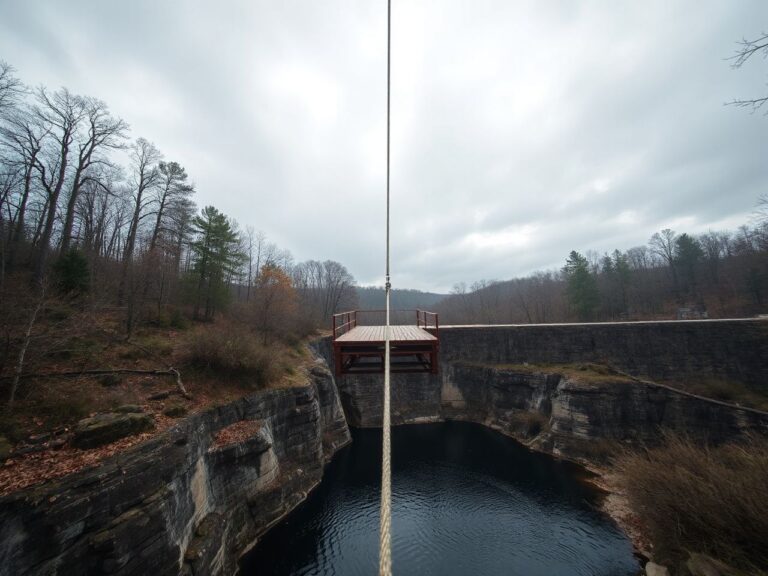
Vertigo Bungee, near Tyrone, Kentucky. This is the bridge jump. The operator bought Young’s High Bridge in 2013 and runs its platform from there, which is a meaningfully different proposition to a tower: greater height, an open drop over a river gorge, and the psychology that comes with both.
The practical distinction is not just height. A tower jump can usually be booked on the day and repeated cheaply. A bridge operation runs on scheduled dates, in seasons, and books out — so the Kentucky option needs planning in a way the Florida one does not.
What a jump day actually involves
Knowing the sequence removes most of the uncertainty, and it is the same at a tower or a bridge.
You sign a waiver, and then you are weighed. The weight is not administrative — it determines which cord you get, and cords are rated in bands. A site that skips the scale is not selecting equipment for you.
Then comes the harness. Most operators use a full body harness, an ankle attachment, or both together, and the briefing covers which you are on and how you are expected to leave the platform. The instruction to step rather than dive is not a formality; it governs how the cord loads.
The jump itself is over in seconds. What takes time is the recovery — being lowered to a landing area or raft, or winched back up — and this is the part that determines how many jumps a site can run in a day, and therefore how far ahead you need to book.
The waiting is the part nobody prepares for. On a bridge you queue on a platform watching other people go first, which is why some jumpers prefer a tower for a first attempt: the sequence is shorter and the drop is visible from the ground before you commit to it.
Why these listings exist at all
It is worth understanding why a search for something that does not exist returns pages full of confident recommendations.
Search demand and supply are independent. Plenty of people in Atlanta want to bungee jump, so the query gets typed thousands of times a month, and a page that ranks for it earns traffic whether or not the activity is available. The result is pages that invent operator names, attach plausible prices and verdicts to them, and never state the one fact a reader needs.
The tell is specificity without contact detail. A genuine operator has a booking page, a location you can put on a map, and a phone number that answers. A fabricated one has a name, a star rating, and a paragraph about its friendly staff. If a listing cannot survive the question “where exactly is this”, it is not a business.
How to judge a bungee operator anywhere
Since you will be booking outside your own state, the operator is the thing you cannot inspect in advance. A few questions separate a run business from a hobby.
- Ask what the cord replacement schedule is, and whether it is measured in jumps or in time. An operator who cannot answer immediately is telling you something.
- Ask how they weigh you. Cord selection is a function of body weight; a site that does not weigh every jumper is not selecting cords.
- Ask who rigs and who checks. Two people should be involved, and the check should not be done by the person who rigged it.
- Ask what happens in wind. A clear answer, including the conditions in which they stop jumping, is a good sign. “We jump in anything” is not.
- Look for a published weight range, not just a maximum. There is a minimum too, and it matters as much.
Common mistake
Improvising. Bungee cord sold for securing cargo is not jumping cord and has none of the elongation properties or safety margin the sport depends on. There is no version of this that is worth attempting privately, and the sites that suggest otherwise are the reason this warning is here.
If you want the drop without the drive
Atlanta does have adjacent activities that scratch some of the same itch, and they are honest about what they are: indoor skydiving wind tunnels, high ropes courses, and zip lines at adventure parks in and around the metro area. None is a bungee jump. All of them are bookable this weekend, which the jump is not.
The trade is real: a wind tunnel gives you the sensation of falling with none of the anticipation, and a bungee jump is almost entirely anticipation. Which one you want depends on which part of it you are actually after.
Frequently asked questions
Is there bungee jumping in Atlanta?
No. There are no commercial bungee jumping operators in Atlanta or anywhere else in Georgia. What the city has is bungee fitness studios and bungee trampoline hire, both of which are different activities.
Where is the closest place to Atlanta to bungee jump?
The Track Family Recreation Center in Destin, Florida operates a 75-foot bungee tower. For a bridge jump, Vertigo Bungee runs from Young’s High Bridge near Tyrone, Kentucky.
What is bungee fitness?
A studio class in which you wear a harness attached to an overhead cord that supports part of your body weight, letting you jump and rebound with reduced impact. Atlanta studios offer it at several levels, including beginner and senior classes. It is exercise, not a jump.
Why do some sites list five or six bungee operators in Atlanta?
Because those pages are not describing businesses that exist. If a listing names an operator, check for a working booking page, a physical address and a phone number before planning around it.
Is bungee jumping legal in Georgia?
There is no state-level ban being reported — the position is simply that no operator runs one. That is different from a prohibition, and it means a site could open. Arizona is the counter-example of a jump that was closed by law: the Navajo Bridge operation has been illegal since April 2012.
What should I ask before booking a jump out of state?
Cord replacement schedule, whether every jumper is weighed, who rigs and who independently checks the rig, and the wind conditions in which they stop. Clear answers to all four are the baseline.