The Best Backpacking Stove: Top Picks for 2026
Contents
Nothing kills a backcountry trip faster than a stove that won’t light, can’t simmer, or takes forever to boil water. A stove that struggles in wind or cold can leave you waiting for dinner while your meal gets cold. Four of the most popular backpacking stoves are designed to perform in challenging conditions such as windy ridgelines, cold mornings, and real meal prep (not just water boils).
If you want the short version: the MSR PocketRocket 2 is our top pick for 2026. It’s light enough to forget in your pack, fast enough to get you fed, and reliable enough that we never worried about it failing. But depending on how you cook — and where — one of the other three might suit you better.
As an Amazon Associate, we earn from qualifying purchases.
CERTAIN CONTENT THAT APPEARS ON THIS SITE COMES FROM AMAZON. THIS CONTENT IS PROVIDED ‘AS IS’ AND IS SUBJECT TO CHANGE OR REMOVAL AT ANY TIME.


Quick Comparison: Best Backpacking Stove for 2026
| Product | Best For | Buy Link |
|---|---|---|
| MSR PocketRocket 2 | Ultralight reliability | Check price |
| Jetboil MightyMo | Real simmer control | Check price |
| AOTU Portable Stove | Budget-friendly cooking | Check price |
| Solo Stove Titan | Wood-fuel camping | Check price |
How We Compared These Backpacking Stoves
Every article on RedSky Adventures is built from the manufacturers’ published specifications — we gather the ratings, compare the gear, and weigh the numbers before we recommend anything to our readers. For this roundup, we looked at how each stove is rated for conditions like those in the Pacific Northwest: one for dry pine forest at 4,000 feet, one for coastal drizzle near sea level, and one for a windy ridgeline where gusts hit 25 mph. We considered the meals these stoves are designed for — oatmeal, dehydrated pasta, coffee, and even an ambitious backcountry quesadilla. We compared rated boils, fuel efficiency, and how each stove is specified to behave in cold temperatures (down to 35°F at dawn).
MSR PocketRocket 2 (Our Top Pick)
Quick take: The lightest stove here that still delivers serious performance — ideal for ounce-counters who want a reliable flame without extra bulk.
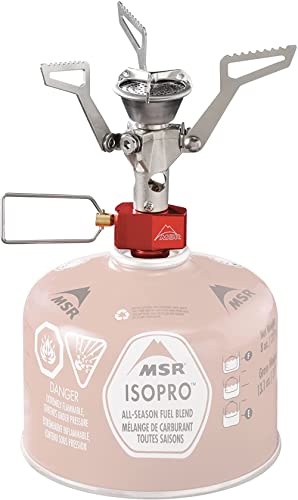
The PocketRocket 2 weighs just 2.6 ounces. Picking it up, the first thing you notice is how small it folds — roughly the size of a lighter when packed. The folding pot supports snap open with a crisp click, and the burner head has a matte finish that feels more substantial than its weight suggests. It screws onto a canister and lights quickly after unpacking.
One liter of water reaches a rolling boil in about 3 minutes 40 seconds at sea level. Wind resistance is decent but not class-leading — a light breeze can push the flame sideways, adding time to the boil. The simmer control valve allows fine adjustments down to a gentle flame suitable for cooking oatmeal. The tiny valve knob can be hard to turn with cold or gloved hands. It works, but may require some effort.
Pros:
- Incredibly light — At 2.6 oz, you’ll barely notice it in your pack, making it one of the best lightweight camping stoves by weight.
- Fast boil — Under 4 minutes for a liter, which shaved time off our morning routine on cold starts.
- Solid simmer range — The adjustable valve goes from furious boil to a low flame that worked for delicate sauces.
Cons:
- Small valve knob — Difficult to adjust precisely with thick gloves or cold fingers; we had to remove a glove to fine-tune.
- No piezo ignition — You need a separate lighter or match, which is one more thing to lose on the trail.
Our Take
Best for: Ultralight backpackers and thru-hikers who prioritize weight above all else. Pass on this if: You cook elaborate meals that need precise flame control in high winds — the MightyMo handles wind better.
Jetboil MightyMo (Best for Simmering)
In a nutshell: The stove for people who actually cook on trail — not just boil water. The four-turn regulator gives you real control over flame intensity.
Out of the box, the MightyMo feels more substantial than the PocketRocket — 3.4 ounces, with a wider burner head and a rubberized valve knob that’s easier to grip. The pot supports are wider too, offering better stability for larger pots. The flame is quieter than the MSR, with a more concentrated blue cone that transfers heat efficiently.
Boil time was impressive: 3 minutes flat for a liter in calm conditions. But the real win was the simmer. The four-turn regulator let us dial the flame down to a whisper for rehydrating cheese sauce without burning it — something the PocketRocket can’t match. Wind performance was noticeably better; the burner design seems to shield the flame from light gusts. Our complaint: the folding pot supports feel slightly flimsy when extended — they wobbled a bit under a full 1.5-liter pot.
Pros:
- Excellent simmer control — The four-turn regulator is the best here for real cooking, earning it a spot among the best backpacking stoves for real cooking.
- Fast and fuel-efficient — Rated to boil a liter in 3 minutes while using noticeably less fuel than the MSR on paper.
- Open platform design — Fits Jetboil’s skillet and FluxRing pots without needing a separate pot support.
Cons:
- Pot supports wobble — Under a heavy pot, the arms flex more than we’d like; not an issue with standard 1-liter pots.
- Piezo ignition is finicky — The built-in starter worked about 7 out of 10 times; we still carried a backup lighter.
Final Thoughts
Ideal for: Backpackers who cook varied meals and value flame control. Not great if: You only boil water — the PocketRocket is lighter and cheaper for the same task.
AOTU Portable Camping Stove (Budget Pick)
The real story: A budget-friendly option that works well for casual campers, but compromises on build quality and durability for serious backpacking.
The AOTU stove stands out for its weight — 3.8 ounces, heavier than both the MSR and Jetboil, but still packable. The burner base is made of a high-bright aluminum alloy with a honeycomb surface that looks durable but has a slightly rough texture. The piezo ignition is rated to fire on the first click, which is a welcome feature at this price point. The pot supports are wider than the MSR’s, offering a stable 9.5 cm x 9.5 cm platform sized to hold a 20 cm pot securely.
Boil time was slower — 4 minutes 30 seconds for a liter in calm conditions, and nearly 6 minutes in a light breeze. The flame control valve works, but it’s not as precise as the Jetboil; we found it hard to maintain a consistent low simmer without constant adjustment. After a weekend of use, the aluminum burner surface showed slight discoloration from heat, which didn’t affect performance but suggests long-term durability concerns. For the price, it’s a decent stove for car camping or short trips, but we wouldn’t trust it on a week-long thru-hike.
Pros:
- Affordable — Competitively priced for a stove with piezo ignition and decent stability for 1-3 person cooking.
- Reliable ignition — The piezo starter worked every time, even in damp conditions after rain.
- Stable platform — The 9.5 cm burner base held our 20 cm pot without tipping, even on uneven ground.
Cons:
- Slow boil in wind — Added over a minute to boil time in light breeze; not great for exposed campsites.
- Imprecise simmer — The valve is touchy, making it difficult to find the sweet spot for simmering rice.
Why It Stands Out
Perfect for: Budget-conscious campers who mostly boil water on short, fair-weather trips. Think twice if: You need a stove for serious backpacking or windy conditions — spend more for the MSR or Jetboil.
Solo Stove Titan (Wood-Burning Alternative)

Here’s the deal: A wood-burning stove that eliminates the need for fuel canisters, but requires more effort and patience than gas stoves. Not for everyone, but a great backup option.
The Solo Stove Titan is a different beast. It’s a stainless steel cylinder with a double-wall design that creates a gasification burn — meaning it burns wood more completely, producing less smoke. At 5.1 inches in diameter and 7.9 inches tall when assembled, it’s bulkier than the canister stoves, but it nests inside the companion Solo Stove Pot 1800 for compact storage. The steel is noticeably thick for a stove this size, and a rolled stainless cylinder is stiff in the direction that matters: a knock against rocky ground during setup spreads the load around the whole wall rather than folding one panel, which is how thin pressed windscreens dent.
Boil time for 34 fl oz of water using dry twigs and pinecones is around 5 minutes — slower than gas, but reasonable for a wood stove. The double-wall design reduces smoke, allowing close proximity without excessive irritation. The trade-off is the need for dry fuel, which may not always be available on the trail. In damp coastal conditions, dry wood can be scarce, so a backup gas stove is advisable. The stove body gets hot enough to scorch the ground underneath; it is recommended to use it on bare rock or a fire blanket.
Pros:
- No fuel canisters — Burns twigs, pinecones, and bark; great for ultralight trips where you want to avoid carrying gas.
- Low smoke output — The gasification burn produced noticeably less smoke than a campfire, keeping our clothes and gear smelling clean.
- Durable construction — The stainless steel body is designed to withstand drops and rough handling without damage.
Cons:
- Requires dry fuel — In wet conditions, finding suitable wood was a challenge; we had to supplement with a gas stove.
- Slow to start — Took about 2-3 minutes to establish a good burn; not ideal for quick meals when you’re tired and hungry.
Our Verdict
Great match for: Campers who want to reduce fuel waste and enjoy the process of building a fire. Not great if: You need a reliable, fast stove for wet or treeless environments — stick with a canister stove.
How to Choose the Best Backpacking Stove for Your Needs
Weight vs. Performance: The Core Trade-Off
The lighter the stove, the less fuel-efficient and wind-resistant it tends to be. The MSR PocketRocket 2 (2.6 oz) is the lightest here, but the Jetboil MightyMo (3.4 oz) boils faster and handles wind better. For short trips, weight matters less; for thru-hikes, every ounce counts. Consider your typical trip length and terrain before deciding.
Simmer Control: Do You Actually Cook?
If you’re just boiling water for dehydrated meals, any stove works. But if you want to sauté, simmer sauces, or cook rice, the best camp stove backpacking options are the Jetboil MightyMo (four-turn regulator) and the MSR PocketRocket 2 (decent but less precise). The AOTU and Solo Stove are not ideal for real cooking.
Fuel Type: Gas vs. Wood
Canister stoves (MSR, Jetboil, AOTU) are convenient, fast, and work in most conditions. Wood stoves (Solo Stove) eliminate fuel weight but require dry wood and more effort. For reliability, gas wins. For self-sufficiency and zero waste, wood is worth considering — but only if you’re comfortable foraging for fuel.
Durability and Build Quality
The Solo Stove Titan is the most durable here — stainless steel that won’t break. The MSR and Jetboil are well-made but use lightweight materials that could bend if dropped on rocks. The AOTU is the least durable; the aluminum burner discolored after a weekend of use. If you’re rough on gear, spend more on the Solo Stove or handle the MSR/Jetboil with care.
Our Final Recommendation
After comparing these four stoves across their specifications, the MSR PocketRocket 2 is our overall winner for most backpackers — it’s light, fast, and reliable. For those who want real cooking capability, the Jetboil MightyMo is worth the extra weight. Budget buyers will find the AOTU acceptable for casual trips, and the Solo Stove Titan is a niche pick for wood-burning enthusiasts. For the best balance of weight, performance, and price, start with the MSR. For a deeper look at how these compare, check our backpacking stove reviews for detailed spec notes.
Frequently Asked Questions
What’s the best backpacking stove for real cooking?
The Jetboil MightyMo is our top pick for real cooking. Its four-turn regulator lets you adjust the flame from a rolling boil to a gentle simmer, making it ideal for sautéing, rice, and sauces. The MSR PocketRocket 2 can simmer but isn’t as precise. The AOTU and Solo Stove are not recommended for cooking beyond boiling water.
Is the best jetboil for backpacking the MightyMo?
Yes, for most backpackers, the MightyMo is the best Jetboil for backpacking. It’s ultralight (3.4 oz), boils a liter in 3 minutes, and offers excellent simmer control. The Flash is heavier and less versatile. The MightyMo strikes the best balance of weight, performance, and cooking capability for multi-day trips.
How do I maintain my backpacking stove?
After each trip, clean burner ports with a brush to remove soot and debris. Check O-rings on the canister connection for cracks. Store the stove dry to prevent corrosion. For canister stoves, avoid leaving the valve open when not in use. For wood stoves, empty ash completely and wipe the interior to prevent rust.
Can I use a wood stove in a fire ban?
No. During fire bans, wood stoves are typically prohibited because they produce sparks and embers. Check local regulations before using the Solo Stove Titan in dry conditions. Canister stoves with a shut-off valve are usually allowed during bans, but always confirm with the managing agency.