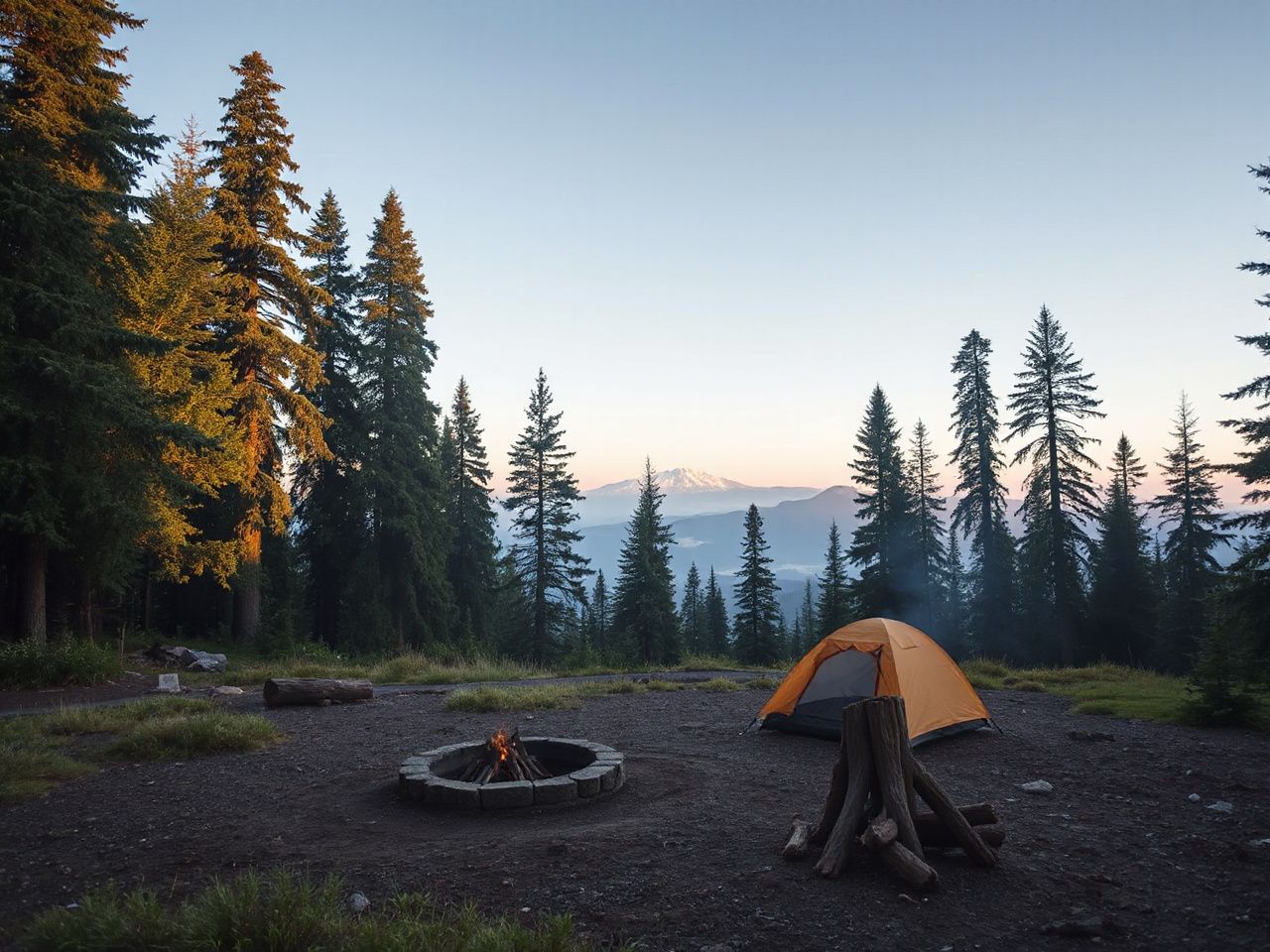
Dispersed Camping Washington State: The Rules by Land Owner
Contents
If you came here for a numbered list of dispersed camping spots in Washington state, the honest answer is that the agency that manages most of it does not publish one. Washington DNR does not publish locations. It states only that dispersed camping, meaning camping outside its designated campgrounds, is allowed in some of its forests, and leaves the word “some” undefined. What it publishes instead are rules.
That is not evasion. The ground under your tires might belong to DNR, to the Department of Fish and Wildlife, or to a national park, and each owner sets a different stay limit, pass and fire rule. Get the owner wrong and everything downstream is wrong too. So what follows is a decision tree rather than a map: establish who owns the ground, buy the pass that owner requires, then apply its stay limit and fire rule.
Key takeaways
- Washington DNR caps camping at ten days within any thirty-day period, counted across all department-managed lands rather than site by site.
- On DNR land, a campfire outside a designated campground is not allowed without advance written authorization from the department unless posting says otherwise.
- WDFW-managed land runs on a different clock: twenty-one days within a thirty-day period, more than double the DNR allowance.
- The Discover Pass costs $45 annually or $10 for a single day and covers exactly three state agencies, which is why it buys nothing on federal ground.
- Mount Rainier charges $12 per person per night plus a $6 non-refundable reservation fee, and that permit puts you in a designated camp.
Why DNR does not publish the list you want
DNR publishes conditions, not coordinates. DNR points you toward an Interactive Recreation Map for finding a campground, trailhead or day-use area, and describes more than 160 recreation sites and 1,200 miles of trail. DNR manages 3.3 million acres of state trust lands. None of it names a dispersed site.
There is a practical reason for the silence. A dispersed site is legal because of what it is and where it sits, not because it has a name. DNR lists four situations where dispersed camping is off the table: where camping is restricted to designated campsites only, within 500 feet of a developed recreation facility, in areas posted day-use only, and in areas posted as closed. Any of those can apply to a given patch of ground on a given day, so a list would go stale the moment a closure went up and would send readers to camp illegally.
The Discover Pass, and the limits of what it buys
The pass is the entry ticket to state land, not a camping permit. It costs $45 annually or $10 for a day pass, and covers lands managed by Washington State Parks, the Department of Natural Resources and the Department of Fish and Wildlife. Those three agencies are the whole list, which is why it does nothing on federal ground.
The annual pass is valid one year from purchase, is transferable between two vehicles and must be visible in the front windshield. DNR requires it for all vehicles including motorcycles, and states that with no visible pass you are subject to citation. State law sets a $99 penalty for failing to display it, reduced to $59 if you supply proof within 15 days of the notice of violation. It is not valid at Sno-Parks, which need their own permit, and it is not needed to reach state land by boat or by non-motorized means: foot, horse, bicycle. On WDFW ground a Vehicle Access Pass replaces it, issued with any annual hunting, trapping or fishing license, excluding an annual razor clam or shellfish and seaweed license.
Pro tip
Do the arithmetic before you buy. At $10 a day against $45 for the year, the annual pass pays for itself on the fifth outing. Washington also publishes free parking days valid on all state-managed lands, falling in 2026 on Jan. 1, Jan. 19, March 9, March 19, April 22, June 6, June 7, June 19, Aug. 9, Sept. 26, Oct. 10 and Nov. 11. Those do not solve an overnight trip: Sno-Park permits still apply and overnight stays are excluded.
What DNR requires of a dispersed camp
Ten days in thirty, counted across the whole system. DNR rules state that persons shall not stay longer than ten days in a thirty-day period on any or all department-managed lands. Moving to a different road or forest does not reset the clock; the limit attaches to you and to DNR land as a whole. When it expires, you must vacate by 1:00 p.m. that day.
Siting rules follow. A campsite must sit at least 200 feet from streams and other water resources, on durable surfaces. DNR also bars camping in a manner requiring more than incidental removal or damage to vegetation. If the spot only works after you cut something, it is not a legal spot.
On cost, DNR states campsites are first-come, first-served at no additional cost with the purchase of your Discover Pass, and names the Elbe Hills ORV Campground as having a limited number of reservation sites. Check current requirements with DNR before you go. Organized events are separate, requiring a recreation permit with applications due at least 60 days ahead.
The campfire rule that catches people out
This is where assumption and rule part company. On DNR land, campfires outside designated campgrounds and day-use facilities are not allowed without advance written authorization from the department unless otherwise posted. A dispersed camp is by definition outside a designated campground, so a fire at your site is not automatically legal. Inside DNR campgrounds and day-use facilities the rule is narrower still, permitting fires only in the department’s own campfire enclosures.
Layered on top is the burn restriction system. DNR permits campfires only in approved fire pits and only when no burn restriction is in place, and publishes daily status through its Burn Portal. A restriction is not limited to state ground: it prohibits outdoor fires on all state, county, city and private land under DNR fire protection. Statewide conditions can close campfires on DNR land entirely while leaving propane stoves with shut-off valves permitted, which is a notice DNR has carried. Read the Burn Portal on the day you travel rather than trusting any figure on a page like this one.
Firewood has its own rules. Gathering requires a valid firewood permit and is limited to dead and down wood no larger than 12 inches in diameter, with no felling of standing trees and no pulling wood from streams and rivers. Collection is prohibited inside developed recreation facilities.
Common mistake
Treating an existing rock ring as evidence that fires are permitted. Somebody else’s fire scar carries no legal weight, and on DNR land the default outside a designated campground is that a campfire needs advance written authorization unless posting says otherwise. DNR states that a burn restriction violation is a crime, that anyone caught burning may be ticketed or prosecuted, and that an escaped fire leaves the responsible person liable for suppression costs.
WDFW land runs on different numbers
Twenty-one days within a thirty-day period. That is the WDFW limit, more than double DNR’s, which is precisely why ownership has to be settled first. WDFW rules make it unlawful to occupy a camp on department lands in excess of twenty-one days within thirty, and unlawful to use those lands as a principal place of residence, such a residence camp being a public nuisance abatable after ten days’ notice. Fire is specified differently too: lawful campfires are limited to three feet in diameter and three feet high.
National parks are not dispersed camping
Inside a national park you are on a permit system. Olympic National Park requires backpacking permits year-round, obtained in advance online, by phone, or in person at a Wilderness Information Center. They cannot be self-issued at the trailhead, and cost a $6 reservation fee plus $8 per adult per night.
Mount Rainier works the same way: a permit is required year-round for all overnight backcountry stays, at $12 per person per night plus the $6 non-refundable reservation fee, and it assigns you a designated camp. Paid, reserved and assigned to a site is a campground booking. It is not dispersed camping, and expecting the freedoms of one while holding the other is how trips fall apart at the permit desk.
The comparison, side by side
| Land manager | Vehicle access | Stay limit or permit | Campfire rule |
|---|---|---|---|
| Washington DNR | Discover Pass, $45 annual or $10 day | 10 days in 30, across all DNR land | Advance written authorization outside designated campgrounds |
| WDFW | Discover Pass, or Vehicle Access Pass with a license | 21 days in 30; residence camps unlawful | Three feet in diameter, three feet high |
| Olympic National Park | State passes do not apply | Permit required year-round, in advance | Not covered by the state rules above |
| Mount Rainier National Park | State passes do not apply | Permit required year-round, designated camp | Not covered by the state rules above |
Building a legal trip without a list
Work the sequence and the spot takes care of itself. Confirm the managing agency, buy the pass it requires, and display it properly. Count nights against that agency’s limit, not one you remember from elsewhere. Check current burn status and pack a stove that works regardless of the answer. Then choose a site meeting the siting rules: 200 feet from water, durable surface, clear of developed facilities, no vegetation damage beyond incidental. That produces a legal camp anywhere the rules permit one.
Frequently asked questions
Is dispersed camping legal in Washington state?
On DNR land it is permitted in some of the agency’s forests, subject to its rules and its four listed prohibitions. On WDFW-managed land, camping is capped at twenty-one days in any thirty-day period. In Olympic and Mount Rainier national parks, overnight stays run on advance paid permits, a different arrangement entirely.
How long can you camp in one place?
On DNR-managed land, no longer than ten days within a thirty-day period, and that limit applies across all department-managed lands rather than resetting when you move. Campers must vacate by 1:00 p.m. on the day it expires. On WDFW land the limit is twenty-one days within thirty.
Do you need a permit to camp on DNR land?
DNR states campsites are first-come, first-served at no additional cost with the purchase of a Discover Pass, and that pass is required to reach its recreation sites by vehicle. Separate permits are documented for other activities: a firewood permit for gathering wood, advance written authorization for campfires outside designated campgrounds, and a recreation permit for organized events. Confirm current requirements with DNR first.
Does the Discover Pass cover national parks or national forests?
No. It covers lands managed by Washington State Parks, DNR and WDFW, and those three state agencies are the full extent of it. It is also not valid at Sno-Parks, which require their own permit.
Can you have a campfire at a dispersed site?
Not by default on DNR land. Campfires outside designated campgrounds and day-use facilities are not allowed without advance written authorization unless otherwise posted, and even when permitted must be in approved fire pits with no burn restriction in place. DNR publishes daily status through its Burn Portal.
What happens if you do not display a Discover Pass?
State law sets a $99 penalty, reduced to $59 if you provide proof of purchase within 15 days after the notice of violation is issued. Keep the annual pass visible in the front windshield of whichever of the two vehicles it covers you are driving.