Best Hiking Boots for Ankle Support: The Honest Picks
Contents
The best hiking boots for ankle support are stiff through the heel and midsole. They lock the heel with the laces, and fit without foot slide. Collar height alone does very little. Six budget boots are compared here on published specs. None of the six listings cites an independent safety or slip-resistance certification.
Pick the Aoleituo Women’s Waterproof Ankle Support Hiking Boots: a high-cut upper, a reinforced midsole and a lace-up closure the listing says locks the heel.
| Product | Best for | Collar / support design (per listing) | Listed weight |
|---|---|---|---|
| Aoleituo Women’s Waterproof Ankle Support Hiking Boots | Best overall | High-cut, reinforced midsole | 1.76 lb |
| SHULOOK Men’s Waterproof Hiking Boots | Best value | Mid-top, EVA midsole | 2.38 lb |
| OrthoComfoot Women’s Orthopedic Mid Trekking Boots | Arch-support focus | Mid-cut, padded ankle | 0.55 lb (listing figure, looks doubtful) |
| NORTIV 8 Women’s Lightweight Ankle Hiking Boots | Easy day hikes | Flexible, ankle-height build | 12.3 oz per shoe (manufacturer claim) |
| OrthoComfoot Men’s High Top Orthopedic Trekking Shoes | Wide feet | High top, TPU ankle wrap | Not listed |
| R CORD Women’s Waterproof Hiking Boots | Toe-cap protection | Protective toe cap, supportive heel | Not listed |
RedSky Adventures is funded by affiliate commission. Our picks come from comparing published specifications and documented features against what matters in the category — no brand pays for a place on this page. If you buy through a link here we may earn a commission at no extra cost to you, and it pays for the research behind the next guide. Full disclosure.
As an Amazon Associate we earn from qualifying purchases. This does not affect the price you pay.
CERTAIN CONTENT THAT APPEARS ON THIS SITE COMES FROM AMAZON. THIS CONTENT IS PROVIDED ‘AS IS’ AND IS SUBJECT TO CHANGE OR REMOVAL AT ANY TIME.
Aoleituo Women’s Waterproof Ankle Support Hiking Boots (High-Cut, Heel-Lock Lacing)

OrthoComfoot Women’s Orthopedic Waterproof Mid Trekking Boots (Built-In Arch Support)

Aoleituo Women’s Waterproof Ankle Support Hiking Boots (High-Cut, Heel-Lock Lacing)
- BrandAoleituo
- ModelAoleituo-ndsx-A1-Purple-40.5
- Dimensions9.84 inches x 5.91 inches x 3.54 inches
- Weight1.76 pounds
- Size / capacity9.5
- ColourPurple
Quick take: The most complete ankle-support spec sheet of the six, aimed at women who want a high collar and a locked heel on a budget.
The listing describes a high-cut design with a reinforced midsole. It also mentions a padded tongue and ankle collar. It pairs that with a rubber sole with multi-directional lugs. The lace-up closure is said to lock the heel. Listed weight is 1.76 pounds. Dimensions read 9.84 x 5.91 x 3.54 inches in a purple size 9.5. The listing doesn’t say whether that weight is per boot or per pair.
Heel lock plus midsole reinforcement is the right pairing. Rolling resistance comes from the base, not the cuff height. Among the best hiking boots for ankle support on this list, this one names all three: a high cut, a reinforced midsole, and a locking closure. Still, the gaps are real. The listing names no waterproof membrane, no shank, and no outsole brand. It also states no slip-resistance testing. ‘Waterproof membrane’ without a name is a claim to check at the seams and tongue.
Pros:
- High-cut upper — the tallest collar claim on the list, wrapping the ankle rather than stopping below it.
- Reinforced midsole — the listing’s stability claim points at the sole, where ankle support actually comes from.
- Heel-lock closure — lace-up design aimed at stopping foot slide, the main cause of blisters in stiff boots.
- Padded collar and tongue — cushioning around the ankle bone for longer days on rocky ground.
Cons:
- No named membrane or shank — waterproofing and torsional stiffness both rest on the manufacturer’s word.
- Women’s sizing only — the listing shows a single size, 9.5, and no width or return details, so fit is a gamble.
Who Should Buy This
Best overall: Women who want a high collar with heel-lock lacing for day hikes and uneven trails. Skip if: heavy pack loads or a documented foot condition are involved, where a named membrane and a stiffer, certified build matter more.
SHULOOK Men’s Waterproof Hiking Boots (Mid-Top, EVA Midsole)

- BrandSHULOOK
- ModelFH25019
- Weight2.38 pounds
- ColourMatte Black
The short version: A plain mid-top men’s boot with a cushioned midsole, and the most affordable-looking way into this list.
The listing gives a mid-top construction. It also lists a cushioned EVA midsole, a rubber outsole, and a waterproof claim. It comes in matte black with a listed weight of 2.38 pounds. Dimensions and sizes aren’t listed. Against the Aoleituo’s 1.76 pounds the SHULOOK reads heavier. Neither listing clarifies pair versus single boot.
EVA is a soft foam. It cushions well, yet resists twisting less than a firm TPU shank. Compared with a high-cut design, mid-top means a lower cuff and less passive ankle wrap. That fits fast, dry trails more than loose scree. The listing says ‘supportive construction’ without naming a heel counter or shank. Men hunting for the best hiking boots for ankle support should treat that as a prompt to check fit and flex themselves. Men with narrower budgets can compare it with our wider men’s hiking boot picks.
Pros:
- EVA midsole — shock absorption on hard ground, which eases fatigue on long walks.
- Rubber outsole — the listing promises dirt, rock and uneven-terrain traction.
- Mid-top height — less bulk and easier flex than a full high-top.
- Broad use claim — listed for hiking, backpacking, camping and travel, so one pair can cover most trips.
Cons:
- Vague support wording — ‘helps provide added stability’ names no shank, counter or lacing feature.
- Missing specs — no dimensions or sizing detail, and no named waterproof membrane.
Final Thoughts
Best value: Men after an inexpensive waterproof mid-top for dry-to-damp day hikes. Skip if: a weak ankle or a rocky, loaded route is the reason for shopping, since the ankle claims here are the thinnest on the list.
OrthoComfoot Women’s Orthopedic Waterproof Mid Trekking Boots (Built-In Arch Support)
- BrandOrthoComfoot
- Model24HW01GOF-8-W1-38
- Dimensions5.91 inches x 4.72 inches x 0.59 inches
- Weight0.55 pounds
- Size / capacity7.5
- ColourW1-black
Quick take: An arch-support-first mid-cut boot for women with sore feet who also want some ankle padding.
The listing leads with built-in orthotic insoles. It also says mid-cut structure, ankle padding, and an adjustable lace-up closure in black size 7.5. Listed weight is 0.55 pounds. Dimensions are 5.91 x 4.72 x 0.59 inches. Those figures are too small to describe a whole boot. Treat them as unreliable.
The copy talks about plantar fasciitis, arthritis, and heel pain. Those are marketing words, not medical treatment. Nothing on the sheet shows a clinical basis. The ankle claim is ‘mid-cut’ with padding. That means comfort more than stiffness. No shank or heel counter is named. Anyone with a real diagnosis should see a podiatrist first.
Pros:
- Built-in arch support — a molded insole profile that suits flatter or tired feet.
- Padded ankle area — added cushioning around the collar.
- Adjustable lacing — the listing claims reduced foot slippage.
- Anti-slip tread — listed for mud, gravel and wet ground.
Cons:
- Dubious spec figures — 0.55 pounds and a 0.59-inch depth cannot describe a finished boot.
- Soft-support focus — comfort claims dominate, with no sign of lateral rigidity.
Our Take
Ideal for: Women whose main complaint is arch or heel discomfort on easy ground. Pass on this if: actual sprain prevention is the goal, or an orthotic fit is needed that the stock insole can’t deliver.
NORTIV 8 Women’s Lightweight Ankle Hiking Boots (Flexible Mesh Build)

- BrandNORTIV 8
- ModelSNHB24009W-W-KHAKI-NEW-7.5W
- Size / capacity7.5 Wide
- ColourKhaki
In a nutshell: A light, flexible, ventilated shoe-boot for easy trails. Comfortable, but not a support pick.
The manufacturer lists 12.3 ounces per shoe, EVA insoles, and a mesh upper with Oxford fabric. It also names TPU patches on high-wear areas and a rubber outsole, in khaki size 7.5 Wide. The waterproofing claim is four hours of static water resistance. That makes it water-resistant, not waterproof.
Flexible construction keeps the weight low. It also means little torsional stiffness, so it fits day hikes. It doesn’t suit heavy backpacking loads or rough terrain. It is a fair lightweight hiking boots with ankle support choice only in the sense of an ankle-height cut. Anyone shopping the best ankle support hiking shoes for a rolled-ankle history should look elsewhere. The wide size helps wide forefeet.
Pros:
- 12.3 oz per shoe — the only clearly stated per-shoe weight, and a low one.
- Mesh upper — ventilation for hot feet.
- TPU patches — extra abrasion resistance in high-wear spots.
- Wide size offered — the tested listing is a 7.5 Wide.
Cons:
- Water-resistant only — four hours static means wet trails will eventually soak through.
- Flexible by design — it gives up the stiffness that actually resists a roll.
The Real Deal
Perfect for: Easy day hikes in warm, dry weather and wider feet. Not great if: loaded packs, wet terrain or a weak ankle are in play.
OrthoComfoot Men’s High Top Waterproof Orthopedic Trekking Shoes (Wide Toe Box)

- BrandOrthoComfoot
- Model26YS06B-OF-K1-46
- Size / capacity12 Wide
- ColourK1-black
Why it earns a spot: A high-top with a roomy toe box for men with wide or swollen feet who still want ankle coverage.
The listing describes a high-top build, plus a wide toe box. Tear-resistant mesh comes with molded TPU overlays, and it includes orthotic arch support. It also uses a wave-shaped cushioning midsole. The color is black, size 12 Wide. Weight and dimensions aren’t listed.
A high top plus TPU wrap is a solid start for the best hiking boots for ankle support. The mesh upper suggests the waterproofing is limited. The copy says only that it blocks light rain. Foot-condition claims like hammer toes and plantar fasciitis are labels, not treatment. A wave-shaped cushioned midsole is soft by nature, and that works against rigid torsional control. Wide-foot buyers get room, but a roomy toe box can mean heel slip without careful lacing.
Pros:
- Wide toe box — for bunions, swollen feet and wider forefeet.
- High-top cut — more ankle coverage than the mid-top SHULOOK.
- TPU overlays — protective ankle wrap over breathable mesh.
- Heavy-duty rubber outsole — multi-directional tread for varied ground.
Cons:
- Light-rain protection only — the copy never claims full waterproofing.
- Weight not listed — a high-top of unknown mass is hard to judge for long days.
Who Should Buy This
Great match for: Men with wide feet who want a high collar and a lot of toe room. Think twice if: storms, stream crossings or a need for a snug heel are likely.
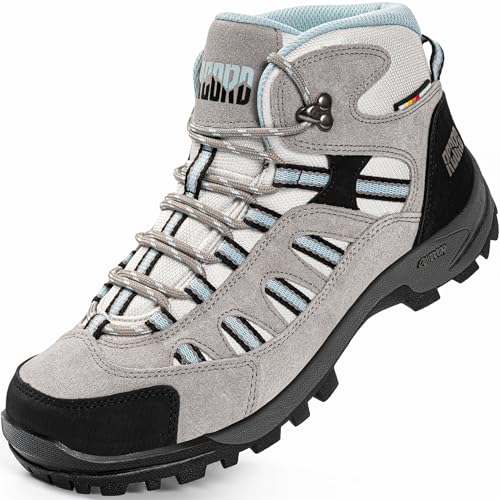
R CORD Women’s Waterproof Hiking Boots (Toe Cap and Heel Support)
- BrandR CORD
- ColourGrey
The short version: A protection-minded boot with a toe cap and supportive heel, held back by almost no published specification.
The spec table shows only the brand, grey colour and category. Everything else comes from the copy. It lists a protective toe cap and a supportive heel. It also mentions a waterproof membrane, anti-slip particles in a rubber outsole, and a cushioning midsole with elastic insole. Dimensions, weight and size aren’t listed.
A supportive heel is the right area to emphasise. Heel-counter stiffness matters for ankle control. Still, ‘supportive’ stays unquantified, and the membrane is unnamed. The copy also lists running, climbing and mountaineering, a spread no single boot covers well. Its ‘ankle support’ appears only in the title. It doesn’t show up in the feature copy.
Pros:
- Protective toe cap — the only toe protection claimed on the list.
- Supportive heel — points toward heel structure rather than just collar height.
- Anti-slip lugs — a rubber outsole with distributed lugs for grip.
- Lace-up closure — adjustable tightness for fit.
Cons:
- Almost no data — no weight, dimensions, size or collar height anywhere in the listing.
- Overbroad use claims — from running to mountaineering, which signals marketing rather than design focus.
Final Thoughts
Best for: Rocky, stubbing-prone trails where toe-cap protection matters. Skip if: exact fit or a verified heel structure is needed, since the sheet gives nothing to check.
How We Chose These Hiking Boots for Ankle Support
These picks come from comparing published specifications, materials and documented features. They also match patterns buyers often mention in reviews. The boots weren’t tested hands-on. Weighting went to what decides ankle support: stiffness through heel counter, shank and midsole, plus a collar and lacing that lock the heel. Fit matters too, since it prevents slide. Traction and waterproofing came next. The product list mixes men’s and women’s sizes (7, 7.5, 9.5, 12), so sizes can’t be compared directly. Return policy matters before ordering, because budget-boot sizing varies. Test the heel lock on a slope.
How to Choose Hiking Boots for Ankle Support
Stiffness Beats Collar Height
Do boots prevent sprains or just feel safer? Partly the second. A tall collar adds feedback, but resistance to twisting comes from the sole. Shanks do the main work. They are rigid metal or plastic inserts in the sole. They come in half, three-quarter and full length. A longer shank generally means a stiffer boot. That helps on rough ground and with a pack. It can make a less natural stride. No listing here names a shank, so test flex by hand. A boot that twists easily will let the ankle roll. No boot replaces strong ankles or good technique. our wider women’s boot picks cover more everyday options.
Best Hiking Boots for Women Ankle Support: Fit and Heel Lock
Fit decides everything. A boot that fits the heel and midfoot snugly resists rolling; one that slides doesn’t. For a high instep, lace loosely over the top of the foot and tighter at the ankle. Heel-lock lacing, such as a surgeon’s knot near the ankle, pins the heel down. Allow for sock thickness and downhill toe room. Thick, cushioned socks change fit. See our hiking sock picks. Lightweight, flexible boots usually need little break-in, but persistent heel rub means the fit is wrong.
Waterproof Claims and Sweat
Every listing here says waterproof or water-resistant, but none names a membrane. Without one, expect seam and tongue leaks, and slow drying. Sweaty feet make this a real trade: a sealed boot traps heat. The rand protects the base of the upper. It’s usually PU-coated leather or rubber, and none of the listings describes one. For slip resistance, ASTM International publishes footwear slip-resistance test methods. None of these listings cites a result. Wet-weather layering is covered in our rain gear guide.
Orthopedic Labels and Weak Ankles
Arch-support and plantar fasciitis wording is marketing. Anyone with a diagnosed condition should see a podiatrist first. A removable insole matters, too, if custom orthotics are on the cards. For the best hiking shoes for weak ankles, stiffness and lacing matter more than any orthopedic label. Strength and balance work helps too.
Our Final Recommendation
The overall winner is the Aoleituo Women’s Waterproof Ankle Support Hiking Boots. The high cut, reinforced midsole, and heel-lock closure address ankle support more directly than anything else here. The best value is the SHULOOK Men’s Waterproof Hiking Boots. That option suits men who want an inexpensive waterproof mid-top. For wider feet, the OrthoComfoot Men’s High Top is the better fit. Readers working through ladies walking boots reviews should note this: none of the six lists a named membrane, a shank, or a slip-resistance rating. Check fit and flex before relying on any of them for a weak ankle.
Frequently Asked Questions
Do hiking boots with ankle support actually prevent sprains?
They reduce risk, but they don’t eliminate it. Hiking boots ankle support comes mainly from a stiff sole and heel counter, plus a locked heel. Collar height isn’t the main driver. A tall but floppy boot can still roll. Strong ankles and balance work help, and trekking poles lower the load too. People with repeated sprains should ask a clinician.
Are orthopedic-style boots enough for plantar fasciitis or arthritis?
Not on their own. Orthopedic and arch-support wording on these listings is marketing language, not medical treatment. None cites clinical testing. A podiatrist can say whether a stock insole is enough or custom orthotics are needed. Check that the insole is removable before ordering.
Can I use my own orthotics in a mid-cut hiking boot?
Often yes, if the stock insole lifts out. Remove it, set the orthotic in its place, and check heel hold and toe room with your usual sock. A thicker insole can crowd the instep and loosen the heel lock. Try the boot with the orthotic in, indoors, before committing.
How do I clean and re-waterproof my boots?
Brush off dirt. Rinse with clean water and let the boots dry away from direct heat. Then apply a waterproofing treatment suited to the upper’s material. Membranes breathe best when the outer fabric is clean. Because none of these six names its membrane, follow the manufacturer’s care instructions.