Best Trekking Poles of 2026: Compared and Reviewed
Contents
The most common mistake with trekking poles is buying on weight alone. A featherweight carbon pair with the wrong length range, or a twist lock that creeps downhill, is worse than a heavier set that fits. Fit beats featherweight. This guide compares five pairs on shaft material, lock type, grip and adjustment range, for hikers who want poles that stay put under load.
The Cascade Mountain Tech Trekking Poles are the pick: 6061 aluminum shafts, a cork grip with an EVA extension and a 26 to 54 inch range for a fair deal of money.
| Product | Best for | Weight per pole (manufacturer) | Shaft and lock |
|---|---|---|---|
| Cascade Mountain Tech Trekking Poles | Best overall | 10 oz | 6061 aluminum, quick-lock |
| TheFitLife Telescopic Trekking Poles | Best value | 9.92 oz | Aluminum alloy, twist-lock |
| Hiker Hunger Outfitters 100% Carbon Fiber Poles | Carbon with metal flip locks | 7.6 oz | 3K carbon fiber, flip locks |
| X Carbon Stick MX-2 PRO | Lowest listed weight | 0.43 lb (listing figure) | X-weave carbon fiber, quick-lock |
| TrailBuddy 7075 Aluminum Trekking Poles | Longest warranty | 9.7 oz | 7075 aluminum, lever locks |
RedSky Adventures is funded by affiliate commission. Our picks come from comparing published specifications and documented features against what matters in the category — no brand pays for a place on this page. If you buy through a link here we may earn a commission at no extra cost to you, and it pays for the research behind the next guide. Full disclosure.
As an Amazon Associate we earn from qualifying purchases. This does not affect the price you pay.
CERTAIN CONTENT THAT APPEARS ON THIS SITE COMES FROM AMAZON. THIS CONTENT IS PROVIDED ‘AS IS’ AND IS SUBJECT TO CHANGE OR REMOVAL AT ANY TIME.
TheFitLife Telescopic Trekking Poles (Twist-Lock, Travel-Friendly)
Hiker Hunger Outfitters 100% Carbon Fiber Trekking Poles (Metal Flip Locks)

Cascade Mountain Tech Trekking Poles (Cork Grip, 6061 Aluminum)
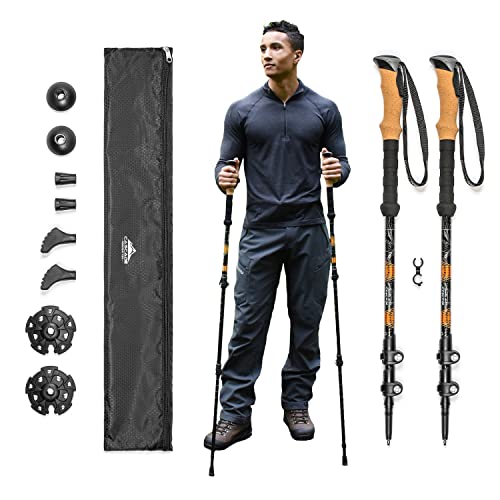
- BrandCascade Mountain Tech
- ModelTP-AL-QL-CORK-3
- Dimensions1.0 inches x 1.0 inches x 26.0 inches
- Weight0.63 pounds
- Size / capacityOne Size
- ColourOrange (Cork Grip)
- WarrantyCascade Mountain Tech offers a limited manufacturer’s
Quick take: A sensible all-round pair for hikers who want a durable aluminum shaft, a proper cork grip and enough accessories to cover mud, snow and rock.
The shafts are aircraft-grade 6061 aluminum, and the manufacturer lists each pole at 10 ounces (the listing weight is 0.63 pounds). The cork grip sits above an extended EVA down grip, so a hand can slide lower on steep climbs without gripping bare shaft. Adjustment runs 26 to 54 inches, which reaches the usual top length for trekking poles of 135 cm.
Aluminum is the forgiving choice here. A hard sideways hit tends to bend 6061 rather than snap it, and a bent pole can often be straightened enough to get you off the trail. Weight is the catch: at 10 ounces a pole, it’s heavier than the carbon pairs below, and the listing calls the lock a quick-lock without saying whether tension is adjustable. The kit is generous, with tungsten carbide tips, rubber snow and mud baskets, boots, tip covers and a travel bag. Warranty runs a minimum of one year and excludes misuse such as using poles as tent poles or for skiing.
Pros:
- 6061 aluminum shaft — bends under abuse instead of splintering, which makes field repair realistic.
- Cork plus EVA extension — cork handles sweat and vibration on the main grip, while the foam lower section allows quick choke-up on climbs.
- 26 to 54 inch range — covers short users and tall users with room to shorten for uphill and lengthen for descents.
- Full accessory kit — carbide tips, snow and mud baskets and rubber tips cover trail, mud and winter use.
Cons:
- Heavier than carbon — 10 ounces per pole adds up over a long day compared with the 7.6 ounce carbon pair.
- Lock details are thin — the listing does not say whether lock tension can be adjusted or what the lock body is made of.
Who Should Buy This
Best overall: hikers who want one durable pair for day hikes, backpacking and light snow. Pass on this if: every ounce matters, since carbon saves meaningful weight.
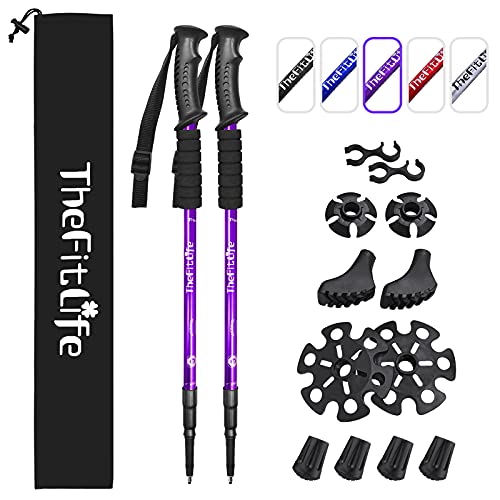
TheFitLife Telescopic Trekking Poles (Twist-Lock, Travel-Friendly)
- BrandTheFitLife
- ModelTheFitLife-Poles-Purple
- Dimensions25.59 inches x 3.94 inches x 2.76 inches
- Weight1.21 pounds
- Size / capacityFrom 26" (65 cm) to 51.2" (130 cm)
- ColourPurple
- Warranty1 Year
Quick take: A light aluminum pair with a long list of packing-friendly numbers, suited to casual hikers and travelers who care about suitcase fit.
The shafts are aluminum alloy, although the listing does not name a grade like 6061 or 7075. Each pole is claimed at 9.92 ounces, and the listing weight of 1.21 pounds appears to cover the pair. Length runs 25.6 to 51.2 inches, and the poles also disassemble to 21.46 inches, which is the shortest packed length in this group.
The lock is a twist-lock, and it’s the weakest point of the design. Twist locks slip under load. They need a two-handed turn and an internal expander that can wear or clog with grit, and a slipping lock under load is the classic cause of poles that collapse on descents. On the positive side, there are no external levers to snag. Maximum length is 51.2 inches, so users close to the typical 54 inch ceiling will have less room than with the Cascade. Its title mentions anti-shock but gives no detail. Springs often add weight and clatter, so that label shouldn’t be a reason to buy. The grip is rubber, not cork, which tends to be warmer in cold weather but less sweat-friendly. You get a rubber tip, walking cap, mud basket and snow basket, and the warranty is one year.
Pros:
- Short packed length — 25.6 inches collapsed and 21.46 inches fully disassembled for suitcases.
- 9.92 oz per pole — nearly the same as the Cascade at a lower listed weight.
- No external levers — a clean profile that will not catch on brush or pack straps.
- Four-season accessory kit — tips, caps, mud baskets and snow baskets are included.
Cons:
- Twist-lock design — more prone to slow slippage than a well-tensioned flip lock, and it wears with dirt and sand.
- Unspecified alloy and grip detail — no aluminum grade is listed, and rubber grips can feel clammy on warm, sweaty hikes.
The Real Deal
Best value: occasional hikers and travelers who need a compact, light pair without paying for carbon. Skip if: you hike steep terrain with heavy loads, where a collapsing lock is a safety risk.
Hiker Hunger Outfitters 100% Carbon Fiber Trekking Poles (Metal Flip Locks)
- BrandHiker Hunger Outfitters
- ModelHH1
- Dimensions5.98 inches x 2.01 inches x 25.51 inches
- Weight0.47 pounds
- Size / capacityCork Grip
- ColourCork – 3K Black
- Warranty1 Year Manufacturing
Quick take: A carbon pair that pairs a light shaft with metal flip locks, aimed at backpackers who want to shed weight without giving up lock security.
The 3K carbon fiber shafts are listed at 7.6 ounces each, 0.47 pounds on the spec sheet. Grips are cork with an EVA foam extension and neoprene padded straps. The listing says the locks are metal flip locks rather than plastic, and that the range is 24 to 55 inches, making this the widest range in the group.
Carbon dampens vibration well and weighs less than the aluminum pairs here, but it fails differently. Common epoxy-based carbon composites show almost no plastic deformation, so a hard side impact tends to crack the shaft instead of bending it. Carbon also has no definable fatigue limit, and absorbed moisture can soften the resin matrix. Where carbon meets aluminum parts, galvanic corrosion is possible. Rinsing and drying matter. The maker claims the first pole from 2015 is still going; that’s a marketing claim, not independent data. The warranty is one year.
Pros:
- Metal flip locks — a lever lock with metal components is easier to re-tension than a twist lock.
- 24 to 55 inch range — more adjustment than any other pair here, from short users to tall ones.
- Cork with EVA extension and neoprene straps — comfortable on sweaty hands and useful on climbs.
Cons:
- Carbon fails by snapping — a sharp lateral hit on rocks can end the pole, with no bend-and-straighten rescue.
- Weight basis is unclear — the listing figure and marketing claim are close but not explained, so check the per-pole weight before ordering.
Ideal for:
Carbon with metal flip locks: backpackers and long-distance walkers who want less swing weight. Pass on this if: you scramble across boulders or want a pole that bends rather than breaks.
X Carbon Stick MX-2 PRO (X-Weave Carbon Fiber)

- BrandX Carbon Stick
- Dimensions0.39 inches x 0.39 inches x 22.44 inches
- Weight0.43 pounds
- Size / capacity57-130 Centimeters
- ColourBlack and Cork
The short version: A very light carbon pair for hikers who prioritize low weight, with some missing details on the listing.
The shaft uses a patented X-shaped carbon weave, which the maker says maximizes strength and durability at low weight. The listing weight is 0.43 pounds, the lowest in this group, with a natural cork handle and a quick-lock system. Adjustment runs 57 to 130 centimeters, and the dimension is listed at 22.44 inches.
That 130 cm ceiling stops short of the 135 cm typical maximum, so tall hikers or those who lengthen poles for descents may run out of range. The listing does not name the lock type, describe lock tension, or list a warranty, and it also lacks accessories such as baskets or carbide tips. Those gaps matter because the lock decides whether the pole holds under load. The X-weave claim is a manufacturer’s statement; carbon still breaks by cracking rather than bending, so rocky scrambles are a bigger risk than with aluminum. Rinse sand and grit off before collapsing, particularly if aluminum hardware is part of the lock.
Pros:
- 0.43 lb listed weight — the lightest figure on any spec sheet here.
- Natural cork handle — manages moisture and vibration on long days.
- Quick-lock adjustment — fast to change length for uphill and downhill.
- Short minimum length — 57 cm collapsed keeps it easy to strap to a pack.
Cons:
- 130 cm top length — shorter than the 135 cm typical maximum, which can leave taller users cramped on descents.
- Warranty and accessories not listed — no warranty figure appears in the spec table, and the listing does not mention baskets or tips.
Perfect for:
Lowest listed weight: short-to-average height hikers on well-maintained trails who want every ounce saved. Not great if: you are tall or want a documented warranty and a full accessory kit.
TrailBuddy Trekking Poles (7075 Aluminum, Lever Locks)

- BrandTrailBuddy
- Weight1.21 pounds
- Size / capacityStandard (All Heights)
- ColourBlack Raven
- WarrantyYour TrailBuddy Trekking Poles are backed by a 5 year
In a nutshell: A 7075 aluminum pair with one-handed lever locks and the longest warranty of the five, built for hikers who want a durable set with support behind it.
The shafts are 7075 aluminum, a stronger alloy than 6061, with a claimed weight of 9.7 ounces per pole (1.21 pounds on the listing, apparently for the pair). Length runs from 24.5 to 54 inches. The lever locks work with one hand, and the moisture-wicking cork handles come with padded straps. Threaded tips hold the included accessories on in snow or mud.
Compared with the Cascade, the TrailBuddy offers a harder alloy and nearly identical range, plus a 5 year limited warranty against defects in materials and workmanship. The warranty excludes misuse, improper storage and excessive force. The listing does not state the packed dimensions beyond the 24.5 inch collapsed length, and the carbide tip is not mentioned. Stronger alloys tend to resist bending better but can be harder to straighten, so the usual aluminum-versus-carbon trade-off applies. The title names women, men and seniors, and the lever locks suit people with weaker grip strength who struggle with twist locks.
Pros:
- 7075 aluminum — a harder alloy that resists bending more than 6061.
- One-handed lever locks — easier to adjust mid-stride and simpler than two-handed twist locks.
- 5 year limited warranty — the longest in this group.
- Cork with padded straps — good for sweaty hands and long days.
Cons:
- Weight sits near the Cascade — 9.7 ounces per pole is not a weight advantage over a 10 ounce pair.
- Few listed details — dimensions are not in the spec table and the tip material is not stated.
Who Should Buy This
Longest warranty: buyers who want a harder alloy and lasting support, including seniors who need balance help. Think twice if: you need the lightest possible pole; carbon saves more.
How We Chose These Trekking Poles
These picks come from comparing published specifications, materials, documented features and warranty terms. Shaft material and lock design carried the most weight, because carbon versus 6061 or 7075 aluminum decides weight, vibration and whether a pole bends or snaps, and the lock decides whether it holds under load. Grip material, adjustment range and collapsed length came next. Before ordering, measure your standing elbow height and check that your needed length falls inside the pole’s range.
How to Choose Trekking Poles
Carbon fiber or aluminum?
Carbon is lighter and damps vibration better, but common epoxy-based carbon composites show almost no plastic deformation and tend to fail by cracking. Aluminum bends first, and a bent pole can often be straightened enough to walk out. Moisture can soften carbon’s resin matrix, and carbon joined to aluminum or mild steel can trigger galvanic corrosion, so rinse and dry them. For rocky ground, the aluminum pairs here are the safer bet; for long, smooth miles, carbon saves effort.
Lock type decides whether poles collapse
Poles that creep down under weight usually have a worn twist lock expander or a flip lock with slack tension. Flip locks are generally the easier design to tighten in the field, and on most the tension can be adjusted. Twist locks lose grip as grit gets into the expander plug. Of the five, the Hiker Hunger, TrailBuddy and Cascade use lever or flip-style closures, while the TheFitLife uses a twist lock. Anti-shock springs, a feature the TheFitLife title mentions, often just add weight and clatter.
Sizing and length
Poles that are too long or short strain the shoulders and wrists. Most poles top out at about 135 cm (54 inches), so the 51.2 inch TheFitLife and 130 cm X Carbon Stick leave less room for tall users. For snowy trips, poles with baskets help when paired with snowshoes in deep snow.
Grip: cork or EVA?
Cork resists sweat. It softens vibration, while EVA foam is lighter and warmer in cold weather. Three of the five pairs here use cork, and the Cascade and Hiker Hunger add an EVA extension for climbs. Cork needs a wipe-down after sweaty days, but the listings don’t give washing instructions. So a rinse with fresh water and thorough drying is the sensible routine.
Packing and flying
Airlines and the TSA generally don’t allow trekking poles in carry-on bags, so collapsed length mainly matters for checked luggage or strapping to a pack. If you’re also planning a trek, see our picks for trekking sleeping bags to round out the kit. Swap in rubber tips. They protect trails and surfaces. Use carbide tips and baskets suited to mud, snow or rock.
Our Final Recommendation
The Cascade Mountain Tech Trekking Poles are our overall pick, with bend-before-break 6061 aluminum, a cork and EVA grip, a 26 to 54 inch range and a full accessory kit. For the best value, there’s the TheFitLife Telescopic Trekking Poles, which pack down to a short length. Its twist lock is the weak point. The Hiker Hunger Outfitters carbon pair is the recommended choice for hikers who want less weight and metal flip locks. Light-weight-focused buyers who can live with missing details suit the X Carbon Stick. The TrailBuddy suits buyers who value the 5 year warranty and a harder alloy.
Frequently Asked Questions
Are carbon fiber trekking poles better than aluminum?
Carbon is lighter and damps vibration, but it tends to crack under sharp side impacts. It doesn’t bend back. Aluminum like 6061 or 7075 bends and can often be straightened enough to finish a hike. Carbon suits smooth trails and long mileage, while aluminum is the more forgiving choice on rocky ground.
Can trekking poles go in a carry-on bag?
Airlines and the TSA generally don’t allow trekking poles in carry-on bags, so plan to pack them in checked luggage. Collapsed length matters here. The TheFitLife folds to 25.6 inches and disassembles to 21.46 inches, which helps in a suitcase.
Why do my trekking poles keep collapsing?
Slipping is usually a lock problem. Twist locks lose grip when the internal expander wears or fills with grit, and flip locks lose tension over time. Clean the sections, tighten flip-lock tension if it’s adjustable, and replace worn expander plugs. Don’t rely on a lock that creeps under body weight.
Can I use trekking poles for snowshoeing?
Yes, they do. Snowshoes and poles work well together in deep snow. Swap the small trail baskets. Use wider snow baskets so the tips don’t sink. The Cascade and TheFitLife both list snow baskets, and the TrailBuddy’s threaded tips keep its accessories attached in snow and mud.