Redwood Forest Train Rides: How It Works and What to Expect
Contents
A redwood forest train is a heritage excursion on a historic logging-era rail line, and California has more than one. There’s a steam run out of Felton in the Santa Cruz Mountains. Then there’s the diesel-powered Skunk Train. It leaves from Fort Bragg and Willits in Mendocino County. The common failure is booking one while picturing the other, or showing up without checking that the line is running at all. The two trips differ in region, locomotive, and scenery, and both are round-trip scenic rides, not transport between towns.
The sensible way to choose is by region, locomotive type, and the kind of redwood scenery you want. Operating status needs verifying. Don’t assume it, because lines built on old logging grades react badly to storms, washouts, and fire-season restrictions.
Key Takeaways
- Two distinct experiences exist: a steam excursion near Henry Cowell Redwoods State Park in the Santa Cruz Mountains, and a diesel railcar run through Mendocino coast forest and river canyon.
- Operating status changes. Schedules, routes, and which locomotive pulls the train depend on season and track conditions, so confirm with the operator before leaving home.
- These are scenic round trips, not a way to get between towns, so the whole outing is planned around returning to the starting depot.
- The trees are fragile. Stay on marked paths, follow park rules, and dress for cool, damp air even when the sky is clear.
What Exactly Is a Redwood Forest Train?
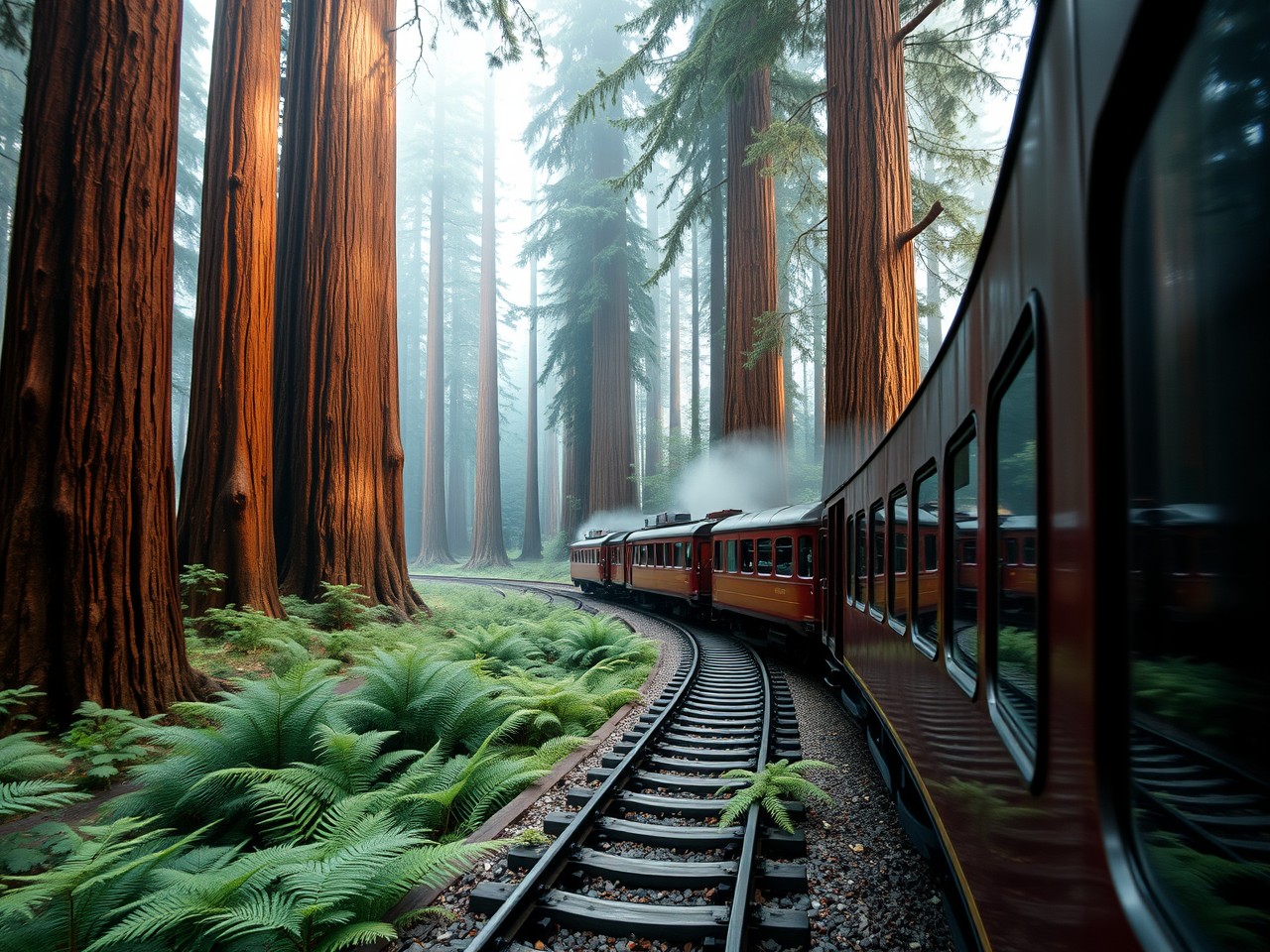
A redwood forest train is a tourist excursion on rail originally laid to haul timber out of coast redwood country. These lines now carry passengers purely for the scenery.
The track threads through groves of Sequoia sempervirens, the coast redwood, along creeks and canyon walls that no highway follows.
The phrase gets used loosely online, and that causes confusion. Searchers may be thinking of the steam trains of the Santa Cruz Mountains, the Mendocino coast line, or a rail trip somewhere else in the Pacific Northwest. Sorting that out first prevents most of the planning errors that follow.
Is there more than one in California?
Yes. At least two separate redwood train experiences operate in different parts of the state, and they share almost nothing beyond the trees.
- Santa Cruz Mountains: operated out of Roaring Camp Railroads in Felton, with steam on the Roaring Camp & Big Trees Narrow Gauge Railroad up Bear Mountain.
- Mendocino coast: the Skunk Train, run by the California Western Railroad under the Mendocino Railway name, with its two ends at Fort Bragg and Willits.
The first is a compact outing built around a grove and a steam locomotive. The second feels longer, a trip through forest and river canyon. It’s usually pulled by diesel power.
Which Redwood Forest Train Fits the Trip?
The Santa Cruz Mountains line suits riders who want steam and an easy pairing with a walk among big trees. The Mendocino line suits riders who want a coastal road-trip anchor and a quieter canyon ride. Choosing by locomotive and region beats choosing by whichever listing appears first.
Steam in the Santa Cruz Mountains
The steam excursion departs from Roaring Camp in Felton. It climbs through second-growth and old-growth redwood country next to Henry Cowell Redwoods State Park. A steam locomotive feels different from a railcar. You get coal or oil smoke, the whistle, and the slow, rocking climb.
Some of the steam engines on logging-heritage lines are Shay locomotives, a geared design built for steep, tightly curved logging track. Which one actually pulls a given departure depends on the day and the operator’s schedule. Engine choice shifts daily, so don’t book around a specific engine without confirming it.
A separate run from the same family of operations heads between the mountains and the Santa Cruz Beach Boardwalk. That route feels different, with more town and coast than forest. Don’t mix the two up when you read a schedule.
Diesel railcar on the Mendocino coast
The Skunk Train runs out of Fort Bragg and Willits, through Mendocino coast forest and river canyon. For a rider, diesel means steadier, quieter, more predictable running than steam. Less drama, more window time.
Diesel doesn’t mean easier to schedule. A line on an old logging grade can lose service to a washout, a tunnel concern, or a fire-season restriction. Diesel trains can’t run on track the operator has closed.
Choosing by the scenery wanted
- Want steam, a grove walk, and a short outing: the Felton operation near Henry Cowell Redwoods State Park.
- Want a longer coastal trip with river canyon views: the Mendocino line from Fort Bragg or Willits.
- Traveling with a road-trip itinerary: the Mendocino line fits naturally into a coastal drive, while the Felton line fits a Santa Cruz weekend.
How Long Is the Ride, and Does It Need a Whole Day?
The ride length depends on the line and the route variant running that day. It also depends on whether the operator runs the full route or a shorter one. Don’t assume exact durations. The operator’s current schedule is the only reliable source.
A realistic plan allows more time than the ride itself. Arrival, parking, ticket pickup, boarding, and any pre- or post-ride walking add up. On a heritage line, a round trip means the return leg is part of the schedule, not optional.
Planning the day around the departure
- Confirm the departure time directly with the operator, and note whether it is a steam or a diesel day.
- Work backward from boarding time to allow for parking and the walk to the depot.
- Leave a buffer after the return so a late arrival does not break the rest of the day.
- Choose a fallback activity within easy reach in case service is cancelled.
Do Redwood Train Rides Need to Be Booked Ahead?
Booking ahead is the safer choice, particularly for summer, holiday weekends, and special event departures. That’s because a heritage train has a fixed number of seats and a limited number of departures. How early a given date sells out varies. Check availability on the operator’s booking page.
Rebooking terms matter as much as the booking itself. Before paying, read what the operator does when a departure is cancelled for weather, track condition, or fire risk. Options include refund, credit, or a different date. A cancellation policy is part of the trip’s survivability, not fine print.
Seasons and weekends
Weekends and school-holiday periods draw the most demand on most scenic railways. Special themed departures can book earlier than standard ones. Weekday travel usually offers more flexibility. Schedules may also be thinner on some lines, though.
Are the Trains Running Right Now?
Operating status is the single most important thing to verify. It’s because a heritage line on a historic logging grade can change schedule or route after storm damage, track problems, tunnel concerns, or fire-season restrictions. A page that lists a route as normal may be out of date. Only the operator’s current notice counts.
The Skunk Train deserves a specific check. Whether the route runs fully from end to end, or whether a section is closed and the operation is limited to a partial run, can differ from one period to the next. A reader should confirm which departure points and which stretch of track are active on the travel date.
What changes the status
- Storm damage and washouts: heavy rain can undercut a grade built for logging, not for permanent service.
- Tunnel or track problems: an inspection finding can close a section until repairs are done.
- Fire-season restrictions: the state fire agency, CAL FIRE, publishes fire information and restrictions in California, and steam operations in particular are sensitive to dry-season limits.
- Weather forecasts: the National Weather Service issues the official forecasts and warnings for the region, and a storm warning is a signal to call ahead.
What Will the Route Actually Show?
The route shows coast redwood forest, creek and river corridors, and the cut-and-bridge engineering of a logging railroad. How much of it is old-growth depends on the line and the stretch. Not every tree beside the track is ancient. Much of this country was logged, so what stands now is a mix of surviving old-growth and regrown forest.
Coast redwoods grow where coastal fog and moisture keep the air cool and damp. That’s why the groves feel different from the surrounding hills. The train passes through that microclimate. On entering the grove, the temperature drop is often noticeable.
The Roaring Camp experience
The Felton steam trip is built around the climb through the grove and the sound and smell of the locomotive. Riders step off at the depot into a setting close to Henry Cowell Redwoods State Park. That makes it easy to pair the ride with time on foot.
The Skunk Train experience
The Mendocino trip trades the compact steam outing for a longer passage through forest and river canyon. A coastal town sits at one end. The setting is less tied to a single park.
Can the Ride Be Combined With a Walk Among the Big Trees?
Yes, especially in the Santa Cruz Mountains. Henry Cowell Redwoods State Park offers old-growth loop trails close to the Felton departure area. Pairing a ride with a short walk gives you one view from the train and another from the ground. The two feel quite different.
Anyone walking in a grove should follow the rules of the park that manages it. California State Parks runs the state park system and publishes park rules and conditions. Trail closures or limits can apply after storms.
Protecting the groves
Coast redwoods have shallow root systems spread wide across the soil. Foot traffic that wanders off the path can compact the ground around them. The rule’s simple: stay on marked paths, avoid stepping on exposed roots, and leave the forest floor as found.
- Keep to signed trails and boardwalks.
- Do not climb on or carve into trees or fallen logs.
- Pack out everything brought in.
- Follow posted limits on fires, smoking, and pets.
Is the Ride Suitable for Children, Older Travelers, and Wheelchair Users?
Heritage trains can suit a wide range of riders, but accessibility varies by line, car type, and depot. It must be confirmed with the operator. Don’t assume. Historic rolling stock wasn’t designed for modern accessibility expectations. Boarding steps, narrow aisles, and uneven platforms are common.
Riders who use a wheelchair should ask specifically whether an accessible car is available on the chosen departure. They should also ask how boarding works. Families with small kids should ask about seating, open-air versus enclosed cars, and any age or ticketing rules.
Questions to ask before booking
- Is there an accessible car or lift on this departure?
- Are the cars open-air, enclosed, or a mix?
- How far is the walk from parking to the platform?
- Are restrooms available at the depot and aboard?
Getting There: Parking, Depots, and Reaching Them Without a Car
Both depots are normally reached by car. Parking arrangements, fees, and overflow areas should be confirmed with the operator for the travel date. Busy departures can fill nearby parking, which is one more reason to arrive early.
Reaching a depot without a car is harder than it sounds. These are excursion operations in mountain and coastal country, not commuter stops. Transit options are limited or not available at all. A reader without a car should check the operator’s directions and local transit information before committing to a date.
For riders who like scenic rail but want a different region, a different kind of trip is covered in this practical guide to riding from Denver to Glenwood Springs by train. There, the train is a real intercity route and not a round-trip excursion.
What to Wear and Bring
Redwood groves stay cool and damp even on sunny days. Layers matter more than the weather forecast for the nearest town. A grove can feel noticeably cooler than the parking lot, and an open-air car adds wind on top of that.
- Layers: a light insulating layer plus a wind- and water-resistant outer layer.
- Closed-toe shoes with grip: platforms and trails can be damp, and wet needles and roots are slippery.
- Sun protection: clearings and open cars can be bright even when the forest floor is shaded.
- Water and a small snack: services at depots may be limited.
- Camera strap or wrist loop: open cars and moving trains are a bad place to drop gear.
Building a Survivable Plan
A survivable redwood train plan still delivers a good day if the train doesn’t run. The real test isn’t the best-case ride. It’s what happens when a storm closes a section or a fire restriction cancels service far from the next obvious alternative.
A simple backup structure
- Primary: the train departure, booked with a clear cancellation policy.
- Secondary: a walk in a nearby state park, such as the old-growth loop trails at Henry Cowell Redwoods State Park for the Santa Cruz side.
- Tertiary: a scenic drive. Redwood National and State Parks and the Avenue of the Giants are well-known drive-through alternatives for redwood scenery by road, and a Mendocino or Santa Cruz coastal drive makes a fallback with views of its own.
Checks in the days before travel
- Confirm the operator’s current status and schedule.
- Check the forecast from the National Weather Service for the area.
- Look at fire-season information from CAL FIRE if traveling in dry months.
- Check road conditions on the approach, since mountain and coastal roads are also exposed to storm closures.
- Keep a fuel and food margin on remote stretches, particularly in Mendocino County where services thin out between towns.
Rail enthusiasts who find the heritage-railroad side appealing sometimes carry that interest home. For that crowd, the roundup of Lionel train sets covers the model-railroad side of the hobby.
Redwood Forest Trains Are Excursions, Not Transport
These trains are heritage excursions on historic logging routes. So they run as round-trip scenic rides and don’t connect towns for ordinary travel. A rider going from one place to another still needs a car, a bus, or another service.
That framing shapes every practical decision. The ticket covers a loop. Parking is part of the plan, and the return leg matters as much as the outbound one. It also explains why the operations are so exposed to conditions: nobody needs the train to get to work, so when track or weather is a problem, service simply stops.
The Bottom Line
California offers two quite different redwood train trips. One is steam through the Santa Cruz Mountains. The other is diesel railcar through the Mendocino coast forest and canyon. Pick by region and locomotive, and confirm the line is running before you leave. Keep a backup activity ready in case storm, track, or fire conditions close a stretch.