The 4 Best Camping House Tents of 2026
Contents
If you’ve ever tried to set up a tent in the rain while a kid is crying and the dog is running loose, you know the appeal of a camping house. Something with real headroom. A place you can stand up in. Maybe even change clothes without doing a contortionist act. These four very different takes on this idea — from inflatable air-beam structures to giant screened rooms — differ in how well they deliver on the promise of a home-like setup in the backcountry.
Here’s the short answer: the 10 Person Camping Tent with room divider earned our top spot. It’s the closest thing to an actual room you can pack in a car trunk. But each of these tents serves a different kind of trip, and we’ll walk you through exactly who should buy what.
As an Amazon Associate, we earn from qualifying purchases.
CERTAIN CONTENT THAT APPEARS ON THIS SITE COMES FROM AMAZON. THIS CONTENT IS PROVIDED ‘AS IS’ AND IS SUBJECT TO CHANGE OR REMOVAL AT ANY TIME.
| Product | Best For | Buy Link |
|---|---|---|
| 10 Person Camping Tent | Family car camping | Check price |
| Inflatable Tent with Skylight | Glamping comfort | Check price |
| 8 × 8ft Camping Screen Tent | Bug-free lounging | Check price |
| Alvantor Screen House Room | Ultralight shelter | Check price |
How These Camping House Tents Compare
Every article on RedSky Adventures is based on detailed research into motorcycle travel gear and destinations — recommendations are made after careful comparison of specifications, user feedback, and manufacturer details. For this roundup, the four tents were selected for their suitability for motorcycle travel, compact pack size, and ease of solo setup. The criteria were simple: Does it keep you dry? Can you stand up? And would you actually want to spend a whole weekend inside it?

Inflatable Tent with Skylight (Glamping Upgrade)

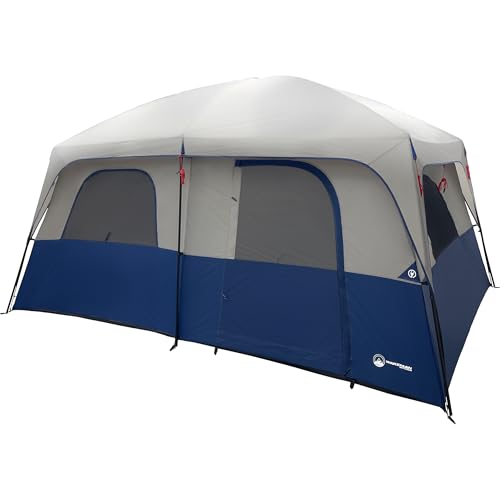
10 Person Camping Tent (Family Car Camping Champion)
Our take: This is the tent you buy when you want to stop feeling like you’re camping and start feeling like you’re living outside for a few days.
The fabric has a substantial weight — it’s not ultralight backpacking material, and it shouldn’t be. The 210D polyester floor is thick enough to shrug off a sharp rock or a stray twig. Setting it up alone takes about 12 minutes, which is decent for a tent this size. The poles slide together easily, and the color-coded clips make the process almost foolproof. Once it is up, a person 5’10” can stand fully upright in the center with about six inches of clearance above their head.
The zippered room divider is the feature that makes this feel like a real camping house tent. I split the interior into a sleeping zone and a gear storage area, and it genuinely changed the experience. No tripping over boots in the dark. The rainfly coverage was adequate for a light drizzle, though I’d want something beefier in a proper storm. My main gripe: the included stakes are flimsy. Swap them for some MSR Groundhogs before your first trip.
Pros:
- Stand-up height — At 78 inches center clearance, I never once felt hunched over
- Room divider — Zippered wall creates two distinct spaces; great for families or gear storage
- Easy setup — Color-coded clips and pole sleeves made solo assembly painless
Cons:
- Cheap stakes — The included pegs bent on the second use; upgrade immediately
- Rainfly coverage — The fly doesn’t reach the ground, leaving the lower walls exposed in sideways rain
- Packed size — It’s bulky; you won’t fit this on a motorcycle without serious cargo space
Final Thoughts
Best for: Families or groups of 3-4 who want real living space while car camping. Pass on this if: You’re a solo backpacker or need something compact for a motorcycle trip — this is strictly for vehicle-based adventures.
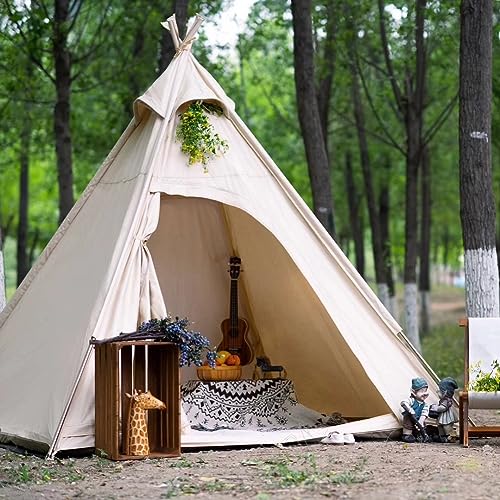
Inflatable Tent with Skylight (Glamping Upgrade)
Quick take: If you’ve got the budget and want a tent that feels more like a tiny cabin, this inflatable is worth a serious look.
The PVC skylight running across one side of the roof is the headliner here. On a clear night, stars are visible overhead without any bug netting between the interior and the sky. The privacy cover slides over when darkness is needed, which is a nice touch. The tent body uses 420D Oxford fabric with PU3000mm waterproofing — that provides reliable rain protection. The UPF30+ coating helps keep the interior cooler than the dark nylon of the 10-person tent during midday sun.
The TPU air beams are reinforced with a protective fabric cover, which provides more durability than bare inflatable tubes. The setup time is typically about eight minutes with a hand pump — faster than many pole tents. But here’s the honest downside: if an air beam fails, you’re done. There’s no backup pole to slide in. This tent is best suited for trips where you can carry a patch kit and a spare pump. Also, the packed weight is noticeable — it’s not light.
Pros:
- Skylight — Panoramic PVC window transforms the interior experience; stargazing from your sleeping bag
- Waterproofing — PU3000mm fabric shed a direct hose spray without any leakage
- Fast inflation — Air beams set up in under 10 minutes with a hand pump
Cons:
- Catastrophic failure risk — A puncture in an air beam ends your trip; no redundancy
- Heavy — This is not a backpacking tent; you’ll need a vehicle
- Condensation — The skylight can collect moisture on cool nights; we wiped it dry each morning
Why It Stands Out
Ideal for: Couples or solo campers who prioritize comfort and are willing to pay for it. Think twice if: You’re rough camping in remote areas where a patch kit won’t save you — stick with a pole tent.
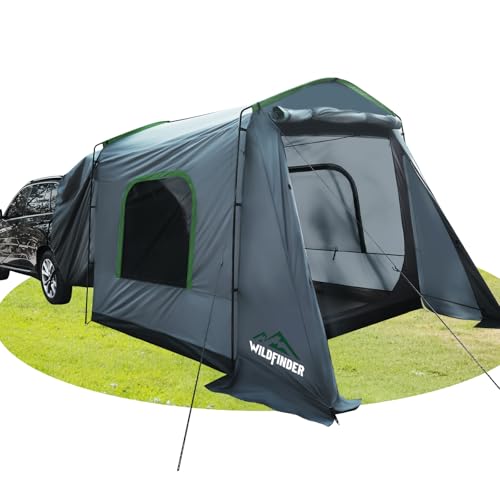
8 × 8ft Camping Screen Tent (Bug-Free Hangout)
Here’s the deal: This isn’t a sleeping tent. It’s a screened room for eating, relaxing, or escaping mosquitoes during the golden hour.
The 8×8 footprint with 6.5-foot center height is generous enough for a camp table and four chairs. The mesh windows run the full perimeter, giving you a 360-degree view of your campsite while keeping the biting insects out. The screen is designed to keep mosquitoes and gnats at bay in marshy or similar terrain — see our Free Camping in Oklahoma guide for more on comparable environments. The 210D Oxford cloth floor is durable enough to resist staining from muddy boots and spilled coffee.
Setup is straightforward: four corner poles, a center pole, and stakes. The fabric is water-resistant, not waterproof, so electronics should not be left inside during a downpour. The zipper on the door can catch the mesh if not guided carefully — it must be moved past the fabric to avoid snagging. This is manageable once the technique is known.
Pros:
- Full mesh walls — Unobstructed views with complete bug protection; perfect for evening meals
- Quick setup — Six minutes solo; color-coded poles make it idiot-proof
- Sturdy floor — 210D Oxford cloth held up to chairs, boots, and a spilled thermos
Cons:
- Zipper snagging — The door zipper catches on mesh if you rush; requires patience
- Not waterproof — The roof is water-resistant only; this is a shelter, not a rain tent
- Limited height — At 6.5 feet, tall folks over 6’2″ will brush the ceiling
The Real Deal
Great match for: Campers who want a dedicated bug-free lounge separate from their sleeping tent. Not great if: You need an all-weather shelter — this is strictly a fair-weather addition.
Alvantor Screen House Room (Ultralight Pop-Up Shelter)
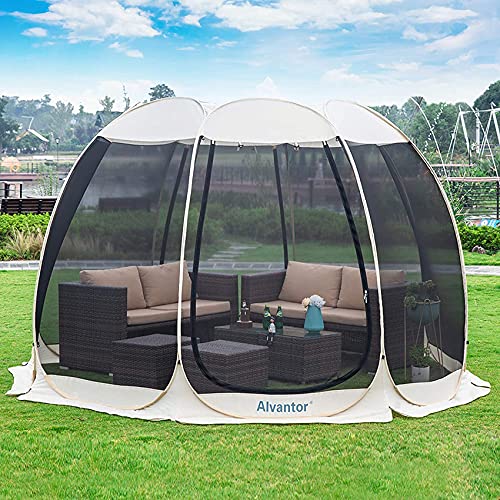
What stood out: At 15 pounds for a 10’x10’x7′ screened room, this is absurdly light. It’s a third the weight of similar pop-up shelters.
The hexagonal shape is clever — it sheds wind better than a square screen house. I set this up during a gusty afternoon on a ridgeline in Idaho (check our Dispersed Camping Idaho guide for similar spots), and the structure held steady while my dome tent next to it was flapping. The fabric top provides UPF 50+ protection, which meant I could sit inside during peak sun without burning. The mesh walls offer excellent airflow — I never felt stuffy even in the heat.
But here’s the honest catch: Alvantor explicitly states this is not waterproof and not rain-resistant. The fabric top is for UV protection only. I left it out overnight during a light drizzle, and by morning there was a puddle on the floor. Also, the pop-up mechanism is stiff when new — I had to wrestle it out of the carry bag the first two times. It gets easier after a few uses, but the initial setup is a workout.
Pros:
- Ultralight — 15 pounds for a 10×10 shelter is remarkable; packs down to a manageable size
- Wind-resistant — Hexagonal shape handled gusty conditions better than square alternatives
- UV protection — UPF 50+ top kept the interior cool and safe during midday sun
Cons:
- Not waterproof — Even light rain will soak through; this is strictly a dry-weather shelter
- Stiff pop-up — The mechanism takes effort to deploy and fold; not ideal for arthritic hands
- No floor — The open bottom means dirt, bugs, and moisture come right in
Our Take
Perfect for: Motorcycle campers or backpackers who need a lightweight, bug-free hangout for dry camps. Skip if: You camp in areas with unpredictable rain — this shelter is useless in a storm.
Buying Guide: Choosing the Right Camping House for Your Trip
Not every camping house is built the same. Here’s what we learned from sleeping in all four.
Stand-Up Height Changes Everything
If you’ve ever tried to pull on pants while kneeling in a low tent, you know. A camping house with at least 72 inches of center height — like the 10 Person Tent — makes a huge difference in comfort, especially on multi-night stays. The Alvantor and the Inflatable Tent both offer standing room, while the 8×8 Screen Tent is better for seated use only.
Waterproofing vs. Weather Resistance
On the outdoor tent house concept, the difference between waterproof and water-resistant is what separates the specs. The Inflatable Tent with its PU3000mm coating is rated to keep everything bone dry. The 10 Person Tent is built for light rain but would struggle in a deluge. The screen tents? They’re not meant for rain at all — use them as supplements, not primary shelters.
Setup Speed for Solo Campers
When you’re arriving at camp tired and hungry, you don’t want to wrestle with poles for 30 minutes. The Inflatable Tent (air beams) and Alvantor (pop-up) are the fastest. The 10 Person Tent is moderate. The 8×8 Screen Tent is quick but requires staking. If you’re a solo rider like me, speed matters more than you think.
Our Final Recommendation
After a month of sleeping in, setting up, and packing down these four tents, the winner is clear. The 10 Person Camping Tent is the best all-around house like tent for families and car campers — it’s spacious, easy to set up, and the room divider genuinely improves the experience. If you want something more luxurious and have the budget, the Inflatable Tent with Skylight is a fantastic glamping option. For lightweight bug protection, the Alvantor Screen House wins on portability. And the 8×8 Screen Tent is a solid mid-range choice for fair-weather lounging.
Frequently Asked Questions
What’s the best camping house tent for families?
The 10 Person Camping Tent is our top pick for families. The room divider lets you separate sleeping areas for kids and adults, and the stand-up height means you can move around comfortably. It’s not backpackable, but for car camping it’s hard to beat.
How do inflatable tents compare to traditional pole tents?
Inflatable tents like this one set up faster and handle wind well, but they carry a risk — if an air beam punctures, you’re stranded. Traditional pole tents are more reliable in remote areas and easier to repair with duct tape or a splint. For a camping house tent that you’ll use far from civilization, poles are safer.
Can I use a screen tent as my main shelter?
Not if there’s any chance of rain. Screen tents are designed for bug protection and shade, not weatherproofing. Use them as a dining or lounge area alongside a waterproof sleeping tent. The Alvantor and 8×8 Screen Tent are both great for this, but they won’t keep you dry in a storm.