Backpacking Sleeping Bag Picks: Ranked by Value for 2026
Contents
A backpacking sleeping bag has to do three jobs: keep you warm at the temperature you’ll actually face, stay light enough to carry, and pack small enough to leave room for everything else. Most budget listings fudge at least one of those. This page compares five on published specs only, and flags the rating claims worth doubting.
As an Amazon Associate we earn from qualifying purchases. This does not affect the price you pay.
CERTAIN CONTENT THAT APPEARS ON THIS SITE COMES FROM AMAZON. THIS CONTENT IS PROVIDED ‘AS IS’ AND IS SUBJECT TO CHANGE OR REMOVAL AT ANY TIME.
The Teton Trailhead is the pick: a 20°F survival rating, a 2.9 lb weight, and a mummy cut with a hood and draft tube.
| Product | Best for | Weight | Stated temperature claim |
|---|---|---|---|
| Teton Trailhead | Best overall | 2.9 lb | Survival rated to +20°F |
| Naturehike Lightweight Compact | Best value | 3.53 lb | 59°F to 32°F; comfort 47.3°F (U250) or 39°F (U450) |
| Kelty Cosmic Synthetic 40 | Name-brand synthetic | 2.65 lb | 40°F rating |
| VENTURE 4TH XXL | Big and tall sleepers | 4.4 lb | Comfortable at 30-70°F |
| BISINNA with Pillow | Couples and car camping | 4.2 lb | “4 Season” label, no figure listed |
RedSky Adventures is funded by affiliate commission. Our picks come from comparing published specifications and documented features against what matters in the category — no brand pays for a place on this page. If you buy through a link here we may earn a commission at no extra cost to you, and it pays for the research behind the next guide. Full disclosure.
Naturehike Lightweight Compact Sleeping Bag 59°F-32°F (Envelope Cut, Pongee Shell)

Kelty Cosmic Synthetic 40 (Cirroloft Fill, Integrated Compression Sack)

Teton Trailhead (20°F Mummy Bag with Compression Sack)

- BrandTETON Sports
- Model1022G
- Dimensions87.0 inches x 32.0 inches x 3.0 inches
- Weight2.9 pounds
- ColourGreen
- WarrantyTETON Sports strives to manufacture the best possible
Quick take: The Trailhead suits backpackers who want real cold-night headroom without carrying a four-pound brick.
The Trailhead is a mummy bag at 2.9 pounds with an 87 x 32 inch footprint. The hood, zipper draft tube and vaulted footbox are the features that matter on a cold night, because they close the gaps where warmth leaks. The liner is double-brushed and breathable, and insulation is microfiber. A compression sack comes included.
The catch is the rating. The listing says survival rated to +20°F, with comfort 20 to 30 degrees warmer, which puts realistic comfort around 40 to 50°F. That’s the honest reading, and it means this is a three-season bag for shoulder-season trips, not a true 20-degree bag. The listing gives no EN or ISO test basis. It also carries a lifetime warranty for the original owner, which says the maker expects it to last.
Pros:
- 2.9 lb weight — lighter than the Naturehike, VENTURE 4TH and BISINNA, and light enough for multi-day carries.
- Hood, draft tube and vaulted footbox — the three features that stop heat escaping at the neck, zipper and feet.
- Lifetime warranty — covers defects in materials and workmanship for the original owner.
Cons:
- Survival rating, not comfort rating — the 20°F figure is the floor, so plan for much warmer comfort.
- Packed size not listed — the compression sack is included, but no packed dimensions are stated.
Who Should Buy This
Best overall: three-season backpackers who want a light bag with a hood and draft tube. Skip if: you sleep cold or expect true 20°F comfort; the numbers say otherwise.
Naturehike Lightweight Compact Sleeping Bag 59°F-32°F (Envelope Cut, Pongee Shell)
- BrandNaturehike
- Dimensions86.6 inches x 31.5 inches x 3.0 inches
- Weight3.53 pounds
- Size / capacityLarge
- ColourBrown & Green
- Warranty1 Year Manufacturer
The short version: A budget-friendly envelope bag for mild nights, with honest comfort figures printed right in the listing.
The Naturehike weighs 3.53 pounds and measures 86.6 x 31.5 inches. Fill is hollow polyester, and the shell is Pongee fabric that the maker says wipes clear of water droplets. That’s water resistance, not waterproofing, despite the title’s wording. Storage size is listed at 15 inches by 9 inches in diameter.
Credit is due for the comfort numbers: 47.3°F for the U250 and 39°F for the U450. That’s more candid than most budget listings. The tradeoff is weight, since 3.53 lb is heavy for a bag with a 39°F comfort figure. The envelope cut is roomier than a mummy but sheds heat more easily. Left- and right-zip versions can be joined into a double. For a frugal shoulder-season trip, it’s a sensible buy; for cold nights, it isn’t. A broader budget sleeping bag shortlist covers more options in this tier.
Pros:
- Stated comfort ratings — 47.3°F and 39°F figures set realistic expectations.
- Zips into a double — pair a left and right version for two sleepers.
- 15 x 9 inch storage size — a listed packed dimension, which several rivals omit.
Cons:
- 3.53 lb for 3-season warmth — heavier than the Trailhead and the Kelty.
- “Waterproof” title versus wipe-clean shell — the copy describes water droplets, not rain protection.
Final Thoughts
Great match for: budget-minded hikers on mild, dry nights. Think twice if: temperatures drop near freezing and weight is a priority.
Kelty Cosmic Synthetic 40 (Cirroloft Fill, Integrated Compression Sack)
- BrandKelty
- Model35428820RR
- Dimensions9.1 inches x 6.1 inches x 15.5 inches
- Weight2.65 pounds
- Size / capacityRegular (2022)
- ColourGreen
In a nutshell: The lightest bag here, built around synthetic insulation that tolerates damp conditions.
At 2.65 pounds, the Kelty Cosmic is the lightest of the five. It uses Cirroloft synthetic insulation with 24 oz of fill, a 40°F rating, and a Regular length fitting sleepers up to 6 feet. The uncompressed stuff size is listed as 15 x 8 inches, and an integrated compression sack and an exterior stash pocket come with it.
Synthetic fill keeps more of its warmth when damp than down does, which is the main reason to choose it for wet-weather trips. The 40°F figure is a manufacturer rating, and the listing doesn’t say whether it follows EN or ISO testing. Treat it as a lower-limit number and expect comfort in the 50s. The listing also doesn’t state a warranty. For lightweight summer and early-fall use, it’s a strong pick, and tall sleepers should look at the long option or a dedicated big and tall bag.
Pros:
- 2.65 lb total weight — the lightest on this list, and a fair contender for good lightweight sleeping bags under synthetic fill.
- Cirroloft synthetic insulation — built for cold and damp conditions, where down fails.
- Spacious footbox and stash pocket — room for the toes and a spot for a headlamp or phone.
Cons:
- 40°F rating only — not a cold-weather bag, and the test basis isn’t stated.
- Regular fits up to 6 ft — taller sleepers must step up to a longer size.
Why It Earns a Spot
Ideal for: summer and shoulder-season hikers who want the lowest weight and a known brand. Pass on this if: nights regularly dip below the 40s.
VENTURE 4TH 3-Season XXL (90 x 39 Inch for Big and Tall Sleepers)

- BrandVENTURE 4TH
- ModelV4-02-XXL-SB-SL
- Dimensions90.0 inches x 39.0 inches x 3 inches
- Weight4.4 pounds
- Size / capacity4.5lbs Single XL
- ColourSilver/Black
- WarrantyExtended Warranty
Here’s the deal: This is the room-first option, and it trades weight for space.
The VENTURE 4TH XXL measures 90 x 39 inches and weighs 4.4 pounds. The shell is 210T polyester, described as breathable and water-resistant, and the stated comfort band is 30-70°F. A two-way zipper allows venting, and a compression sack is included. A lifetime replacement guarantee is claimed.
For broad-shouldered or tall sleepers, that’s the whole point. The cost is carry weight: 4.4 lb is a lot for backpacking, and the listing gives no packed dimensions or insulation type. A 30°F lower figure is also ambitious for a bag this wide, since all that extra interior volume means more air to warm. It’s best treated as a roomy bag for short walk-ins and car camping.
Pros:
- 90 x 39 inch cut — real space for tall or broad sleepers.
- Two-way zipper — lets you vent on milder nights up to the 70°F end of the range.
- Lifetime replacement guarantee — stated by the maker.
Cons:
- 4.4 lb weight — the heaviest here, a hard sell on multi-day trips.
- Insulation and packed size not listed — two numbers a backpacker needs.
The Real Deal
Perfect for: big and tall campers on short trips who’ve been cramped in standard bags. Not great if: ounces matter more than elbow room.
BISINNA Sleeping Bag with Pillow (400GSM Hollow Cotton, Zip-Together Design)
- BrandBISINNA
- ModelSL010RL
- Dimensions86.6 inches x 31.5 inches x 3 inches
- Weight4.2 pounds
- Size / capacity86.6" x 31.5" Left Zipper
- ColourGray
Quick take: A heavy, feature-stuffed bag that fits car camping and couples better than a long trail.
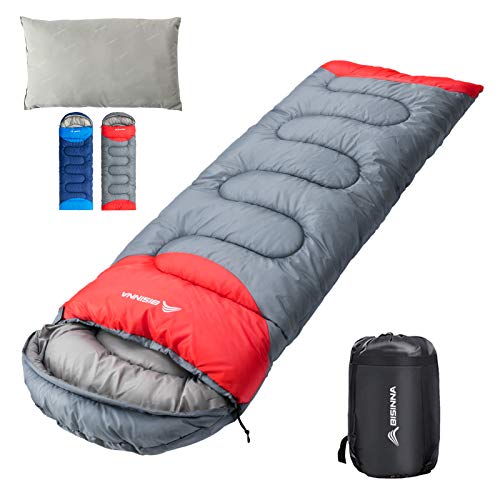
The BISINNA weighs 4.2 pounds and measures 86.6 x 31.5 inches, using 210T polyester over 400GSM hollow cotton. The title says “4 Season” and “waterproof,” but there’s no temperature figure in the listing. Both labels are exactly what to verify before buying, and that’s because a 210T polyester shell is water-resistant at best.
It offers a half-circle hood, a separable bottom zipper to free the feet, a compression sack, and a pillow. Not in the spec table. The copy, though, claims a lifetime warranty on materials and workmanship.
Pros:
- Included pillow — one less item to pack for casual trips.
- Foot-venting bottom zipper — handy for temperature control.
- Zips to a double — suits couples or family camping.
Cons:
- No temperature rating — “4 Season” means nothing without a number and a test basis.
- 4.2 lb — too heavy for most multi-day carries.
Who Should Buy This
Best for: couples and car campers who want a pillow and double-bag option. Skip if: you’re carrying it more than a mile, or need verified winter warmth.
How We Chose These Backpacking Sleeping Bags
These picks come from comparing published specifications, materials, care details and documented features. None of the bags were tested hands-on. Weight, listed temperature claims and insulation type counted most, because those decide whether a bag gets carried and whether it keeps you warm. Packed dimensions and shell fabric came next. Before you order, check whether a rating is a comfort or lower-limit figure, and confirm the packed size fits your pack. Any bag with a vague “4 season” label and no number lost ground.
Buying Guide: Choosing a Backpacking Sleeping Bag
Read the Temperature Rating Correctly
The EN 13537 standard has been used since 2005 to standardize sleeping bag ratings. ISO 23537-1:2016 replaced it in October 2016. Under the standard, a heated mannequin produces four readings: upper limit, comfort, lower limit and extreme. The extreme figure applies only to survival. So it shouldn’t guide everyday use. Most buyers should focus on the range between comfort and lower limit. Details are available from ISO.
The U.S. has no standardized warmth rating. So a 20°F bag from one maker may not match a 20°F bag from another. Test ratings also assume long underwear, socks, a hat and a pad with an R-value around 5.5. A sleeping pad matters as much as the bag, because insulation compressed under your body provides almost no warmth. For colder trips, see this guide to a 0 degree backpacking sleeping bag; none of these five qualifies as the best 0 degree sleeping bag.
Best Lightweight Sleeping Bag for Backpacking: Weight and Packed Size
Weight splits this group cleanly. The Kelty at 2.65 lb is the lightest backpacking sleeping bag here, the Trailhead follows at 2.9 lb, and the other three sit between 3.53 and 4.4 lb. Packed size matters equally: only the Naturehike and Kelty list stuff dimensions. Compression sacks help. But long-term compressed storage degrades loft, so store the bag loosely. A compact sleeping bag is only useful if the number is actually listed.
Synthetic Fill and Wet Weather
Dampness from rain or sweat sharply reduces insulation, and synthetic fill holds warmth when wet far better than down. All five bags here use synthetic fill, which suits budget buyers. Ultralight down is a different category, and an ultralight bag at that level costs far more. Check the shell too: “waterproof” on a 210T polyester bag usually means water-resistant. Trapped air in small pockets is what insulates, so keep fill lofted and dry.
Cut and Fit
Mummy bags like the Trailhead hold heat better, and envelope bags like the Naturehike offer more room. Mummy bags win on warmth. Tall or broad sleepers should look at the VENTURE 4TH or the shell and fill breakdown before they buy a standard size.
Our Final Recommendation
Overall, the Teton Trailhead wins: it’s light at 2.9 lb, cold-capable on paper, and backed by a lifetime warranty. Best value goes to the Naturehike Lightweight Compact, with candid comfort figures for mild nights. Value is its strength. Anyone chasing the lightest weight should pick the Kelty Cosmic, while big sleepers suit the VENTURE 4TH. You’ll need to look beyond this budget tier for the best ultralight sleeping bag. The BISINNA suits car camping more than the trail.
Frequently Asked Questions
What temperature rating should I buy for 30°F nights?
Look for a comfort rating at or below 30°F, not a lower-limit or survival figure. None of these five lists a comfort rating that low. The Trailhead’s 20°F is a survival number, so comfort lands much warmer. Add a well-insulated pad. Also bring a hat and dry base layers, or step up to a dedicated cold-weather bag.
Is the temperature rating on a backpacking sleeping bag what I’ll actually feel?
Rarely. Standardized EN/ISO comfort ratings assume long underwear, a hat, socks and an insulated pad. Many budget bags skip standardized testing. Some publish only a lower-limit or survival number. Plan on being comfortable several degrees warmer than the headline figure. Choose by comfort rating when one’s listed.
Should I choose a synthetic or down sleeping bag?
Synthetic holds warmth better when damp, costs less, and tolerates rough handling. Down is lighter for its warmth and packs smaller, but it loses insulation when wet. Dampness is its weak spot. All five bags here are synthetic, which suits wet climates and tight budgets. Ultralight trips justify down only if you can keep it dry.
Are cheap sleeping bags good enough for backpacking?
For mild, dry three-season trips, yes, if the weight is acceptable to you. Weight is the catch. The Kelty and Trailhead are light enough for multi-day carries, while the VENTURE 4TH and BISINNA exceed 4 lb. Budget bags struggle with vague ratings, so check the temperature basis and packed dimensions before trusting them in the cold.
]