Small Cruise Companies: What to Know Before You Book
Contents
A traveler books a 90-passenger cruise along the Dalmatian coast, expecting the intimacy of a yacht with the stability of a mega-ship. On night two, a bora wind kicks up in the Adriatic, and the vessel rolls fifteen degrees while the dining room empties. The ship is fine, but the guest is not. Small cruise ships do not ride like big ones, and knowing why is the first step in choosing among small cruise companies.
A practical distinction for small cruise companies is that “small” is not just about passenger count but about ship design. Small ships built for river or coastal navigation have shallower drafts and can access waterways that larger ships cannot, but this design trade-off affects onboard space, stability, and amenities. An experienced evaluator looks at each company’s ship class and build date, because older small vessels may lack modern features like stabilizers or hybrid propulsion, while newer ones are purpose-built for specific itineraries like Rhine river sailings or Adriatic island hops.
Key Takeaways
- Passenger count under 300 is common, but the real differentiator is hull design, draft, and stabilizer presence.
- Small ships can feel significantly rougher in open water than large liners because they lack the mass and stabilizer span of megaships.
- Shallow draft allows docking in tiny historic ports and rivers, but onboard amenities are limited compared to mainstream cruise lines.
- Inclusion policies vary widely: some small cruise companies bundle drinks, excursions, and gratuities, while others charge separately for each.
The Real Meaning of “Small” in Cruise Ship Design
Most travelers define “small” by passenger count, and that is only half the story. A ship carrying 150 guests can have the hull of a coastal ferry, a river paddle-wheeler, or a deep-draft sailing yacht. Those designs behave very differently in a seaway. A shallow-draft riverboat drawing 1.5 meters will not handle the open Adriatic the way a 5-meter-draft expedition vessel will, even if both carry 120 people.
Passenger Count vs. Hull Architecture
The loose industry benchmark calls a ship small if it carries fewer than 300 passengers, but many companies go far lower. Sea Cloud Cruises sails with under 100 guests. Star Clippers operates tall ships carrying between 170 and 227. Ponant runs expedition vessels for 184 to 264. What matters for risk assessment is not the number, but how that number interacts with the hull form. A long, narrow sailing ship with a deep keel and ballast behaves differently from a wide, flat-bottomed riverboat, even if both hold 150 passengers. The keel provides righting moment; the flat bottom provides initial stability but can roll quickly in beam seas.
An older small ship built before the 2000s often lacks the bulbous bow, active fin stabilizers, and computer-controlled trim systems that are standard on newer builds. The listing for an older vessel will rarely advertise this absence, but a sharp traveler can check the build date and ask directly about stabilizer type. That one question separates a calm coastal cruise from a queasy crossing.
Why Draft and Displacement Matter
Draft is the vertical distance from the waterline to the lowest point of the hull. A shallow draft lets a ship enter harbors where a 9-meter-draft megaship would run aground. The Rhine River requires vessels that draw less than about 1.9 meters in low-water conditions, which is why CroisiEurope’s river ships ride so high and flat. The trade-off is that a shallow, wide hull has less resistance to rolling than a deep, narrow hull. That is not a flaw; it is a physical consequence of the design choice that makes river navigation possible.
A self-contained fact worth remembering: A ship with a 2-meter draft can enter many Adriatic island harbors that a 8-meter-draft cruise ship cannot, but that same shallow hull will roll more in a 2-meter swell than the deep-draft vessel. If your itinerary includes open-water crossings, draft becomes a risk factor you should weigh against port access.
Stability, Seasickness, and the Truth About Stabilizers
Large cruise ships use stabilizers that extend several meters from the hull, generating lift to counteract roll. Small ships have less space and less power for such equipment. Some small vessels carry fin stabilizers that retract into the hull; others rely on bilge keels alone, which reduce roll but do not eliminate it. A ship without active fin stabilizers will move more in a beam sea, period. That does not mean it is unsafe, but it does mean anyone prone to seasickness should plan differently.
How Stabilizers Work on Small Ships
Active fin stabilizers pivot to create an opposing force as the ship rolls, but they require forward speed to work. At anchor or in slow cruising near a port, fins provide little help. Passive systems like bilge keels and anti-roll tanks are always working but are less effective. The most stable small ships for open ocean are purpose-built expedition vessels like those from Ponant, which use a combination of fin stabilizers, retractable azimuth thrusters, and hull shapes designed for polar seas. A riverboat on the Rhine does not need stabilizers because it never faces large swells; a 90-passenger coastal cruiser in the Aegean does, and many older ones simply do not have them.
What to Expect in Open Water vs. Coastal Sailing
Coastal itineraries along the Adriatic or the Greek islands stay within sight of land and often travel only at night, or during calm mornings. The bora wind in the Adriatic is a real and predictable hazard in winter and early spring. A small ship caught in a bora will roll hard because the wind funnels down the mountain gaps and hits the beam. Open-water passages, like the crossing from mainland Italy to Corsica, expose the ship to longer-period swells that even a well-stabilized vessel will feel. For risk assessment, consider the season and the specific crossing: a July coastal hop is not the same threat profile as a March Adriatic transit.
Access to Small Ports and Shallow Drafts
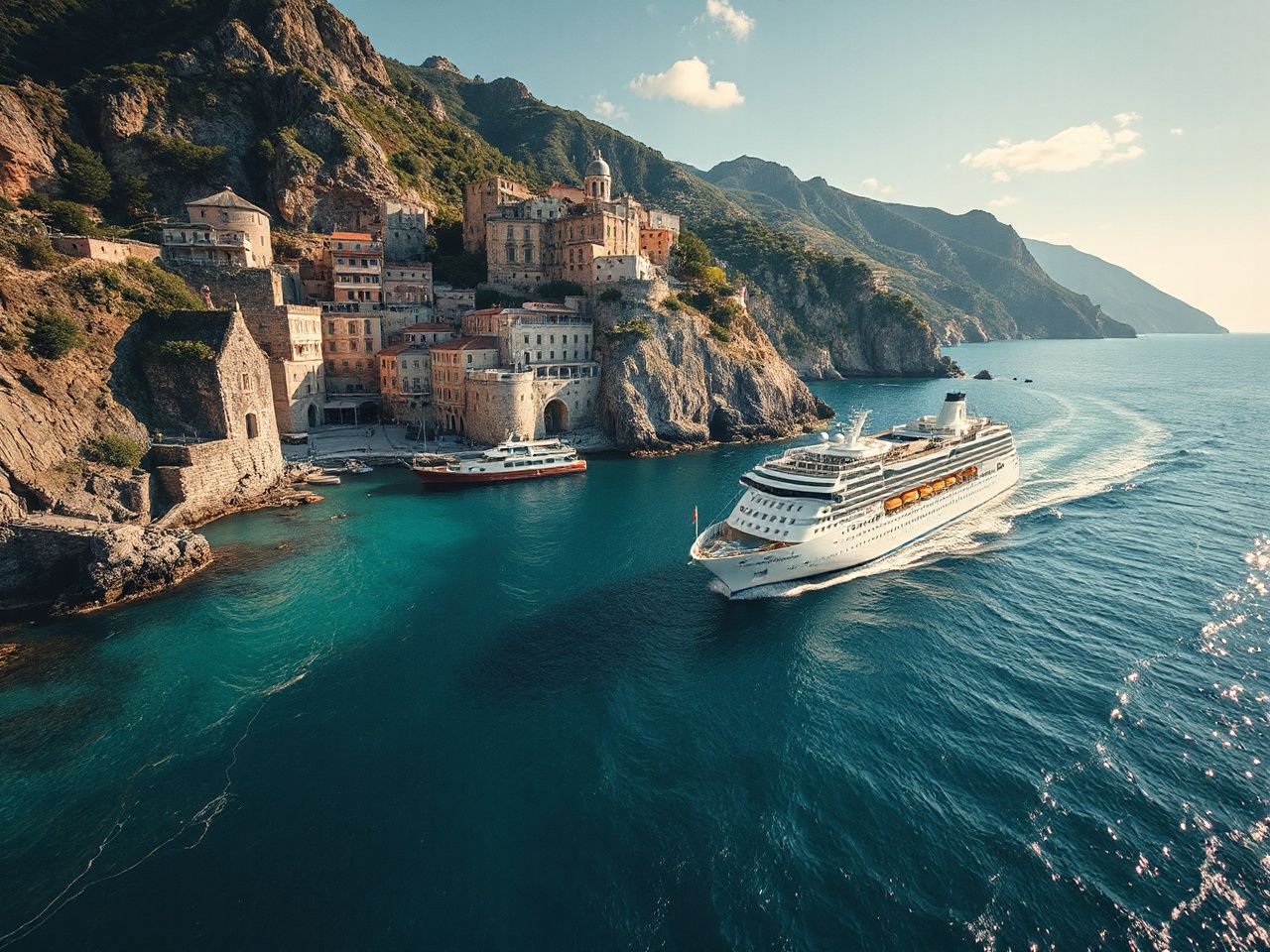
This is the core advantage that small cruise companies sell, and it is real. A ship drawing 3 meters can dock at Korčula, Hvar, or the inner harbor of Kotor, where a 10,000-passenger megaship must anchor offshore and tender guests in. Shallow draft also allows river navigation on the Rhine, Danube, and Seine, which is impossible for any ocean-going cruise ship. The trade-off appears when you look at what the ship gives up to achieve that access: deck space, stabilizer room, engine size, and sometimes even headroom in lower cabins.
River Cruises vs. Coastal Cruises
River ships from CroisiEurope and similar operators are long, narrow, and flat-bottomed. They draw between 1.2 and 1.9 meters, which lets them clear low bridges and navigate shallow channels. They have no need for stabilizers because the water is nearly always calm. But they cannot operate in open sea; a riverboat on the Rhine is legally and physically different from a coastal cruiser on the Adriatic. Coastal small ships like Variety Cruises’ motor yachts draw 3 to 4 meters and can handle moderate swells, but they may still lack the size to ride through a storm as comfortably as a 100,000-ton liner.
Tendering and Shore Excursions
Even with a shallow draft, a small ship may still have to tender when a port has no berth large enough or when water depth at the quay is insufficient. Tendering means stepping from the ship’s gangway into a small boat, often with a swell running. That transfer is a risk point for anyone with mobility limitations. Some small ships carry their own Zodiacs or tenders; others hire local boats. The safety standards for tendering are set by the International Maritime Organization through the Safety of Life at Sea (SOLAS) convention, which applies to all passenger ships on international voyages, regardless of size. A responsible cruise line will brief passengers on tender procedures and provide crew assistance. If a company’s materials do not mention tendering for an itinerary that obviously includes small ports, ask directly.
Onboard Amenities: What You Sacrifice and What You Gain
Space is the first casualty of small-ship design. A 150-passenger vessel cannot fit a 1,000-seat theater, three specialty restaurants, and a water park. What it can fit is a dining room that seats all guests at once, a lounge with real windows, and an open deck where you can actually find a quiet corner. The value proposition is not more stuff; it is fewer people and better access.
Cabins and Balconies
Small ship cabins are almost always smaller than their big-ship equivalents. A standard outside cabin on a CroisiEurope river ship might run 14 to 16 square meters; a balcony cabin on a Ponant expedition yacht is around 18 to 20. Compare that to a 20-square-meter inside cabin on a mainstream mega-ship, and you see the difference: on a small ship you often pay more per square meter. Some older small vessels have only portholes, not picture windows or balconies, because the hull structure could not accommodate large openings when built. Newer builds, especially those after 2010, are more likely to offer private balconies, but even then a French balcony on a river ship is just a sliding glass door with a railing, not a walkout terrace.
Dining and Entertainment
Most small cruise companies operate a single dining room with open seating. There is no “anytime dining” choice because there is only one place to eat. Menus change daily and often reflect regional ingredients, but if you have dietary restrictions, you need to tell the line well in advance. Entertainment on a small ship is a lounge singer, a lecture about the next port, or nothing at all. Some expedition lines hire naturalists and historians who give talks; that is the main event. If you need a casino, a climbing wall, or a production show every night, a small ship is the wrong choice, and no amount of marketing will change that.
Inclusions: Drinks, Excursions, Gratuities
The fare structure varies as much as the ship design. Ponant and Hebridean Island Cruises lean toward nearly all-inclusive pricing: all drinks, all excursions, all gratuities, and sometimes even charter flights. Variety Cruises and Star Clippers are more a la carte: port taxes, drinks, and shore excursions cost extra, and gratuities are suggested but not always included. CroisiEurope includes wine and beer with meals, but not open bar or excursions. The rule is never assume inclusion. Request a written list of what the base fare covers before comparing prices. A $400-per-night fare that includes nothing may end up costing more than a $600-per-night fare that includes drinks, excursions, and transfers.
Cost Comparison: Small Ships vs. Big Lines
The average cost per night on a small cruise line runs between $350 and $900 per person, depending on the company, season, and itinerary. A mainstream big-ship cruise can cost under $100 per night in an inside cabin. That gap is not just markup; it reflects the cost of operating a small vessel with high crew-to-passenger ratios, boutique food sourcing, and port fees at tiny harbors that cannot handle volume. A 100-passenger ship has roughly one crew member for every two guests on a luxury line; a 5,000-passenger ship has one crew member for every three or four. Labor is the biggest cost in cruising, and small ships cannot spread it over thousands of fares.
Average Cost Per Night
By the numbers, a CroisiEurope Rhine river cruise often prices at $250 to $400 per night. A Star Clippers Mediterranean sailing runs $350 to $500 per night. Ponant expedition voyages in the Adriatic or Arctic start around $700 per night and climb. Hebridean Island Cruises, which operates a 50-passenger ship around Scotland, can exceed $1,000 per night. These are not list prices you can simply compare; seasonal discounts, airfare bundles, and last-minute deals are common. But the ballpark is useful: expect to pay three to six times more per night than a Carnival or Royal Caribbean inside cabin.
What’s Bundled vs. À La Carte
When comparing fares, create a spreadsheet with columns for drinks, excursions, port fees, gratuities, Wi-Fi, and transfers. Fill in what each company includes. You will find that an apparent bargain at $299 per night becomes $450 per night once you add two excursions, a drinks package, and gratuities. Conversely, a $650 per night Ponant fare may include Zodiac excursions, open bar, and no tipping, making it the better value for an expedition-style trip. Pricing transparency is a real differentiator among small cruise companies, and the cheaper sticker price is rarely the cheaper trip.
How to Choose the Right Small Cruise Company
Choice starts with the experience you want, not the ship you imagine. Sailing ships, luxury expedition yachts, and riverboats are three different products that happen to share the word “small.” Matching your interests to the right category is the first step, and then the specific company follows.
Sailing Ships: Star Clippers and Sea Cloud Cruises
If the point is to travel under sail, not just to visit ports, Star Clippers and Sea Cloud Cruises are the two dominant names. Star Clippers operates three tall ships with 170 to 227 passengers, using a combination of sail and engine power. Sea Cloud Cruises runs two historic square-riggers, one from 1931 and one from 2001, carrying under 100 guests. These ships have real rigging, real sails, and real deck work. You can help haul lines or just watch. The trade-off is that sailing ships heel under wind, which adds another layer of motion, and their cabins are often smaller and quirkier than a modern motor yacht. If you get seasick on a moving deck, a square-rigger under sail is not the place to discover it.
Luxury Expeditions and Coastal Yachts: Ponant and Variety Cruises
Ponant builds modern expedition ships with ice-strengthened hulls for polar regions, but also deploys them in the Mediterranean and Adriatic. They carry 184 to 264 passengers, offer all-balcony cabins on newer ships, and include most costs in the fare. Variety Cruises runs smaller motor yachts and sailing yachts for 34 to 72 passengers, focusing on Greek islands, the Adriatic, and the Seychelles. Their ships are older, less luxurious, and more about access than pampering. A Variety ship can anchor in a cove that Ponant’s 130-meter vessel cannot enter, but the cabins will be smaller and the amenities leaner. For a full breakdown of specific Mediterranean itineraries and ship comparisons, see our small ship Mediterranean cruise reviews page, which covers six operators with detailed notes on ship age and stabilizer fit.
River and Specialty Lines: CroisiEurope and Hebridean Island Cruises
CroisiEurope dominates European river cruising with over 50 ships on the Rhine, Danube, Seine, and other waterways. They are not luxury in the Ponant sense; they are efficient, well-run, and often significantly cheaper, with a strong French focus on food and wine. Hebridean Island Cruises operates one small ship, the 50-passenger Hebridean Princess, around Scotland’s west coast and islands. That ship is a former car ferry converted to a country-house-hotel atmosphere, with no stabilizers and no balconies. Its draw is not cutting-edge design but intimacy, crew service, and access to remote Scottish anchorages. Your choice between these two is not about quality; it is about whether you want a river valley or a sea loch.
Safety and Environmental Considerations
Small ships are not inherently less safe than large ones, but they operate under different regulatory frameworks depending on route. An ocean-going passenger vessel on an international voyage must comply with the International Convention for the Safety of Life at Sea (SOLAS), set by the International Maritime Organization. A river ship on the Rhine falls under the Central Commission for Navigation on the Rhine (CCNR) regulations, which are separate and tuned to inland waterways. That distinction matters for evacuation procedures, lifeboat requirements, and crew training. A ship certified for the Rhine is not automatically certified for the open Adriatic, and vice versa.
Certification and Navigation Rules
Before booking, ask the company under which flag the ship sails and which classification society certifies it. Common societies include Lloyd’s Register, DNV, and Bureau Veritas, all of which publish ship data that you can check online. A reputable small cruise company will state the ship’s class and flag in its brochures. If they refuse to tell you, that is a red flag. The IMO maintains a database of ship particulars through its GISIS system, though access is sometimes limited. The practical takeaway: don’t assume that because a ship is small and looks charming, it meets the same safety standards as a big cruise line. Ask.
Environmental Practices
Small ships are often marketed as more environmentally friendly than megaships, and there is some truth to it. A 50-passenger vessel burns less fuel per day than a 5,000-passenger resort, and it can visit small ports without overwhelming them. But small ships also tend to be older, and older engines may emit more per passenger-mile than a modern megaship with exhaust scrubbers and LNG propulsion. Ponant has built hybrid-electric icebreakers; CroisiEurope has experimented with shore-power connections. The environmental claim is not automatic. Look for ships with Tier III engine certification or shore-power capability, and check the company’s actual track record, not just its marketing language. The International Maritime Organization’s MARPOL convention sets air and water pollution standards for all ships, and compliance is mandatory regardless of size.
If you are considering a Mediterranean itinerary, the same structural questions apply to every operator. Our guide to small ship Mediterranean cruises walks through six companies with a specific eye on ship age, stabilizer fit, and what the fare actually includes.
Frequently Asked Questions
How many passengers count as “small” on a cruise ship?
The common threshold is under 300 passengers, but the more useful definition is about ship design and draft. A 150-passenger riverboat behaves completely differently from a 150-passenger coastal yacht. Ask about hull type, stabilizers, and build date rather than focusing only on the number.
Do small cruise ships have stabilizers, and do they get rough in the sea?
Many newer small ships have retractable fin stabilizers, but older ones may rely only on bilge keels or nothing at all. Even with stabilizers, a small ship will move more in open water than a large liner because it has less mass and a shorter roll period. Expect more motion on coastal crossings, especially in shoulder seasons.
What is included in the fare on small cruise lines?
Inclusion varies sharply. Ponant and Hebridean Island Cruises bundle most drinks, excursions, and gratuities. Star Clippers and Variety Cruises charge extra for excursions and sometimes drinks. CroisiEurope includes wine and beer with meals but not open bar. Always request a written list of inclusions before comparing prices.
Are small cruise lines more environmentally friendly than big ones?
Not automatically. Small ships burn less total fuel and can access small ports without overwhelming them, but many older small vessels have less efficient engines and no shore-power capability. Check for Tier III engine certification or hybrid propulsion. The most environmentally responsible small ships are newer builds from companies like Ponant that were designed with current standards in mind.