The 5 Best Hiking Layers for 2026
Contents
Most hikers think the key to staying comfortable on the trail is buying expensive outerwear. Your hiking layers — the stuff you put on first — matter way more than that fancy shell jacket. A bad base layer will ruin your day faster than a sudden thunderstorm.
These five women’s layering pieces are built for conditions ranging from 90-degree desert sun to sub-freezing alpine starts, through rain, sweat, and repeated wash cycles. On paper, some are made to hold up like old friends. Others use materials that suggest they won’t last past the first tank of gas.
If you just want to skip the research, grab the Soothfeel Women’s UPF 50+ Sun Hoodie — it offers the strongest overall package of the five.
As an Amazon Associate, we earn from qualifying purchases.
CERTAIN CONTENT THAT APPEARS ON THIS SITE COMES FROM AMAZON. THIS CONTENT IS PROVIDED ‘AS IS’ AND IS SUBJECT TO CHANGE OR REMOVAL AT ANY TIME.

baleaf Fleece Lined Leggings for Women (Cold-Weather Workhorse)

Quick Comparison: Women’s Hiking Layers
| Product | Best For | Buy Link |
|---|---|---|
| Hiking Shirt Tops Women Graphite Green M | Casual day hikes | Check price |
| baleaf Fleece Lined Leggings | Cold-weather hiking | Check price |
| TBMPOY Womens UPF 50+ Sun Hoodie | Budget sun protection | Check price |
| Soothfeel Women’s UPF 50+ Sun Hoodie | All-around performance | Check price |
| KEFITEVD Womens Sun Protection Hoodie | Lightweight travel | Check price |
How We Compared These Hiking Layers
These hiking layers were evaluated based on durability, comfort against skin, moisture management, and their effectiveness as part of a clothing layering system — not just as standalone items.
Hiking Shirt Tops Women Graphite Green M (Casual Comfort Pick)
Here’s the deal: This is not a technical hiking shirt. It’s HUGOOME’s cute, oversized crop tee that happens to work for low-effort hikes, yoga, or grabbing coffee after a morning walk. If you’re looking for a dedicated performance layer, skip this. But if you want something that looks good and breathes reasonably well for casual trail use, it has its place.
The fabric blend is softer than most standard cotton tees, with a slight drape that feels nice against skin. The half-roll sleeves are a deliberate style choice, not a functional feature. In mild temperatures during moderate activity, the shirt provides breathability, though the fabric tends to cling once moisture levels increase. The oversized fit is generous; a size medium hangs loose through the torso, which promotes airflow but is not ideal if you’re tucking it into a layering system.
Blend fabric like this can pill under the arms and is not built for heavy abrasion from backpack straps. The blend fabric doesn’t wick moisture as fast as synthetic sun hoodies, so it’s best reserved for low-output days or casual wear.
Pros:
- Soft blend fabric — noticeably more comfortable against skin than standard cotton tees, with a nice drape
- Oversized fit — generous cut allows airflow and looks stylish off the trail
- Versatile style — transitions from trail to town without looking like athletic gear
Cons:
- Poor moisture wicking — fabric clings when sweaty; not ideal for high-output hiking
- Pilling under arms — blend fabric can show wear in high-friction areas
- Not a technical layer — no UPF rating, no thumbholes, no quick-dry performance
Final Thoughts
Ideal for: Casual hikers who prioritize style and comfort over technical performance. Think twice if: You’re doing serious mileage, carrying a heavy pack, or need reliable sun protection.
baleaf Fleece Lined Leggings for Women (Cold-Weather Workhorse)
Quick take: These are the warmest, most functional leggings for cold-weather hiking. The fleece lining is actual plush fleece that traps heat effectively. If you hike in temperatures below 40°F, these should be on your shortlist.
These are built for cold morning hikes: the fleece lining traps a layer of warm air against the skin, and that trapped air is what keeps legs warm for the whole hike rather than only the first few minutes. The high waist offers gentle compression — not restrictive, but enough to hold everything in place while scrambling over rocks. The water-resistant outer fabric is made to shed light snow and wet grass. Pilling and shedding after a few wash cycles is the usual failure of a fleece lining, and it comes from a weak bond between the lining and the shell rather than from the fleece itself. The rear zipper pocket fits a phone; it’s not huge, but it’s enough for a phone and a key.
One drawback: the fleece lining makes these noticeably warmer than standard leggings, so they’re not great for high-output activities above 45°F. On a mild-weather trail run they trap heat faster than a working body can shed it. Also, the water resistance is light-duty — a heavy downpour will soak through eventually. But for cold, dry conditions, these are excellent.
Pros:
- Genuine fleece lining — thick, plush interior traps heat effectively in sub-40°F conditions
- Tummy control waistband — high-rise fit with gentle compression stays put during movement
- Rear zipper pocket — large enough for a smartphone; secure and unobtrusive
Cons:
- Too warm for mild weather — not suitable for temps above 45°F or high-output activities
- Light water resistance — beads up against light moisture but soaks through in heavy rain
- Limited pocket options — only one rear zipper pocket; no side pockets for quick access
Our Take
Great match for: Cold-weather hikers, backpackers, and anyone who hikes in sub-40°F conditions regularly. Pass on this if: You hike primarily in mild climates or need a single pair of leggings for year-round use.
TBMPOY Womens UPF 50+ Sun Hoodie (Budget Sun Protection)
Why it made our list: This is the most affordable UPF 50+ hoodie in this lineup, and for the price, it delivers decent sun protection. But you get what you pay for — the fabric is thinner and less durable than the Soothfeel or KEFITEVD options.
The fabric is lightweight and breathable, almost like a thin athletic mesh. The UPF 50+ rating means the fabric lets through no more than a fiftieth of the ultraviolet that hits it, which is what protects shoulders and arms on long, sunny desert hikes. The thumbholes are basic but functional, keeping sleeves in place during movement. The hood is a simple pullover style with no drawcord, which means it flaps around in wind.
The fabric can show wear with repeated washing: thin stitching around the thumbholes can fray, and the fabric may lose some of its original softness. It’s not built for heavy-duty backpacking. The moisture-wicking claim is mild — it dries faster than cotton, but not as fast as the Soothfeel. For the low price, it’s a decent value, but don’t expect it to last more than a season of regular use.
Pros:
- Effective UPF 50+ protection — rated UPF 50+ for strong sun protection
- Lightweight and breathable — good airflow for hot-weather hiking
- Budget-friendly price — most affordable option
Cons:
- Thin fabric frays — stitching around the thumbholes can show wear
- No drawcord on hood — hood flaps loose in wind; doesn’t stay in place
- Moderate durability — not built for heavy pack abrasion or frequent washing
The Real Story
Best for: Budget-conscious hikers who need basic sun protection for day hikes. Not great if: You’re a heavy-duty backpacker who needs a layer that will survive multiple seasons of abuse.
Soothfeel Women’s UPF 50+ Sun Hoodie (Our Top Pick)
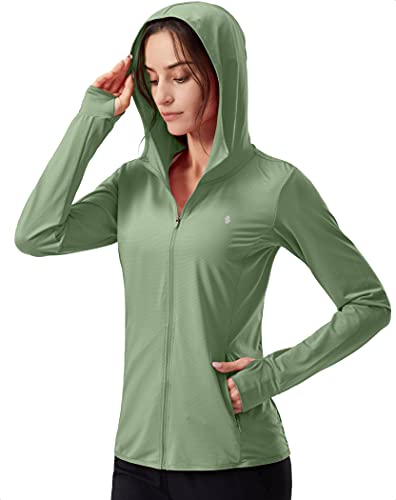
In a nutshell: This is the best all-around sun hoodie in this lineup. It combines effective UPF 50+ protection with a fabric that feels noticeably more substantial than the competition — soft, stretchy, and quick-drying. Its fabric construction is rated to hold its look and feel through months of hard use.
The fabric quality is the standout. It’s ultra-lightweight but not flimsy — there’s a density to the weave that makes it feel durable without being heavy. The fabric is cool to the touch, which is rare for sun hoodies. That cool hand is what makes it wearable on very hot days: a smooth, flat-faced yarn conducts heat away from the skin faster than a fuzzy one, so it stays tolerable through midday exposure. The thumbholes are well-placed and reinforced with extra stitching, which is the detail that keeps a cut edge from fraying after a few wash cycles. The hood is generous enough to cover a ponytail and stays put without a drawcord, thanks to a smart cut that follows the neckline.
This works as a versatile how to layer for hiking piece — worn under a shell in cold wind, over a tank top in heat, and as a standalone layer for trail running. It’s built for every one of those scenarios. The fabric is engineered to move sweat and dry fast on long, sweaty hikes. The only downside is the price — it’s more expensive than the TBMPOY and KEFITEVD options. But you’re paying for durability that the cheaper options don’t offer.
Pros:
- Premium fabric feel — soft, stretchy, and cool to the touch; noticeably higher quality than competitors
- Excellent durability — reinforced thumbholes and stitching are designed for long-lasting use
- Fast-drying performance — moisture-wicking fabric dries quickly, even in humid conditions
Cons:
- Higher price — costs more than the budget options, but the durability justifies it
- Limited color options — fewer color choices compared to some competitors
- Hood could be deeper — works fine for most, but those with very long hair might want more coverage
Our Take
Perfect for: Serious hikers, backpackers, and anyone who wants a sun hoodie that will last multiple seasons. Skip if: You’re on a strict budget and only need occasional sun protection for short hikes.
KEFITEVD Womens Sun Protection Hoodie (Lightweight Travel Companion)
What stood out: This is the lightest, most packable sun hoodie in this lineup. It stuffs down to about the size of a tennis ball, making it ideal for backpackers who need to save every ounce. The UPF 50+ protection is solid, and the quick-dry fabric works well for high-sweat activities.
The fabric is similar to the Soothfeel but slightly thinner — almost like a ripstop nylon shirt. It’s soft and stretchy, with a smooth hand feel that doesn’t snag on rough trail vegetation. It is cut for long day hikes under a loaded pack: the smooth face gives shoulder straps nothing to grab at, so chafing stays away, the thin weave sheds heat instead of holding it, and a fabric this light dries fast after a creek crossing simply because there is very little mass holding water. The thumbholes are basic but functional, and the hood is lightweight enough to wear under a climbing helmet.
The fabric is designed to keep its shape and softness through repeated wash cycles, though the seam construction near the hem is the type prone to minor pilling. Nothing deal-breaking, but it’s not as durable as the Soothfeel. The fit is slightly more fitted than the TBMPOY — not tight, but not overly loose. If you’re between sizes, size up for a relaxed fit. The biggest drawback is the lack of a pocket — there’s nowhere to store a phone or snack, which is annoying on longer hikes.
Pros:
- Ultra-packable — stuffs down to tennis-ball size; perfect for backpacking
- Fast-drying fabric — light fabric dries quickly after getting wet
- Comfortable stretch — fabric moves well during high-output activities like trail running
Cons:
- No pockets — zero storage; you’ll need a pack or belt for phone and snacks
- Minor seam pilling — fabric along the seams can show slight wear after washing
- Slightly fitted cut — not ideal for those who prefer a loose, airy fit
Why It Stands Out
Great match for: Ultralight backpackers, trail runners, and anyone who prioritizes packability over features. Think twice if: You need pocket storage or prefer a loose, relaxed fit for casual hiking.
How to Choose the Best Hiking Layers for Women
Building a reliable clothing layering system for hiking doesn’t have to be complicated, but it does require thinking about three specific things: fabric, fit, and function. Here’s how these five pieces compare.
Fabric Matters More Than Price
The biggest difference between a budget sun hoodie and a pricier one is fabric durability. Cheap polyester blends pill, snag, and lose their UPF rating faster than higher-quality weaves. If you hike regularly, spending a bit more on a layer like the Soothfeel will save you money in the long run — it’s built to last longer.
Fit Affects Layering
A hiking layer that’s too tight traps heat and restricts movement. One that’s too loose lets cold air in. The sweet spot is a semi-fitted cut that allows a thin base layer underneath without bunching. The KEFITEVD and Soothfeel both nail this balance. The HUGOOME crop tee, by contrast, is too loose for effective layering under a shell.
Don’t Forget the Hood
A hood is one of the most underrated features in a hiking layers for women system. It protects your neck and ears from sun and wind without requiring a separate hat. The Soothfeel’s hood stays put without a drawcord and covers a ponytail. The TBMPOY’s hood, lacking a drawcord, flaps annoyingly in wind.
Best Layers for Backpacking
If you’re carrying a pack, prioritize layers that don’t chafe under straps and dry quickly when you sweat. The Soothfeel and KEFITEVD are both excellent choices for backpacking. The HUGOOME tee and baleaf leggings are better suited for day hikes without a heavy load.
Our Final Recommendation
The Soothfeel Women’s UPF 50+ Sun Hoodie combines high fabric quality, durability, and performance in a single layer suitable for all seasons. For budget-conscious hikers, the TBMPOY Sun Hoodie offers decent protection at a lower price but is intended for shorter-term use. For cold-weather hiking, the baleaf Fleece Lined Leggings serve as an effective bottom layer. Build your best hiking layers system around these two pieces — a Soothfeel hoodie on top and baleaf leggings on the bottom — to stay comfortable from 30°F to 90°F with the right shell and base layer adjustments.
Frequently Asked Questions
What’s the best layering system for hiking in variable weather?
A three-layer system works best: a moisture-wicking base layer (like a synthetic tee or tank), an insulating mid-layer (like the Soothfeel sun hoodie or baleaf leggings), and a weather-resistant outer shell. This lets you add or remove layers as conditions change. The best layers for backpacking follow this same system, prioritizing quick-dry fabrics.
How do I wash hiking layers without damaging them?
Use a tech-wash detergent designed for performance fabrics. Wash in cold water on a gentle cycle, and tumble dry on low or hang dry. Never use fabric softener or bleach — both degrade UPF ratings and moisture-wicking properties. By their fabric specs, the Soothfeel and KEFITEVD are the ones built to hold up best after multiple washes.
Can I wear cotton as a hiking layer?
It is not recommended. Cotton absorbs moisture and stays wet, which can lead to chafing and hypothermia in cold conditions. The HUGOOME crop tee is a casual blended-fabric tee — fine for easy walks, but not for serious hiking. Stick to synthetic or merino wool for performance layering.
How long do UPF 50+ sun hoodies last?
It depends on fabric quality and care. Higher-quality weaves like the Soothfeel are built to hold their protection longer, while thinner budget fabrics like the TBMPOY tend to degrade sooner. Expect a budget sun hoodie to lose effectiveness after one season; a premium one can last two to three years with proper care.
What should I look for in hiking layers for women?
Prioritize moisture-wicking fabric, UPF rating (if hiking in sun), thumbholes for sleeve stability, and a hood that stays in place. Fit should be semi-fitted — not too tight, not too loose. The Soothfeel hoodie and baleaf leggings are examples of well-designed hiking layers for women.