Bike Pump Compared: Which Model Is Worth Your Money
Contents
A slow leak on a Tuesday night, a Presta valve on the road bike and a Schrader on the hybrid: that’s the standard job for a bike pump. A poorly seated head can turn it into a bent stem. This page compares six options, four manual and two cordless, on valve fit, gauge and build. The comparison rests on published specifications only, and none of these were handled.
As an Amazon Associate we earn from qualifying purchases. This does not affect the price you pay.
CERTAIN CONTENT THAT APPEARS ON THIS SITE COMES FROM AMAZON. THIS CONTENT IS PROVIDED ‘AS IS’ AND IS SUBJECT TO CHANGE OR REMOVAL AT ANY TIME.
The Beto Bike Pump is the pick: a steel barrel, a 160 PSI rating and a patented auto head that takes Presta, Schrader and Dunlop valves with no adjustment.
| Product | Best for | Max pressure (listed) | Type and weight |
|---|---|---|---|
| Beto Bike Pump | Best overall | 160 PSI | Floor pump, listed at 100 grams |
| BV Steel Bike Pump | Best value | 160 PSI | Floor pump, 1.0 pound |
| GOBKO Bike Pump with Gauge | Multi-sport adapters | 160 PSI / 11 bar | Floor pump, 1.87 pounds |
| ZTinno Floor Bike Pump | Light trunk storage | Not listed | Floor pump, 0.49 pounds |
| AstroAI L7 Tire Inflator | Car-and-bike use | 150 PSI | Cordless, 0.96 pounds |
| OlarHike Cordless Inflator | Quick top-ups | 150 PSI | Cordless, weight not listed |
RedSky Adventures is funded by affiliate commission. Our picks come from comparing published specifications and documented features against what matters in the category — no brand pays for a place on this page. If you buy through a link here we may earn a commission at no extra cost to you, and it pays for the research behind the next guide. Full disclosure.
Beto Bike Pump (Patented Auto Head for Three Valve Types)

- BrandBeto
- Dimensions5.04 inches x 10.04 inches x 25.04 inches
- Weight100.0 Grams
- Size / capacity160 PSI
- ColourA: Sliver
Quick take: The most complete spec sheet of the six for a rider who owns more than one kind of valve.
The headline feature is the AH4 patented auto head, which the listing says connects to Schrader, Presta and Dunlop valves with no adjustment. That matters, since a head you have to flip or thread is one you’ll forget mid-job. The barrel is high-volume steel on a wide base, topped with a 2.5-inch gauge and a red air bleed button for correcting an overfill. A 160 PSI rating is a ceiling, not a target. Road tires sit well below it.
The 47.2-inch hose leaves the pump near the top, which helps when a bike sits in a work stand. Ball needles tuck into the handle, so the pump doubles for balls and air beds. One oddity: the listing gives a weight of 100 grams, which doesn’t square with a steel barrel, so treat that figure with suspicion. The warranty isn’t listed. An auto head is only as good as its seal, which the spec sheet can’t prove.
Pros:
- Auto head — one head for Presta, Schrader and Dunlop, with nothing to flip or thread.
- Large gauge — 2.5 inches across, top-mounted, easy to read from standing height.
- Air bleed button — drops pressure after an overshoot without pulling the head off.
- Long hose — 47.2 inches reaches a valve on a stand or a raised bike.
- Steel barrel — a wide base and anti-skid handle suit repeated high-pressure strokes.
Cons:
- Odd weight figure — 100 grams is listed, which looks wrong for a steel floor pump; check before ordering.
- No warranty stated — the listing gives none, so the maker’s claim of Taiwan manufacturing is the only assurance.
- Not a ride-day pump — the listed 25-inch height makes it a garage tool, not a saddlebag item.
Who Should Buy This
Best overall: households with road, hybrid and older bikes sharing one pump. Pass on this if: storage space is tight or a pump has to travel on the bike.
BV Steel Bike Pump (Reversible Twin Valve Head)

- BrandBV
- ModelBV-GF55S-YL
- Dimensions17.5 inches x 9.0 inches x 4.0 inches
- Weight1.0 pounds
- ColourBlack
- Warranty1 Year
The short version: A compact steel floor pump with a one-year warranty, which is more than most of this list states.
Model BV-GF55S-YL weighs 1.0 pound and measures 17.5 x 9.0 x 4.0 inches. The title calls it durable steel with a 160 PSI rating. Its head uses a twin valve design. Switching between Presta and Schrader means reversing components in the head. That’s slower than an auto head, but there are fewer parts that can fail to seat.
Against the Beto, the BV trades convenience for portability and a stated 1-year warranty. The listing names no Dunlop support and gives no gauge size beyond a title mention of a gauge. Readability is unknown. The marketing copy cites a 16.25-inch length and an ergonomic handle, which is helpful for small garages and car trunks.
Pros:
- Steel construction — the title specifies durable steel at only 1.0 pound.
- 1-year warranty — a stated term, unlike the Beto, GOBKO or ZTinno.
- Compact footprint — 17.5 inches tall fits a closet or trunk.
- 160 PSI rating — comfortable headroom above any road tire sidewall maximum.
- Ball use — the listing covers balls as well as bike tires.
Cons:
- Manual head switch — reversing parts between Presta and Schrader is easy to fumble.
- Gauge details missing — no stated size or accuracy, which matters at low pressures.
- Shorter reach — no hose length is given, so a bike on a stand is a gamble.
Final Thoughts
Best value: a rider wanting a steel pump with a warranty and no extras. Not great if: several people with different valves share the pump and want zero fiddling.
GOBKO Bike Pump with Gauge (Copper-Movement Gauge, Adapter Kit)

- BrandGOBKO
- Model032Y
- Dimensions17.72 inches x 9.25 inches x 4.72 inches
- Weight1.87 pounds
- ColourOrange
Why it earns a spot: The accessory kit is the widest of the manual pumps, and the gauge construction is described in detail.
Model 032Y weighs 1.87 pounds, making it the heaviest manual pump here at 17.72 x 9.25 x 4.72 inches. The listing claims a copper-movement mechanical gauge, high-strength steel construction and a thickened rubber hose that’s described as frost proof. The title gives 160 PSI and 11 bar.
The kit adds a multifunctional adapter, four needles and two nozzles, so balls, pool rings and motorcycle tires are covered. Compared with the BV, the extra mass probably buys stability under pressure. No warranty is listed, and the listing names Presta and Schrader only, not Dunlop. The only colour is orange.
Pros:
- Copper-movement gauge — the listing claims accurate, readable values.
- Heavier build — 1.87 pounds should resist rocking during hard strokes.
- Dual units — 160 PSI and 11 bar are both named, helpful for European tire markings.
- Accessory kit — four needles and two nozzles cover sports and inflatable jobs.
- Thick hose — thickened rubber that the maker says tolerates cold and heat.
Cons:
- No warranty listed — nothing backs the durability claims.
- Bulkier — the largest footprint of the manual pumps, awkward for tight storage.
Our Take
Ideal for: a family garage with bikes, balls and a motorcycle to inflate. Think twice if: a warranty or a small footprint is the priority.
ZTinno Floor Bike Pump (Light Metal Body for Trunk Storage)
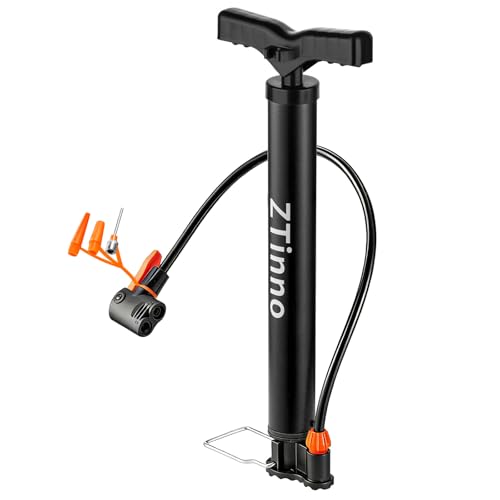
- BrandZTinno
- ModelBP001
- Dimensions5.12 inches x 1.57 inches x 12.6 inches
- Weight0.49 pounds
- ColourBlack
In a nutshell: A lightweight, short pump for occasional use, with the thinnest spec sheet on the list.
At 0.49 pounds and 12.6 inches long, the BP001 is the lightest and shortest manual pump here. Its body is metal with a spray powder coating, and the hose measures 16.54 inches. Dual Presta and Schrader valves are supported, and ball needles come attached.
The trade-off is information. The listing gives no maximum pressure and no gauge, so there is no way to hit a target PSI except by feel, which is a real issue for narrow road tires. A 16.54-inch hose also limits reach compared with the Beto’s 47.2 inches. This is a top-up and ball pump, not a precision tool.
Pros:
- Weight — 0.49 pounds is the lightest of the manual pumps.
- Length — 12.6 inches fits a backpack or car trunk.
- Dual valve support — Presta and Schrader are both listed.
- Metal body — powder coating is claimed to resist fading and impacts.
- No power needed — nothing to charge before a trip.
Cons:
- No pressure rating — maximum PSI is not listed.
- No gauge mentioned — a problem when pressure windows are narrow.
- Short hose — 16.54 inches limits awkward valve positions.
Who Should Buy This
Light trunk storage: casual riders and ball inflation where precision isn’t critical. Skip if: a road bike with tight pressure targets is in the household.
AstroAI L7 Tire Inflator (Digital Gauge, Preset Modes, LED Light)

- BrandAstroAI
- ModelAIRUN L7
- Dimensions2.95 inches x 5.51 inches x 3.15 inches
- Weight0.96 pounds
- ColourOrange
- Warranty2 Year Manufacturer
Quick take: A cordless car-first inflator with a bicycle preset, suited to people who already need a car tire tool.
The AIRUN L7 weighs 0.96 pounds and measures 2.95 x 5.51 x 3.15 inches. It’s rated for 150 PSI with a 4000mAh battery, which the maker says tops up eight car tires from 30 to 36 PSI. Presets cover car, motorcycle, bicycle, ball and custom, in PSI, bar, kPa or kg/cm². Auto-off stops it at the set value.
That auto-off and the digital display are the useful bits for bikes, as manual gauges on cheap compressors can be unreliable at low pressures. Still, a car-tire motor is built for volume, not for narrow tires, and the listing states no accuracy tolerance. The flashlight has three modes (flashlight, SOS, strobe). A 2-year warranty is stated. Battery inflators need charging before a ride, so they’re no trail substitute for a hand pump.
Pros:
- Auto shut-off — stops at a preset value so tires aren’t overfilled.
- Bicycle preset — a dedicated mode alongside car, motorcycle and ball.
- Four units — PSI, bar, kPa and kg/cm² cover any sidewall marking.
- 2-year warranty — longer than any manual pump on this list.
- Pocketable — under a pound with an LED light for night roadside work.
Cons:
- Accuracy untested — no tolerance is given for the digital sensor.
- Valve head details — the listing says nothing about how a Presta valve seats.
- Needs charging — a flat battery makes it dead weight on a ride.
The Real Deal
Car-and-bike use: owners who want one inflator for the car, motorcycle and bikes. Not great if: the only job is high-pressure road tires or trail repairs.
OlarHike Cordless Tire Inflator (Triple-Cell Battery, Memory Presets)

- BrandOlarHike
- ModelTIC3V413
- Dimensions6.5 inches x 2.76 inches x 2.17 inches
- Size / capacity4500 (Standard Capacity)
- Colour1-gray
- Warranty2-Year Warranty
The short version: A cordless inflator whose maker quotes a specific bike-tire figure, which is rare for this category.
Model TIC3V413 measures 6.5 x 2.76 x 2.17 inches and carries three 1500mAh batteries. It is rated for 150 PSI, with a dual LED display and auto shut-off. The maker claims it raises a standard bike tire from 39 to 45 PSI in 16 seconds. That’s an unverified manufacturer figure. It also claims up to 14 car tires per charge.
Four presets cover cars, bikes, motorcycles and sports equipment, and memory recalls the last setting. A 2-year warranty is stated. Weight isn’t listed, which is odd for something meant to ride in a pack. As with the AstroAI, a motor sized for car tires is a poor match for skinny tires needing exact pressures.
Pros:
- Triple battery — three 1500mAh cells for repeated top-offs.
- Memory function — recalls the last used setting between jobs.
- Auto shut-off — stops at the preset pressure.
- Dual LED display — shows current and target PSI together.
- 2-year warranty — a stated term of coverage.
Cons:
- Weight not listed — a gap for anything intended for carrying.
- Bike speed claim unverified — the 16-second figure is the maker’s own.
- Head fit unstated — no detail on Presta compatibility.
Final Thoughts
Quick top-ups: mountain bikers and commuters with wide, lower-pressure tires. Think twice if: a narrow road tire at high pressure is the usual job.
How These Bike Pumps Were Selected
These picks come from comparing published specifications, materials, warranty terms and documented features. The products weren’t tested hands-on. Valve and head compatibility was weighted most heavily, followed by whether the pump type fits the job, then build material and gauge readability. Before ordering, check the valve type on the bike and the maximum pressure printed on the tire sidewall. Confirm that the chosen pump’s head names that valve.
How to Choose a Bike Pump
Valve head and pump type
Presta valves, common on road bikes, need the small lock nut unscrewed before inflating; skipping this, or pumping at an angle, bends stems. An auto head like the Beto’s removes the switching step, while the BV’s reversible head costs a few seconds. Floor pumps suit controlled high-pressure work. Cordless units like the AstroAI L7 suit convenience, but they depend on battery charge and gauge accuracy at low bike pressures.
Gauge accuracy and temperature
Set a tire to 4.00 bar at 20 °C and it reads 3.66 bar (53.1 psi) at 0 °C, since gas pressure rises and falls with absolute temperature. Fill it in the garage before a cold morning ride. It’ll read low out on the road. The 160 PSI rating isn’t a target either: the sidewall maximum is the limit, and the pump’s number is only headroom.
Mountain riders who also want trail know-how can read the MTB ride tips before choosing tire pressures.
Build and maintenance
Steel barrels, like those on the Beto, BV and GOBKO, hold up to repeated strokes better than thin plastic. The seal, o-ring and hose fail first, though. A leaking head also produces false gauge readings. For a tidy kit, affordable bike accessories are worth pairing with a floor pump.
Our Final Recommendation
The Beto Bike Pump is the overall winner, with an auto head for three valve types, a steel barrel and a 2.5-inch gauge. That makes it the most flexible choice. The BV Steel Bike Pump is the best value, with a stated 1-year warranty and a compact steel build. The GOBKO suits households needing adapters. Cordless inflators like the AstroAI and OlarHike are for car-and-bike multi-use, not a replacement for a good floor pump. Chain care matters too, and the bike chain lube comparison covers it.
Frequently Asked Questions
Do I need a pump that handles both Presta and Schrader valves?
Only if the household has both. Road bikes usually carry Presta, while hybrids and kids’ bikes often carry Schrader. The Beto’s auto head covers Presta, Schrader and Dunlop without adjustment, while the BV and ZTinno handle two types. A dual-valve pump also covers a future bike purchase.
Can a car tire inflator like the AstroAI L7 or OlarHike fill a road bike tire?
The listings include bicycle presets, so it’s possible, but both are built around car-tire volume. A narrow road tire has a small air volume, so a motor can overshoot quickly. Auto shut-off helps, though neither listing states a gauge tolerance or Presta head details. A floor pump gives finer control.
Is 160 PSI actually useful on a bike pump?
It’s mostly headroom. Tire sidewalls state a maximum, and exceeding it risks a blowout or rim damage. A pump rated to 160 PSI simply won’t strain at normal road pressures. Treat the rating as a sign of build quality and the sidewall number as the real limit.