Best Shoe Insoles for Sports: The Ones Worth It
Contents
The right sport insert makes a shoe feel like it was built around your foot. Heel stays locked down, arch stays held up, and impact feels softer. To get there, you match the insert’s structure to the sport. That means you don’t just buy the thickest foam. This page compares seven options, from gel-cushioned to rigid carbon, so you can pick the best shoe insoles for sports you play with specs instead of packaging.
As an Amazon Associate we earn from qualifying purchases. This does not affect the price you pay.
CERTAIN CONTENT THAT APPEARS ON THIS SITE COMES FROM AMAZON. THIS CONTENT IS PROVIDED ‘AS IS’ AND IS SUBJECT TO CHANGE OR REMOVAL AT ANY TIME.
Short answer: the EASYFEET Running Athletic Shoe Insoles (JF-146) combine PU gel pads at the heel and forefoot with a 72D TPU arch shell, a flexible-yet-supportive mix that suits the widest range of sports.
| Product | Best for | Core structure | Size listed |
|---|---|---|---|
| EASYFEET Running Athletic Insoles | Best overall | PU gel pads + 72D TPU arch shell | M (Men 9-10.5 / Women 10-11.5) |
| VoMii Memory Foam Insoles | Best value | Memory foam, heel gel pad, U-shaped heel cup | M (Men 6-9 / Women 7-11) |
| EASTRUN All-Purpose Sports Insoles | Choosing arch height | Low / Med / High profiles, dual-density core | XL (Men 8.5-9.5 / Women 10.5-11.5) |
| Dr. Scholl’s Sport Insoles for Men | Drugstore familiarity | Gel cushioning, side-to-side support | Men 8-14, 1 pair |
| LMHCISO Sports Performance Inserts | High arches | Moderate-firmness high arch, structured heel pads | Men 8-10 / Women 9-11 |
| Pefuair Carbon Fiber Athletic Insoles | Stiff court and track feel | Rigid carbon fiber core, mesh top | 6 Men / 7.5 Women (per title) |
| TEGA Carbon Fiber Insole | Turf toe and hallux rigidus | 1.3mm 3K carbon fiber plate | Women’s 9.5 / Men’s 8.5 |
RedSky Adventures is funded by affiliate commission. Our picks come from comparing published specifications and documented features against what matters in the category — no brand pays for a place on this page. If you buy through a link here we may earn a commission at no extra cost to you, and it pays for the research behind the next guide. Full disclosure.
EASYFEET Running Athletic Shoe Insoles (JF-146, Gel Pads and TPU Arch)

EASTRUN All-Purpose Sports Arch Support Inserts (Three Arch Profiles)

EASYFEET Running Athletic Shoe Insoles (JF-146, Gel Pads and TPU Arch)
- BrandEASYFEET
- ModelJF-146
- Dimensions10.43 inches x 3.75 inches x 0.83 inches
- Weight0.4 pounds
- Size / capacityM (Men 9-10.5/Women 10-11.5)
- ColourBlack
Quick take: A balanced, cushioned insert for runners, court players and hikers who want impact protection without losing foot flexibility.
The EASYFEET uses PU gel pads under the heel and ball of the foot with a PU foam body. It also has a 72D thermoplastic polyurethane arch shell. The listing calls the arch medium-low. That matters because it supports without forcing a high arch into a flat foot. The Orxinlite top layer is claimed to help air move through. Listed dimensions are 10.43 x 3.75 x 0.83 inches at 0.4 pounds, in size M. In size M, that’s Men 9-10.5 / Women 10-11.5.
The manufacturer claims up to 62% shock absorption and 47% energy return. Those are seller figures, unverified, and the listing gives no test method. Still, the structure is sensible. Gel goes where impact lands, while a springy shell goes where the foot loads. Compared with the carbon options below, this one bends more. That’s the point for running and basketball, but it can be the wrong answer for a painful big toe joint. The 0.83-inch dimension also suggests a thicker heel zone. So low-volume shoes may feel tight.
Pros:
- Targeted gel placement — PU gel sits at the heel and forefoot, the two highest-impact zones.
- 72D TPU arch shell — firm enough to hold the arch, with a springy return the listing quantifies at up to 47%.
- Medium-low arch — fits neutral and lower arches without pushing up hard.
- Broad sport range — the title names walking, hiking, hockey, tennis and basketball.
- Guide lines for trimming — cut lines across the toe let the old insole serve as the template.
Cons:
- Not for high arches — a medium-low profile may leave a high arch under-supported.
- Thick for slim shoes — 0.83 inches in the listed dimensions can crowd cleats or low-volume trainers.
- Unverified numbers — the 62% and 47% claims have no stated test standard.
Who Should Buy This
Best overall: multi-sport players and runners wanting cushioning plus moderate support. Skip if: a high arch or a stiff-plate condition like turf toe is the problem.
VoMii Memory Foam Insoles (Heel Gel Pad, Kids to Adults)
- BrandVoMii
- ModelBD13272
- Size / capacityM(Men 6-9/ Women 7-11)
- ColourBlue
The short version: A soft, budget-friendly insert for anyone who wants cushioning and a deep heel cradle.
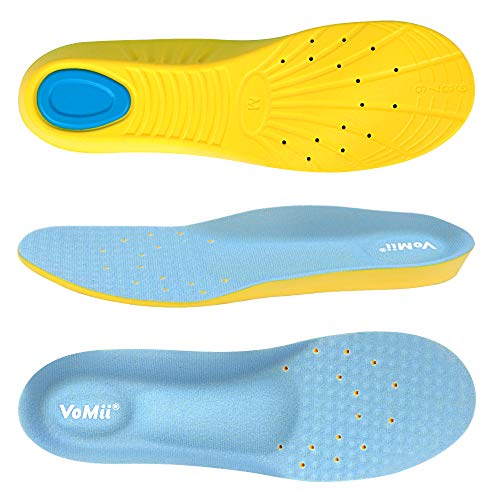
VoMii pairs high-elastic memory foam with a gel pad under the heel. It also includes a U-shaped heel cup. The top uses a velvet fabric. The listed heel thickness is 0.9 inch. Size M covers Men 6-9 / Women 7-11. The listing offers three sizes with a cut line on the back. Weight and overall dimensions aren’t listed.
Memory foam gives the softest feel here. That’s why resilience is the real question. The material is viscoelastic polyurethane, and it compresses flat. When that happens, it loses its benefit quickly, and the listing doesn’t provide a durability figure. For that reason, it’s usually a better fit for walking, casual court use, and standing. Hard, repeated impact is where it can fall short. The listing does include a one-year guarantee. That helps as a backstop. The wide size range, Men 6-9 against Women 7-11, can also mean a men’s 9 sits at the very top edge.
Pros:
- Deep heel cup — the U-shaped structure helps keep the heel from sliding.
- Heel gel pad — adds impact absorption where the foot lands.
- Soft feel — memory foam suits anyone shopping for soft insoles for sports and daily wear.
- One-year guarantee — stated in the listing copy.
- Kids-to-adult sizing — the title names men, women and kids.
Cons:
- Foam may flatten — memory foam is the type most prone to compressing, and no lifespan is stated.
- Thick heel — 0.9 inch can lift the heel out of snug shoes.
- Thin specs — weight and dimensions are not listed.
Final Thoughts
Ideal for: budget buyers wanting soft, forgiving cushioning for walking and light sport. Pass on this if: hard, repetitive impact or serious arch correction is the goal.
EASTRUN All-Purpose Sports Arch Support Inserts (Three Arch Profiles)
- BrandEASTRUN
- Dimensions12.0 inches x 4.0 inches x 1.3 inches
- Size / capacityXL(Men 8.5-9.5 | Women 10.5-11.5)
- ColourGreen
Here’s the deal: The only insert here that lets the buyer choose arch height, which is the spec that most often decides fit.
EASTRUN offers Low, Medium and High arch profiles. It also provides five trimmable sizes. The core is dual-density. It uses high-elastic forefoot foam, a deep molded heel cup, and a slim textured fabric top with ventilation holes. Listed dimensions are 12.0 x 4.0 x 1.3 inches in size XL. In that size, that’s Men 8.5-9.5 / Women 10.5-11.5. Weight isn’t listed.
Choosing arch height is the right idea. A profile that’s too tall can cause arch or heel pain. A profile that’s too low can do nothing. The wet footprint test uses a wet foot on paper. It shows low, neutral, or high in seconds. The listing also says the design is ultra-thin. Yet the 1.3-inch dimension probably reflects the arch height of the uncut piece, so checking shoe volume helps. The plantar fasciitis wording in the title is marketing. Persistent heel pain deserves a podiatrist, not just an insert.
Pros:
- Three arch profiles — Low, Med or High, matched to the wet footprint result.
- Five trim sizes — finer fit than most three-size ranges.
- Dual-density core — the listing says it spreads load across 8 pressure zones.
- Ventilated top — holes and textured fabric for airflow.
- Deep heel cup — stabilises the heel in running and ball sports.
Cons:
- Wrong pick means pain — a mismatched arch profile can cause new soreness.
- Confusing sizing — the XL label spans Men 8.5-9.5, so read the chart carefully.
- Fit claims are broad — the copy lists sneakers through work boots, but no insert suits all of them.
Why It Earns a Spot
Perfect for: buyers who know their arch type and want to match it. Not great if: the arch type is unknown, since the wrong profile is easy to order.
Dr. Scholl’s Sport Insoles for Men (Gel Cushioning, Sizes 8-14)

- BrandDr. Scholl's
- Model011017570103
- Dimensions4.79 inches x 2.09 inches x 14.09 inches
- Weight0.37 pounds
- Size / capacity1 Pair (Pack of 1)
- ColourBlue
In a nutshell: A familiar drugstore-brand gel insert aimed at men playing mixed sports and fitness classes.
Dr. Scholl’s markets these as gel insoles with shock absorption and flexible side-to-side support. The listing covers men’s sizes 8-14 as one pair, at 0.37 pounds. It lists dimensions as 4.79 x 2.09 x 14.09 inches, which looks like packaging. So it says little about insole thickness.
The listing is vague on structure. There’s no arch height, no foam type, and no thickness. The lateral-support claim matters for basketball or tennis, since cutting moves load the sides of the foot. Sizing ranges are wide, so trimming accuracy decides the fit. It’s also men-only, which is a limit versus the unisex options. Those wanting a fuller comparison of cushioned and supportive formats can read our shortlist of insoles for every kind of shoe.
Pros:
- Gel cushioning — the stated shock-absorbing approach.
- Lateral support — flexible side-to-side stability for multi-direction sports.
- Wide men’s range — sizes 8-14 cover bigger feet.
- Light — 0.37 pounds for the pair.
- Multi-sport positioning — fitness classes are named alongside other activities.
Cons:
- Sparse detail — no arch profile, material or thickness is listed.
- Men only — women need a different option.
- Odd dimensions — the listed 14.09-inch figure looks like packaging, not the insole.
The Real Deal
Great match for: men wanting a known brand for general gym and court use. Think twice if: arch height or exact thickness matters to the fit.
LMHCISO Sports Performance Inserts (Moderate-Firmness High Arch)

- BrandLMHCISO
- ModelLMHSI-0312-BR-41-43
- Size / capacityMen 8 – 10 | Women 9 – 11
- ColourRed
Why it earns a spot: A high-arch-oriented insert for people who find flat liners do nothing.
LMHCISO describes adaptive high arch support with moderate firmness that molds to the foot on stepping. It also includes structured heel pads and breathable layers. Size is listed as Men 8-10 / Women 9-11 in red. Dimensions, weight and warranty aren’t listed.
A high arch needs support to sit higher. That’s the reverse of the EASYFEET’s medium-low profile. The seller itself warns to make sure the shoe has space for high-arch inserts, and says a brief adjustment period is normal. Taller shoes or removable factory liners help, but tight cleats won’t. Soreness that lingers beyond adjustment usually signals the arch is too high for the foot. Overpronators should also read our guide to shoe inserts for overpronation.
Pros:
- High arch focus — fills a gap most medium-profile inserts leave.
- Moldable feel — moderate firmness that conforms on stepping.
- Heel pads — structured to absorb impact.
- Breathable layers — aimed at keeping feet dry.
- Cross-training scope — basketball, hiking and gym work are named.
Cons:
- Needs shoe volume — the seller itself says to check space.
- Break-in period — the listing admits an adjustment time.
- Missing specs — no dimensions, weight or thickness.
Who Should Buy This
Ideal for: high-arched athletes in roomy shoes. Pass on this if: arches are low or neutral, or shoes are snug.
Pefuair Carbon Fiber Athletic Insoles (Rigid Core, Mesh Top)

- BrandPefuair
- ModelX2-IITI-MZ1C
- ColourPurple
Quick take: A stiff, plate-style insert for adults who want a firm, springy platform in running and basketball shoes.
Pefuair combines a high-rigidity carbon fiber core with high-rebound cushioning and a breathable mesh top. The title lists size 6 Men / 7.5 Women, but weight and dimensions aren’t listed. The copy mentions a zero-drop design and a satisfaction guarantee.
Stiffness is the trade-off. A carbon plate resists forefoot bending, which can help power transfer for some players. For others, it feels harsh when cushioning is the goal. The listing doesn’t state plate length or thickness. It also gives no stated sizing range beyond the title, so exact fit stays uncertain. For regular running mileage, compare it with the flexible picks in our running insole comparison.
Pros:
- Carbon fiber core — rigid by design for stiff forefoot feel.
- High-rebound layer — pairs the plate with cushioning.
- Mesh top — wicks sweat, per the listing.
- Court and road scope — running and basketball are named.
- Adult-specific — designed for adult men and women.
Cons:
- Stiff — can feel harsh in cushioning-led sports.
- Vague specs — no plate thickness, length or dimensions.
- Small size shown — the title lists 6 Men / 7.5 Women, so confirm the available range.
Final Thoughts
Best for: players wanting a firm, springy plate feel. Skip if: soft cushioning is the priority or a medical condition needs a defined plate.
TEGA Carbon Fiber Insole (1.3mm Plate for Turf Toe)
- BrandTEGA
- Size / capacityWomen's 9.5 – Men's 8.5
- ColourBlack
The short version: A purpose-built rigid plate for limiting big toe motion, not a general comfort insert.
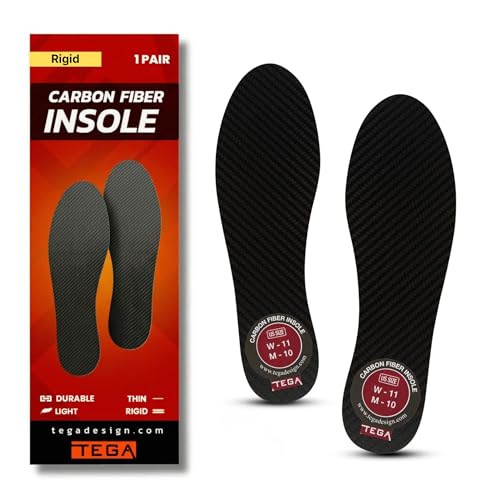
TEGA uses 1.3mm 3K carbon fiber, sold as a pair, and it lists a size as Women’s 9.5 / Men’s 8.5. The title names turf toe, foot fractures, hallux rigidus and limitus. Sizing works by measuring the original insole’s length against the chart. So the measurement drives fit.
This is the one product here that targets limited-motion problems. Rigid carbon suits turf toe and hallux rigidus because it stops the forefoot bending that causes the pain. It offers no cushioning, which makes it a poor fit for impact sports on its own. The title calls it an alternative to a post-op shoe, but a fracture or surgical foot needs a doctor’s approval first. Trail runners can pair our trail running shoe reviews with a plate like this only if the shoe has room.
Pros:
- 1.3mm thickness — thin enough to fit many shoes.
- 3K carbon fiber — the listing says 100% genuine.
- Sold as a pair — both feet covered.
- Condition-specific — turf toe, hallux rigidus and Morton’s toe are named.
- Unisex sizing — measured against the original insole’s length.
Cons:
- No cushioning — harsh for anyone wanting comfort.
- Medical limits — fractures and post-op feet need professional sign-off.
- Size mismatch risk — a plate cannot be trimmed like foam.
Our Take
Perfect for: athletes with turf toe or hallux rigidus who need less forefoot flex. Not great if: general comfort is the goal.
How We Chose These Sport Insoles
These picks come from comparing published specifications, materials, and documented features, plus patterns buyers often mention like heel slip and break-in soreness. The products weren’t tested hands-on. Weight went to structure matching: cushioning type, arch height, plate rigidity, thickness, and trim-to-fit accuracy. Before ordering, remove the shoe’s original insole. Measure it and check the arch type with a wet footprint test. Seller claims like shock absorption percentages remain unverified.
Finding the Best Shoe Insoles for Sports
Match structure to the sport
Cushioned gel or memory foam suits running and court sports. A firmer arch contour suits plantar fasciitis-type heel pain. Insoles aren’t medical care substitutes. A rigid carbon plate suits turf toe and hallux rigidus, and it can feel harsh otherwise. Persistent pain counts. If a stress fracture is suspected, a podiatrist is needed.
Understand what the sole is made of
Every shoe has a sole that touches the ground. Soles can be built in layers from an insole, midsole, and outsole. An aftermarket insert replaces only the top layer. That stacks height over a thick factory liner, and heel slip follows. Take the old insole out first.
Check sole materials and standards
Most modern soles use natural rubber, polyurethane, or PVC compounds. Manufacturers must meet applicable quality and safety standards. For footwear and materials standards, ASTM International is the relevant body. None of the listings here cite it. So buyers shouldn’t assume compliance.
Trim carefully and break in gradually
Use the original insole as a template and cut slowly. Cuts can’t be undone. Expect a short adjustment period, and replace foam once it stays flat. For heel-specific issues, see the heel support insoles guide. For background on categories, read about how sport insoles work.
Our Final Recommendation
The EASYFEET Running Athletic Insoles are the overall winner: gel at the impact points, a 72D TPU shell, and room for most sports. The VoMii Memory Foam Insoles deliver the best value for soft, budget-friendly cushioning. The EASTRUN is the pick when arch height needs choosing. The TEGA stays the specialist for turf toe or hallux rigidus. Match the structure to the foot first, then the sport.
Frequently Asked Questions
Are soft insoles good for sports?
Soft insoles, like the VoMii memory foam, absorb impact and feel comfortable. Foam that compresses flat loses its benefit. They suit walking and light court use. For running or cutting sports, a gel-and-shell design like the EASYFEET holds shape better.
Do I need to remove the original insole?
Yes. Stacking a new insert over the factory insole raises the foot. That causes heel slip and a cramped toe box. Pull the original out. Use it as a trimming template. Then check the new insole fits flat before wearing it.
Are carbon fiber insoles too stiff for everyday use?
Often, yes. TEGA’s rigid plate limits forefoot bending, and that helps turf toe and hallux rigidus. Without cushioning, it can still feel harsh. Anyone with a fracture or post-surgical foot should ask a doctor before relying on one.