The MNBN Train: Sending a Motorcycle by Rail
Contents
You’ve just spent an entire morning disassembling your bike’s mirrors and strapping down the handlebars, only to hear the station master say, “Consignment booking closed an hour ago.” That hollow, sinking feeling is exactly what this guide exists to help riders avoid. The moments that make the best stories are almost always the ones where something went wrong, and the difference between a story and a stranded morning is what was arranged beforehand. Preparation doesn’t prevent adventure — it just gives you better options when it shows up. The MNBN train service is one of the most cost-effective ways to move a two-wheeler across long distances, but only if you treat it like a logistics operation, not a casual railway errand.
Key Takeaways
- Booking your bike on the MNBN train is not a last-minute booking — 3 days of advance preparation is the bare minimum for a trouble-free consignment.
- Military-precision documentation (photographs, packing lists, insurance copies) can cut claim settlement time by up to 60% if damage occurs.
- Understanding the train’s specific parcel van timings and intermediate halts gives you a bail-out point network for recovering your bike mid-journey if plans shift.
What Exactly Is the MNBN Train?
Before plotting a single coordinate, it helps to define the service properly. The MNBN train is an Indian Railways long-distance express service connecting Mumbai and New Delhi — a critical artery for two-wheeler transport. It’s not a luxury passenger train, nor a dedicated freight corridor; it’s a scheduled express run that includes dedicated parcel and luggage vans where motorcycles are accepted for carriage. While European rail travel might conjure images of gondolas and vineyard views (we have a complete guide to Italy by train if that’s more your style), the MNBN railway route is purpose-built for utility — moving people and their gear over 1,400 kilometers in roughly 17 to 19 hours, depending on the season and track maintenance windows.
The train operates under a specific schedule: departure from Bandra Terminus in Mumbai at 16:35 hours, with arrival at Hazrat Nizamuddin in Delhi the following morning at 09:30 hours. That’s the advertised timeline, but it’s wise to overlay a 30-minute arrival buffer in your planning. Parcel vans are typically positioned at the train’s head-end, and unloading can take an additional 45 to 90 minutes after the train berthed — a fact that many first-time shippers overlook, leading them to stand on the platform fuming because “the bike hasn’t arrived.”
The Mission Brief: Pre-Departure Preparation for MNBN Train Transport
Approach every bike shipment as a mission brief. That means no detail is too small, and every assumption is challenged. When moving a motorcycle via the MNBN train, the pre-departure checklist runs across five critical phases: documentation, mechanical prep, packing, booking, and contingency mapping. Skip one, and you’re gambling with an asset worth several lakh rupees.
Phase 1: Documentation — The Paper Shield
Railways run on paperwork, and missing a single signature can bounce your consignment right back to the parking lot. For the MNBN train, you’ll need:
- Original RC book (smart card) with at least one clear photocopy.
- Valid insurance certificate — do not assume “it’s on my phone” will suffice. Station clerks want physical copies, often in triplicate.
- Government-issued photo ID (Aadhaar, passport, or driver’s license) matching the RC owner’s name.
- Parcel booking form available at the station’s parcel office. Fill it out with the bike’s correct make, model, and chassis-embedded engine number — not the number on the registration sticker, which can fade.
- A self-declaration letter stating the fuel tank has been drained, battery terminals disconnected, and no dangerous goods are packed with the bike. Having this notarized is wise, though not every station demands it. For a few extra rupees, it adds a layer of formal accountability.
Phase 2: Mechanical Prep — Draining, Disconnecting, and Safeguarding
Indian Railways mandates that all flammable liquids be removed from the vehicle. That means completely draining the fuel tank, the carburetor float bowl (if applicable), and even the reserve fuel line. A 1-litre fuel-safe siphon and a clear plastic container are necessary to capture every drop — riders who push a dripping bike onto the parcel van often see the entire consignment rejected on the spot. Temperature on the platform during summer months can exceed 42°C, so even a residual fuel film can vaporize and trigger safety alarms.
Disconnect the battery negative terminal and tape it off. Vibrations during the 17-hour journey can jostle connections loose, and a short circuit in a confined parcel van is a fire hazard. Some riders go further and remove the battery entirely, carrying it as separate luggage. That’s allowed, but mark it clearly as “dry battery — no acid spill risk.” Also disconnect the spark plug cap — not for safety, but to ensure no accidental ignition attempts happen during handling.
Phase 3: Packing and Wrapping — The Cocoon Principle
Indian Railways parcel vans are not climate-controlled and your bike will be loaded alongside crates, luggage, and sometimes even furniture. Wrap every bike as if it’s heading into a sandstorm. The process:
- Fold in the rear-view mirrors and secure them with bubble wrap and masking tape — never duct tape, which can peel paint.
- Wrap all painted surfaces with at least two layers of industrial stretch wrap. Pay extra attention to the tank, side panels, and headlamp cowl.
- Pad the exhaust pipe opening with a clean cloth and tape it shut to prevent debris from entering.
- Secure loose items: number plate, saree guard, and any removable load carriers must be either removed and packed separately or bolted down with thread-locking compound.
- Label the bike with a waterproof tag showing the PRR (Parcel Receipt Report) number, destination station code, and your phone number. Use a laminated tag and zip-tie it to the handlebar riser.
Phase 4: Booking — The Tactical Window
The MNBN train’s parcel booking counter opens 3 hours before scheduled departure and closes 90 minutes prior. That’s a razor-thin 90-minute window. Arrive at the parcel office 4 hours early — not because waiting is fun, but because there’s always a queue, and the “system is down” excuse appears with uncanny frequency. Early birds get the first loading slot, meaning their bike goes into the van first and is less likely to be wedged under heavier cargo.
Booking costs depend on the bike’s weight and declared value. For a typical 150–180 kg motorcycle, expect to pay between ₹2,200 and ₹3,800 as of 2026. Pay for the declared value protection — it’s a percentage of the insured value and it’s the only way to guarantee compensation if the bike is damaged or lost. Keep the PRR slip like your passport. Laminate a photocopy and keep the original inside a waterproof document pouch.
Phase 5: Contingency Mapping — Bail-Out Points
Even the best plan encounters friction. The MNBN train makes 10 to 14 intermediate halts, depending on the weekly schedule. Map every halt that has a parcel handling office. Key bail-out points en route include Vadodara, Ratlam, Kota, and Mathura. If you receive intelligence en route — say, a family emergency or a weather event at destination — you can request that your bike be offloaded at one of these stations. This requires a formal application at the originating station and a fee, but it’s far cheaper than letting the bike reach Delhi and then shipping it back. Keep the station code list and the parcel office phone numbers of these halts on a laminated card tucked into your riding jacket.
Boots on the Ground: Day-of-Transport Execution
Mission day. The MNBN train won’t wait, and neither should you. The on-ground protocol should be drilled to the minute.
Loading Supervision — The Human Element
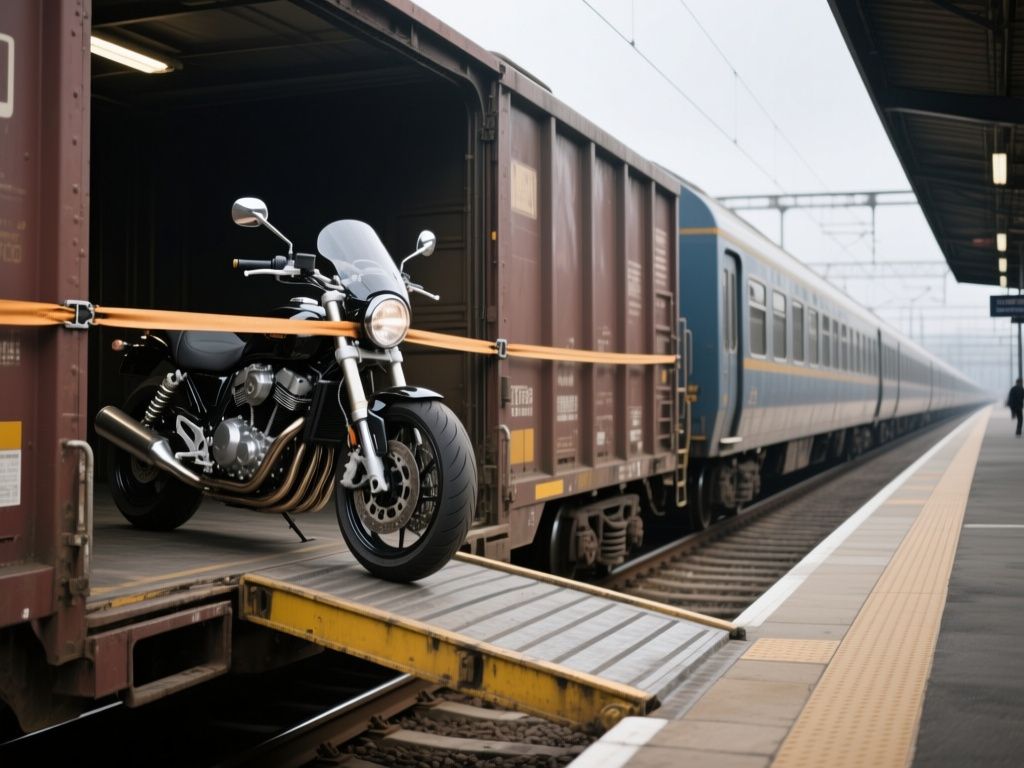
You are allowed to accompany your bike to the parcel van, provided you have a platform ticket and cooperative loading staff. It is advisable to offer a ₹100–200 tip to the loaders — not a bribe, but an acknowledgment that they’ll handle the bike with more care for a cup of tea. Watch the bike being wheeled in, check that it’s strapped to the side rails with at least two nylon ratchet straps (carrying your own, rated for 500 kg each, is recommended), and verify that no heavy luggage is stacked against it. Taking a video of the entire loading process, narrating the time, date, and PRR number, can serve as useful documentation in case of damage claims.
Post-Loading Surveillance
Don’t disappear into the waiting room yet. Stay on the platform until the train departs, watching the parcel van door. Confirm that the door is sealed and that no additional cargo is forced in at the last minute — a common practice that can shift your bike out of its secured position. If you’re traveling on the same train as a passenger, vigilance can continue at every station halt. If not, track the MNBN train’s live running status via the NTES app or the Indian Railways website. Set up SMS alerts for station arrivals and departures to know exactly when the bike is on the move.
When the Plan Goes Sideways: Damage, Delays, and Recoveries
No matter how crisp the mission brief, variables will conspire against you. A late departure due to fog, a parcel van overloaded at an intermediate station, or a careless loader can all introduce chaos. The best approach to disruptions is to have the countermeasures memorized in advance.
Scenario 1: Bike Arrives Damaged
Upon arrival at the destination station, do not untie the bike until you have thoroughly inspected it. Take 20 full-resolution photos from every angle, including close-ups of any scratch, dent, or broken part. Immediately notify the station parcel supervisor and request an official Damage Certificate on railway letterhead. Without that certificate, your insurance claim is dead in the water. File a claim with the railway’s claims tribunal within 6 months, attaching the certificate, PRR, and your original loading video.
Scenario 2: Consignment Goes Missing or Is Misdirected
This is rare on a direct train like the MNBN service, but it can happen if the bike is offloaded at a halt due to a suspected fuel smell or paperwork discrepancy. The first move is to call the parcel office of the originating station and quote your PRR number. They can trace the consignment via the railway’s internal teleprinter system. If you’re within 100 km of one of the bail-out points listed earlier, you can authorize a friend or a local agent to collect the bike on your behalf with a signed letter and a copy of your ID. Keep a digital template of this authorization letter saved in cloud storage, ready to be emailed on a moment’s notice.
Scenario 3: Payment and Release Hassles
Occasionally, the destination parcel office will demand additional “handling charges” or unpaid demurrage if you’re late to collect. Demurrage kicks in 6 hours after the train’s scheduled arrival and is charged at roughly ₹50 per hour. Clear your schedule to be at the station within 3 hours of arrival — and if you can’t, assign a local friend to collect the bike. Never let a bike sit uncollected overnight; not only do charges accumulate, but the risk of vandalism or theft increases sharply in unattended railway yards.
Long-Term Strategies: Building Your Railway Transport SOP
The whole process can be distilled into a Standard Operating Procedure that any rider can follow. Here’s the condensed playbook:
- Create a digital vault: Store scanned copies of all documents (RC, insurance, ID, PRR) in a folder synced across your phone and laptop. Name each file with the consignment date and train number.
- Pre-pack a “consignment kit”: A small duffel bag containing ratchet straps, stretch wrap, masking tape, a waterproof tag, a siphon, and a laminated checklist of steps. This kit should be kept ready in the garage for quick access.
- Build station intelligence: Visit the parcel office a week before your planned booking to observe the process, ask about their specific rules (some stations demand a non-judicial stamp paper, some don’t), and note the names of the supervisor and senior loading staff.
- Use technology: Apps like NTES and Where is my Train give real-time tracking. WhatsApp status updates can inform a contact at the destination station of the bike’s progress — simple, free, and effective.
- Maintain a transport log: After every shipment, record the date, train number, cost, damage notes, and overall satisfaction. Over time, patterns emerge — you’ll learn which stations have the most courteous staff and which parcel vans are better maintained. That data is gold for future missions.
And if you’re ever delayed and stuck at the station with hours to kill, a model train set can be a surprisingly good way to keep spirits up — especially if you’re traveling with family. While not a substitute for the real thing, our roundup of the best electric train set for 2026 has a few portable options that can turn a dreary waiting room into a miniature railway workshop. It’s a handy distraction while you monitor that NTES tracker.
Frequently Asked Questions
Is the MNBN train the only option for shipping a motorcycle between Mumbai and Delhi?
No, but it’s the most direct passenger-express option with a dedicated parcel van. Other trains like the Paschim Express or August Kranti Rajdhani also carry parcels, but the MNBN service has a simpler booking process and fewer intermediate handling points, which reduces damage risk. You can also use freight-only parcel specials, though their schedules are less predictable.
Can I travel on the same MNBN train while my bike is in the parcel van?
Absolutely. Booking a passenger ticket on the same train gives you the advantage of monitoring your bike at every halt. However, passenger accommodation is separate from the parcel van; you cannot physically access your bike mid-journey. Keep your PRR slip handy — the ticket examiner may ask to verify that the consignment matches your ticket’s origin and destination.
What if my motorcycle is heavily modified — will the railway accept it?
Acceptance depends on whether the modifications affect the bike’s dimensions, fuel system, or structural integrity. Aftermarket exhausts, crash guards, and top boxes are usually fine if declared. However, nitrous oxide systems or auxiliary fuel cells are outright banned. Measure your bike’s overall length (including any extended swingarm) and width (crash bars) to ensure it fits through the parcel van door, which is typically 120 cm wide and 180 cm high.
How does weather affect the MNBN train’s parcel service?
Fog in the northern plains during December and January can delay the train by 2 to 6 hours, which in turn extends the bike’s exposure to cold and moisture. Apply a corrosion inhibitor spray on metal parts before winter shipments, and place silica gel packets inside the exhaust and air intake to prevent condensation buildup during prolonged halts in foggy yards.
Are there any alternative railways if the MNBN train’s parcel quota is full?
Yes. The Mumbai Central–New Delhi Rajdhani and the Bandra–Nizamuddin Garib Rath both offer parcel services, though booking procedures differ. Additionally, if you’re open to a slightly longer transit time, shipping via rail to a nearby intermediate city (like Kota) and then riding the remaining distance can be a smart workaround. For a completely different railway experience, our best Lionel train sets of 2026 roundup shows how enthusiasts scale down the passion to tabletop size, but for real two-wheeler transport, sticking with the scheduled passenger trains is your most reliable bet.