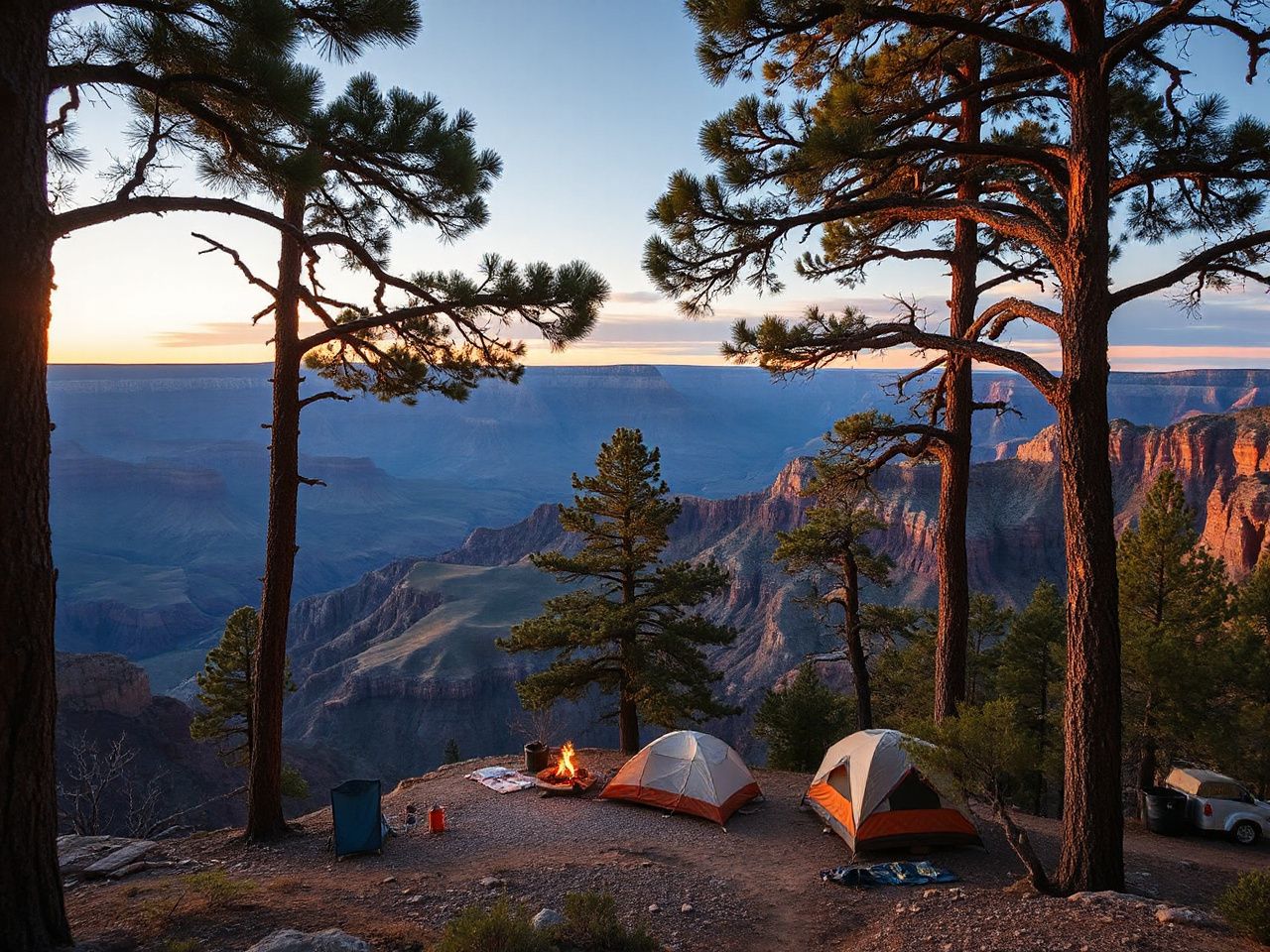
The Best Places to Camp in Grand Canyon
Contents
If you are deciding where to camp at Grand Canyon National Park right now, the honest answer changed in the last week of August 2026. In a news release dated August 30, 2026, the National Park Service reported that a flash flood in Bright Angel Canyon the previous afternoon had closed Phantom Ranch, Bright Angel Campground and the entire North Kaibab Trail from the trailhead to Phantom Ranch, all until further notice, along with the Black Bridge and Silver Bridge over the Colorado River. Sixty-two people were evacuated from Phantom Ranch and the lower North Kaibab that morning, with no injuries reported, and nearly all the footbridges over Bright Angel Creek were destroyed.
That removes the answer most guides give to this question. What remains is the developed camping: three campgrounds on the South Rim, one on the North Rim, and two national forest campgrounds just outside the park boundary. Conditions are changing week to week, so check the park’s alerts page and Recreation.gov before you commit to a drive.
Key takeaways
- Bright Angel Campground, Phantom Ranch and the whole North Kaibab Trail are closed until further notice after the August 29, 2026 flood.
- Standard campsites at Mather, Desert View and North Rim campgrounds are $30 per night; group sites are $50, a rate set by the park on May 1, 2025.
- Mather Campground takes reservations six months out on Recreation.gov and keeps roughly 20 first-come sites a day in peak season, which typically sell out by 11:00 a.m.
- The North Rim reopened May 15, 2026 after the Dragon Bravo Fire, but the park states potable water is not available anywhere on the North Rim for the 2026 season, and there is no lodging.
- Overnight backcountry permits cost $10 per application plus $15 per person per night below the rim, through an Early Access Lottery four months ahead.
Where things stand at the end of the 2026 season
Two separate events shape your options. The first is the 2025 Dragon Bravo Fire, which destroyed the historic Grand Canyon Lodge and dozens of other structures on the North Rim. The park reopened the North Rim on May 15, 2026, with all paved roadways back in service. Its status page states plainly that overnight lodging is not available on the North Rim this season, and that potable water is not available anywhere on the rim. That changes what you pack.
The second is the August 29 flood, which hit drainages including ground burned by that same fire. Recreation.gov’s permit page had already noted that rim-to-rim hiking would not be possible from October 15, 2026 through roughly February 2027 because of North Kaibab work; the flood moved that closure forward and made it open-ended. Treat any inner-canyon itinerary as unconfirmed until the park says otherwise.
The South Rim campgrounds
Mather Campground in Grand Canyon Village is the default and the largest campground in the National Park Service system, with 327 sites including seven group sites and two equine sites. It is open all year with no hookups, though Camper Services has a dump station, water fill, pay showers and laundry. The park’s bulletin sets quiet hours at 10 p.m. to 6 a.m., generator hours at 7 to 9 a.m. and 6 to 8 p.m. with generators banned in Pine Loop, and a 30-foot vehicle limit. Standard sites take six people, three tents and two vehicles.
Desert View Campground sits 23 miles east of Grand Canyon Village, near the Watchtower, and is the quieter option if you would rather not sleep next to the village shuttle system. The park lists it as open April 11 through October 18, 2026, reservations required, no hookups. The distance is the point and the catch: little is nearby in the way of services, so arrive stocked.
Trailer Village is the only campground inside the park with full hookups, and it is open all year. It is run by the park’s lodging concessioner rather than Recreation.gov, so it sits on a separate booking system with a longer advance window — and being the only in-park sewer and electric on the South Rim, it books far ahead in summer.
| Campground | Season (2026) | Hookups | Standard fee | Booked through |
|---|---|---|---|---|
| Mather (South Rim) | Open all year | None | $30 per night | Recreation.gov, 6 months ahead |
| Desert View (South Rim) | Apr 11 – Oct 18 | None | $30 per night | Recreation.gov, reservations required |
| Trailer Village (South Rim) | Open all year | Full hookups | Concessioner rate | Park lodging concessioner |
| North Rim Campground | Jun 1 – Oct 15 | None | $30 per night | Recreation.gov |
| Tusayan – Montane (Kaibab NF) | May 1 – Oct 31 | None | Forest Service rate | Recreation.gov, reservations advised |
| DeMotte (Kaibab NF) | May 15 – Oct 31 | None | Forest Service rate | Recreation.gov |
How the reservation windows actually work
Mather takes reservations on Recreation.gov six months in advance, and the listing states that advance reservations are strongly recommended during the peak season of March 1 through November 30. During that peak window the campground also holds roughly 20 first-come, first-served sites for purchase in person, day-of, one night at a time, and Recreation.gov warns these typically sell out by 11:00 a.m. If you are gambling on a walk-up, you are competing at breakfast, not at dinner.
The rest of the mechanics come from the park’s Mather bulletin. Every visitor checks in at the kiosk on arrival; check-in begins at noon, check-out is 11 a.m., and you can renew after 9 a.m. if sites are free. Stays are limited to seven consecutive days and 30 days per calendar year, sites are assigned, and you should not move without a ranger’s approval.
Pro tip
Set a calendar reminder for the six-month mark rather than trying to remember it. Recreation.gov releases Mather inventory on a rolling daily basis, so the site you want for a July Saturday goes live in January, and popular summer dates move quickly. If you miss the window, check again around the 30-day mark, when refundable cancellations tend to shake loose.
Camping the North Rim in 2026
North Rim Campground reopened June 1, 2026 and runs through October 15. It has standard nonelectric sites, tent-only sites and a few group areas; check loop-by-loop availability on Recreation.gov, because the 2026 closures changed what is bookable. The caveats are substantial: no water, no RV hookups, no dump station, showers and laundry closed for the season, and all wood and charcoal fires prohibited under fire restrictions. Gray and black water dumping is not permitted either, so you pack out liquids.
Services on the rim are thin by design this year. The North Rim General Store runs May 15 to October 15, 9 a.m. to 4 p.m. daily, and the gas station is 24 hours, pay-at-the-pump only. Cape Royal, Cliff Springs, Cape Final, Roosevelt Point and Point Imperial are open; Bright Angel Point, Widforss, Transept and Uncle Jim are closed.
Common mistake
Assuming you can refill water at the North Rim. The park’s reopening announcement states that potable water will not be available anywhere on the North Rim during the 2026 season, and that visitors must bring all the drinking water they need for their visit and hikes. Water can be purchased at the General Store during its limited daily hours, but that is a retail counter, not a spigot. Arrive with your full supply.
Just outside the park: the Kaibab National Forest
When the park campgrounds are full, the surrounding national forest is the realistic fallback. Tusayan – Montane Campground sits four miles south of the park entrance at 6,600 feet, with 142 single sites, 18 double sites and two group sites, and no utility hookups. The Kaibab National Forest lists it as open May 1 through October 31, with the reservable window running May 15 to September 30; reservations are advised inside that window. Water spigots are centralized, and filling RV holding tanks is not permitted because supply is limited.
DeMotte Campground is the North Rim equivalent, seven miles north of the park boundary on the Kaibab Plateau, with 38 single-family campsites with tables and grills, no hookups, and limited drinking water. The Kaibab National Forest lists it as open May 15 through October 31, reservable through September 17 and first-come, first-served after that. It is a high-elevation site, so plan for cold nights even in midsummer. The forest also permits free dispersed camping outside developed campgrounds; check the current motor vehicle use map and any active fire restrictions with the North Kaibab or Tusayan ranger district before you rely on it.
What an overnight backcountry permit requires
Every overnight stay below the rim outside a developed campground needs a backcountry permit, obtained through Recreation.gov. The fee structure is $10 per permit or lottery application, which is non-refundable, plus a nightly charge of $15 per person for below-rim areas and $4 per person for above-rim areas. Those nightly charges are refundable until 30 days before your start date.
The park runs an Early Access Lottery for the earliest requests. Applications open on the 16th of the month and close at 5 p.m. MST on the 1st, four months before your start date; winners are notified the next day and get booking timeslots four days after it closes, with general access following about two weeks later. If you miss all of that, Recreation.gov still takes reservations as late as five days before the hike, and cancellations do appear.
Bright Angel Campground to the North Rim is 14.5 miles one way with about 6,000 feet of elevation change, which is why the park directs backpackers to break it at Cottonwood Campground. None of that is bookable while the North Kaibab closure stands.
What it costs to get in
Entrance is separate from camping. A vehicle pass is $35 and covers one private vehicle up to a 15-person van; a motorcycle pass is $30 and admits two motorcycles with four passengers; an individual pass for cyclists and walkers aged 16 and over is $20. All are valid for seven days. A Grand Canyon annual pass is $70. The park does not accept cash at entrance stations, so bring a card.
Frequently asked questions
Can I camp at Bright Angel Campground right now?
No. The park closed Bright Angel Campground, Phantom Ranch and the entire North Kaibab Trail until further notice after the August 29, 2026 flash flood, which destroyed nearly all the footbridges over Bright Angel Creek. Both Colorado River footbridges are closed too. Watch the park’s news releases for a reopening.
How far in advance should I book Mather Campground?
Six months, which is the full window Recreation.gov allows. Summer weekends are the tightest. If you are inside that window, keep checking for cancellations, and treat the roughly 20 daily first-come sites as a backup that requires arriving well before 11:00 a.m.
Is the North Rim open in 2026?
Yes, it reopened May 15, 2026, and the campground reopened June 1 and runs through October 15. There is no lodging and no potable water anywhere on the rim this season, so it suits self-sufficient campers rather than anyone expecting a lodge and a restaurant.
Which campground works for a large RV?
Trailer Village is the only in-park campground with full hookups. Mather caps vehicle length at 30 feet and has no hookups, and North Rim Campground has no hookups or dump station in 2026. Book Trailer Village through the park’s lodging concessioner, not Recreation.gov.
Can I camp for free near the Grand Canyon?
Dispersed camping is allowed on the surrounding Kaibab National Forest outside developed campgrounds and is free. It has no water, no toilets and no trash service, and it is subject to seasonal fire restrictions. Confirm current rules with the relevant ranger district before you plan around it.
How long can I stay?
At Mather, stays are limited to seven consecutive days and 30 days per calendar year. Check-in is at noon and check-out is 11 a.m., and you can renew after 9 a.m. if a site is available.