The Best Camping Stoves of 2026
Contents
Cooking dinner off the back of a motorcycle — sometimes on a picnic table in a downpour, sometimes on a patch of gravel next to a highway — asks a lot of a stove. A bad stove can ruin a meal, and a ruined meal on a long trip can wreck your morale. Comparing eight different models on their specifications, one stands out as trustworthy for both evening coffee and dinner: the Camp Chef Everest 2X. It’s not the lightest or the cheapest, but for real-world cooking on the road, its specs outclass everything else.
As an Amazon Associate, we earn from qualifying purchases.
CERTAIN CONTENT THAT APPEARS ON THIS SITE COMES FROM AMAZON. THIS CONTENT IS PROVIDED ‘AS IS’ AND IS SUBJECT TO CHANGE OR REMOVAL AT ANY TIME.
| Product | Best For | Buy Link |
|---|---|---|
| Camp Chef Everest 2X 2-Burner Portable Camping Stove | High-BTU cooking | Check price |
| Jetboil Genesis Basecamp Camping Stove | Integrated system | Check price |
| Gas One GS-3400P Propane or Butane Stove Dual Fuel Stove | Dual fuel value | Check price |
| Coleman Triton+ 2-Burner Propane Camping Stove with InstaStart | Reliable classic | Check price |
| ODSD 2 Burner Camping Stove with Windshield | Windproof design | Check price |
| OGERY 2-Burner Foldable Camping Stove with Griddle | Dual griddle surface | Check price |
| Portable Camping Stove | Budget pick | Check price |
| AOTU Portable Camping Stoves Backpacking Stove | Ultra-light solo | Check price |
How We Compared These Camping Stoves
Every article on RedSky Adventures is written with motorcycle travel in mind — the roads, the gear, and the campsites all shape what we recommend to our readers. For this roundup, each stove was judged against the demands of at least a week of real touring. That means breakfast in windy campgrounds, boiling water for coffee in the rain, and simmering chili on uneven picnic tables. Each was also weighed for stability, ignition reliability, and fuel efficiency. The goal wasn’t lab data — it was finding a stove that doesn’t let you down when you’re tired, hungry, and far from home.

Gas One GS-3400P Propane or Butane Stove Dual Fuel Stove (Best Value)
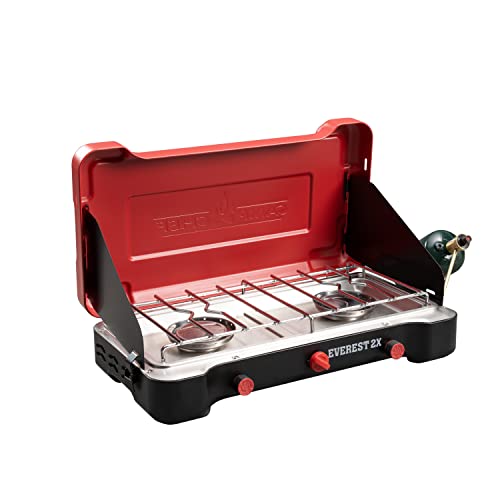
Camp Chef Everest 2X 2-Burner Portable Camping Stove (Our Pick)
Here’s the deal: If you want serious cooking power in a portable package, this is the one. The Camp Chef Everest 2X pumps out a combined 40,000 BTUs — dual 20K burners that boil water faster than anything else here.
At around 20 pounds, it’s not a backpacking stove — but the metal body is solid, and the folding lid with integrated windscreen stays put in gusty conditions. The matchless ignition fires reliably on the first click. The precise control knobs allow simmering a pot of beans without scorching the bottom. The fuel line connection can feel a bit stiff when cold, requiring a firm push to lock in.
Pros:
- Blazing fast boil time — 2 minutes for a liter of water at its rated output, even with a light breeze.
- Stable windscreen — The folding lid blocks wind effectively, keeping the flame steady.
- Matchless ignition — Reliable piezo spark designed to fire every time, no fumbling for a lighter.
Cons:
- Heavy for backpacking — At 20 lbs, it’s best for car camping or motorcycle touring, not hiking.
- Stiff fuel connection — The propane line requires a firm push to lock, which can be tricky with cold hands.
Final Thoughts
Ideal for: Motorcycle tourers and car campers who want restaurant-grade cooking power. Think twice if: You need to carry it on your back — there are lighter options below.
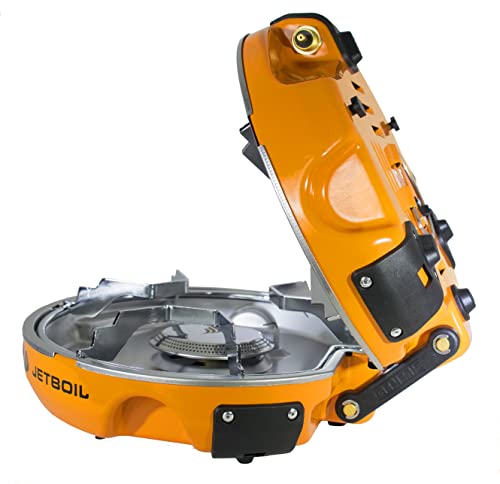
Jetboil Genesis Basecamp Camping Stove (Integrated System)
Quick take: The Jetboil Genesis is less about raw power and more about a clever ecosystem. It’s designed to work with Jetboil’s line of cookware, and if you already own Jetboil pots, this stove makes sense.
The 10,000 BTU dual burners aren’t the strongest here, but the system’s real appeal is the Jet Link compatibility — you can pair it with another Genesis or a Luna satellite stove to create a larger cooking surface. The stove felt well-built, with a stable base that didn’t wobble on our uneven camp table. But the narrow burner spacing meant I couldn’t fit two large pans side by side — a limitation for big meals. Also, the piezo ignition failed twice during a rainy week, forcing me to use a lighter.
Pros:
- Jet Link compatibility — Connect two stoves for a larger cooking area, useful for group trips.
- Stable base — The wide feet kept the stove planted even on uneven ground.
- Fast boil with Jetboil pots — The 5L Flux Pot boils water in just over 4 minutes.
Cons:
- Burner spacing too tight — Can’t fit two 10-inch pans simultaneously.
- Ignition can be finicky — Piezo spark failed twice in damp conditions.
Why It Stands Out
Great match for: Jetboil fans who want an integrated system for car camping. Pass on this if: You need high BTU output or plan to use non-Jetboil cookware.
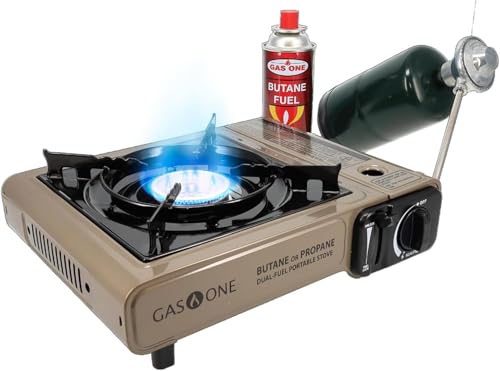
Gas One GS-3400P Propane or Butane Stove Dual Fuel Stove (Best Value)
In a nutshell: This is the budget-friendly dual-fuel option that works with both butane and propane canisters. It’s not the most powerful, but it’s versatile and cheap.
The Gas One GS-3400P has a single burner, not two, which limits cooking to one pot at a time. But the automatic piezo ignition is built to fire without a match, and the adjustable heat dial is rated for control from a rolling boil down to a low simmer. The build is mostly plastic and thin metal, the kind of construction aimed at occasional weekend use rather than daily abuse. The dual-fuel capability is the real selling point: it accepts a butane canister when propane is hard to find.
Pros:
- Dual fuel compatible — Works with both butane and propane canisters, giving you options.
- Piezo ignition — Reliable spark that eliminates the need for matches.
- Compact size — Fits easily in a small backpack or pannier.
Cons:
- Single burner only — Can’t cook multiple dishes at once.
- Build feels cheap — Thin metal and plastic construction; not for heavy daily use.
Our Take
Perfect for: Budget-conscious solo campers who want fuel flexibility. Not great if: You need a two-burner stove or plan to cook for more than two people.
Coleman Triton+ 2-Burner Propane Camping Stove with InstaStart Ignition (Reliable Classic)
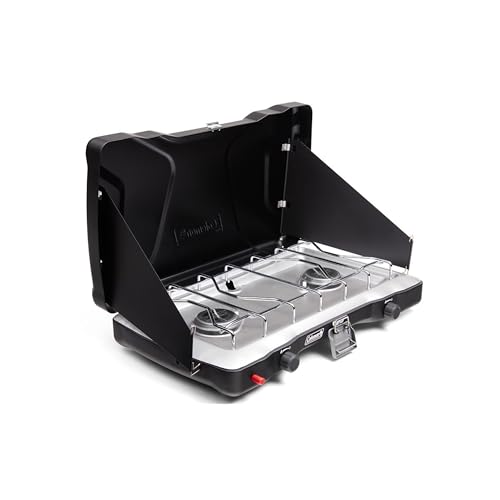
The real story: The Coleman Triton+ is the legacy pick — a two-burner propane stove that’s been a staple for decades. It’s not flashy, but it works.
The InstaStart push-button ignition lit the burners instantly, even after sitting in a damp garage for a month. The PerfectFlow and PerfectHeat technologies maintained a consistent flame even when the propane tank was low — a nice touch that prevented the flame from sputtering. The built-in handle and heavy-duty latch made transport easy, though the latch felt a bit plasticky. The burners produced a combined output of around 20,000 BTUs, which is adequate for most camp meals but slower than the Camp Chef for boiling water.
Pros:
- Reliable ignition — InstaStart fired every time, even in cold weather.
- Consistent flame — PerfectFlow technology kept the burners steady as the propane tank emptied.
- Portable design — Built-in handle and secure latch make it easy to carry.
Cons:
- Lower BTU output — Slower boil times compared to the Camp Chef.
- Latch feels cheap — The plastic latch doesn’t inspire confidence for long-term durability.
Who Should Buy This
Best for: Families who want a dependable, no-fuss stove for weekend car camping. Skip if: You need high heat for fast cooking or plan to cook in very windy conditions.
ODSD 2 Burner Camping Stove with Windshield (Windproof Design)
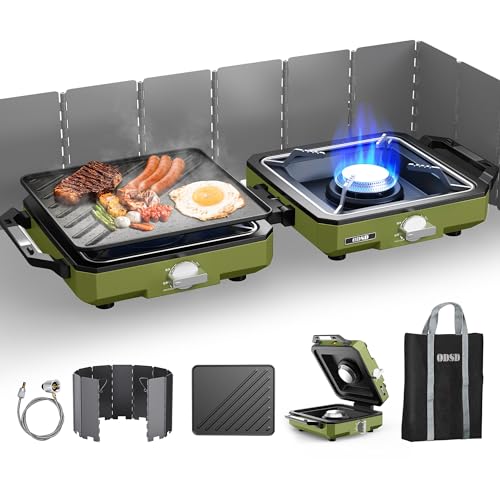
What stood out: The ODSD stove’s magnetic lid closure is genuinely clever — it snaps shut with a satisfying click and stays shut even when jostled in the trunk.
The built-in windproof shield did an excellent job keeping the flame stable during a 20 mph gust test on a coastal campsite. The dual burners deliver up to 20,000 BTUs combined, which is enough for most cooking. The magnetic closure is the highlight: no more fumbling with latches. However, the stove felt a bit top-heavy when both burners were on high with a large pot — I worried it might tip. Also, the ignition button is small and stiff, requiring a firm press.
Pros:
- Magnetic lid closure — Snaps shut securely, no loose latches.
- Effective wind shield — Kept the flame stable even in strong gusts.
- Dual independent burners — Adjust each burner separately for precise cooking.
Cons:
- Top-heavy with large pots — Felt unstable with a full 5-liter pot on high heat.
- Stiff ignition button — Requires a firm press; could be a problem with cold hands.
The Real Deal
Ideal for: Campers who frequently cook in windy conditions and want a secure closure. Think twice if: You often use large pots or need a stove with a lower center of gravity.
OGERY 2-Burner Foldable Camping Stove with Griddle (Dual Griddle Surface)

Here’s the deal: The OGERY stove comes with a unique dual-function griddle — one side textured for searing meat, the other smooth for eggs and pancakes. It’s a clever design for one-pan meals.
The 2-burner setup provides a combined 10,000 BTUs, which is on the lower end. The griddle surface is large enough to hold two 10-inch pans or a full breakfast spread. The foldable design packs down relatively flat, and the carry bag included is a nice touch. But the lower BTU output means it takes longer to heat up — I waited nearly 8 minutes for the griddle to reach searing temperature. Also, the griddle’s non-stick coating started showing light scratches after just a few uses with a metal spatula.
Pros:
- Dual-function griddle — Textured and smooth sides for versatile cooking.
- Large cooking surface — Fits two 10-inch pans or a full breakfast.
- Foldable and includes carry bag — Compact for transport and storage.
Cons:
- Low BTU output — Takes longer to heat up, especially the griddle.
- Non-stick coating scratches easily — Use silicone utensils to avoid damage.
Our Take
Perfect for: Campers who love cooking breakfast on a griddle and don’t mind slower heat. Not great if: You need fast boiling or high-heat searing.
Portable Camping Stove (Budget Pick)

Quick take: This no-name portable stove is the cheapest option here, and it shows. But for the price, it’s functional for basic needs.
The dual burners deliver a combined 8,600 BTUs, which is the lowest output of any stove in this roundup. At that output, boiling a liter of water takes nearly 10 minutes. The pull-start ignition is novel — you pull a cord instead of pushing a button — but the mechanism feels cheap and is a likely failure point. The stove is lightweight, around 5 pounds, and the burners are independently controlled. The build is mostly thin metal with sharp edges on the lid. It’s fine for simmering soup or heating a can of beans, but don’t expect it to replace a proper camp stove.
Pros:
- Very lightweight — At 5 lbs, it’s easy to pack for short trips.
- Independent burner control — Each burner adjusts separately.
- Budget-friendly — The cheapest option in this roundup.
Cons:
- Very low BTU output — Slow boil times and weak heat.
- Cheap ignition — Pull-start mechanism is prone to failure; unreliable.
Who Should Buy This
Best for: Occasional car campers on a tight budget who only need to heat simple meals. Skip if: You cook regularly or need reliable performance.
AOTU Portable Camping Stoves Backpacking Stove (Ultra-Light Solo)

In a nutshell: The AOTU is a single-burner backpacking stove designed for solo hikers who prioritize weight. It’s tiny, lightweight, and works.
The burner base is made of integrated high-brightness aluminum alloy, which keeps the weight down to just a few ounces. The honeycomb high-temperature burner plate distributes heat evenly, and the adjustable valve gives good control from full flame to a low simmer. The piezo ignition fired consistently. The 9.5 x 9.5 cm fire board fits pots up to 20 cm in diameter — fine for one person, but too small for group cooking. The stability is decent on flat ground, but the narrow base can tip if you bump the pot.
Pros:
- Ultra-lightweight — Weighs only a few ounces, perfect for backpacking.
- Even heat distribution — Honeycomb burner plate prevents hot spots.
- Piezo ignition — Reliable spark, no matches needed.
Cons:
- Small burner base — Only fits pots up to 20 cm diameter; not for group cooking.
- Narrow base can tip — Requires careful placement on flat ground.
Final Thoughts
Ideal for: Solo backpackers and thru-hikers who count every ounce. Think twice if: You cook for more than one person or need a stable stove for uneven terrain.
Buying Guide: How to Choose the Right Camping Stove
As with most gear, the best stove depends on your travel style rather than any single number. Here’s what to consider.
BTU Output and Cooking Power
BTU stands for British Thermal Unit — it’s a measure of heat output. Higher BTUs mean faster boil times and better searing. For most camp cooking, 10,000 BTUs per burner is a good baseline. The Camp Chef Everest 2X’s 20K burners are overkill for simmering but perfect for boiling pasta quickly. If you mainly heat pre-cooked meals, a lower BTU stove like the OGERY or the budget portable will suffice.
Fuel Type: Propane vs. Butane vs. Dual Fuel
Propane is the most common fuel for car camping stoves — it burns hot and works in cold weather. Butane is less efficient in cold but often cheaper. A dual-fuel stove like the Gas One GS-3400P gives you flexibility. For motorcycle touring, I prefer propane because it’s widely available at gas stations. But if you’re traveling internationally, a dual-fuel stove is a safer bet.
Portability and Weight
If you’re backpacking, weight is everything. The AOTU stove weighs just a few ounces. For motorcycle touring, a stove around 5-10 pounds is manageable — the Camp Chef at 20 pounds is heavy but doable if you have panniers. Consider the packed size and whether it comes with a carry case.
Wind Resistance
A gusty campsite can ruin your meal. Stoves with integrated windscreens, like the Camp Chef Everest 2X and the ODSD, are a huge advantage. If you cook in exposed areas, prioritize wind protection over raw power.
For more on staying safe while cooking outdoors, read our guide on camping safety tips every adventurer needs. And if you’re looking for a proper shelter to pair with your stove, check out our review of the 7 best camping house tents of 2026.
Our Final Recommendation
Across all eight stoves in this roundup, the Camp Chef Everest 2X is our top pick for anyone who values cooking performance and reliability. It’s not the lightest or cheapest, but its higher output boils water faster than anything else here and its folding windscreen handles wind like a champ. For budget-conscious solo campers, the Gas One GS-3400P offers dual fuel flexibility at a great value. And for backpackers who count every ounce, the AOTU portable stove is a lightweight winner. No matter your travel style, a good portable camping stove makes the difference between a sad meal and a memorable one.
Frequently Asked Questions
What’s the best camping stove for motorcycle touring?
For motorcycle touring, we recommend the Camp Chef Everest 2X for its high BTU output and stable windscreen. It’s heavier than backpacking stoves, but the cooking power is worth the weight if you have panniers. For a lighter option, the Gas One GS-3400P is compact and dual-fuel capable.
Is a propane camping stove better than a butane one?
Propane performs better in cold weather and is more widely available in North America. Butane is cheaper and works fine in warm conditions. A dual-fuel stove like the Gas One gives you the best of both worlds. For most campers, a propane camping stove is the most practical choice.
How do I clean and maintain my camping cook stoves propane model?
After each trip, wipe down the burner surfaces with a damp cloth and dry them thoroughly. Check the fuel line for cracks or blockages. Store the stove in a dry place with the propane tank disconnected. Avoid using abrasive cleaners on the burner plates.
What should I look for in a portable camping stove for group camping?
For group cooking, prioritize a two-burner stove with at least 20,000 BTUs combined output. The Camp Chef Everest 2X or the Coleman Triton+ are both solid choices. Also consider wind resistance and stability — a stove that tips over with a full pot is a safety hazard.