Compression Socks for Flying: Which One to Get in 2026
Contents
Long flights leave legs puffy, heavy and sore, and a sock that’s too loose does nothing about it. Choosing compression socks for flying comes down to two things: the mmHg rating and a size that matches the calf, not the shoe. This page compares eight pairs on their published specs, with the gaps in each listing called out.
The short answer is the FuelMeFoot 3 Pack Copper Compression Socks, a three-pair bundle in copper-infused nylon that names flying right in its title.
| Product | Best for | Compression level | Pairs and size listed |
|---|---|---|---|
| FuelMeFoot 3 Pack Copper Compression Socks | Best overall | Not listed | 3 pairs, L/XL |
| ACTINPUT Copper Compression Socks | Best value | 15-20 mmHg | 4 pairs, L/XL |
| Physix Gear Compression Socks | Firm 20-30 support | 20-30 mmHg | Pack count not listed, S/M |
| Musesox Compression Socks | Left/right labeling | 15-20 mmHg | 3 pairs, Medium |
| Iambamboo Merino Wool Compression Socks | Merino comfort | 15-20 mmHg | Pack count not listed, L/XL |
| Iseasoo 4 Pairs Compression Socks | Colour multipack | Not listed | 4 pairs, L-XL |
| PULIOU Compression Socks | Easy on and off | 15-20 mmHg | 2 pairs, S/M |
| SB SOX Compression Socks | Wide calves | 20-30 mmHg | Pack count not listed, Large |
RedSky Adventures is funded by affiliate commission. Our picks come from comparing published specifications and documented features against what matters in the category — no brand pays for a place on this page. If you buy through a link here we may earn a commission at no extra cost to you, and it pays for the research behind the next guide. Full disclosure.
As an Amazon Associate we earn from qualifying purchases. This does not affect the price you pay.
CERTAIN CONTENT THAT APPEARS ON THIS SITE COMES FROM AMAZON. THIS CONTENT IS PROVIDED ‘AS IS’ AND IS SUBJECT TO CHANGE OR REMOVAL AT ANY TIME.
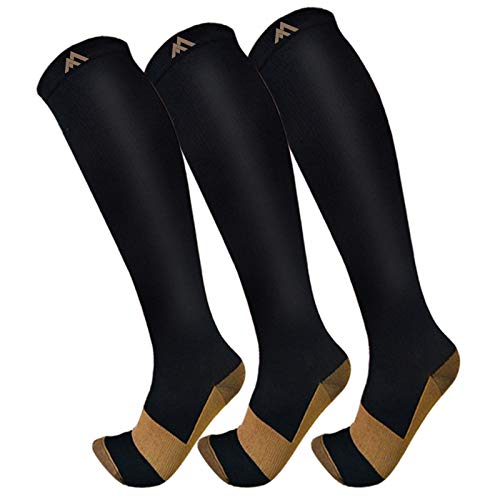
FuelMeFoot 3 Pack Copper Compression Socks (Copper-Infused Nylon)
- BrandFuelMeFoot
- ModelEE
- Dimensions5.0 inches x 5.0 inches x 0.7 inches
- Weight0.42 pounds
- Size / capacityLarge-X-Large
- Colour00 Black
Quick take: A three-pair bundle for travelers who want a pair per leg of a trip and don’t mind verifying the pressure level themselves.
The listing describes copper-infused premium nylon, a 3-pair bundle in size Large/X-Large, black, machine washable and quick drying. The pack’s listed weight is 0.42 pounds, light enough that three pairs won’t dent a carry-on. The title names flying, travel and nursing directly. Flying’s right there.
Here’s the catch: the listing never states an mmHg figure. For flying, that’s the single number a buyer wants. The pair that skips it makes the buyer guess at graduated strength. Copper claims deserve caution too. The compression level and fit do the real work, and evidence for extra copper benefits is limited. Compared with the ACTINPUT, which states 15-20 mmHg, this is the vaguer listing.
Pros:
- Three pairs — enough for a trip out, a trip back and a spare.
- Nylon construction — the maker says it’s gentle on skin and ventilated.
- Machine washable, quick drying — handy for hand-rinsing in a hotel sink.
- Light pack weight of 0.42 pounds — easy to pack.
- Travel named in the title — flying is an intended use, not an afterthought.
Cons:
- No mmHg rating listed — the key spec for flying is missing.
- Only one size shown — L/XL, with no calf chart in the supplied data.
- Copper marketing — odor and circulation claims are the seller’s, not independently verified.
Who Should Buy This
Best overall: Travelers who want a multi-pack of general-purpose compression socks for flying and are fine confirming the pressure level before ordering. Skip if: a stated 15-20 or 20-30 mmHg figure is a must.
ACTINPUT Copper Compression Socks (15-20 mmHg, Wide Size Range)

- BrandACTINPUT
- ModelAC-01
- Size / capacityLarge-X-Large
- ColourA1 – Black
The short version: A four-pair set with a stated mmHg rating and the broadest size run on this list.
The listing states 15-20 mmHg support in a knee-high design, with a nylon-based fabric. Sizes run S/M, L/XL, 2XL, 3XL and 4XL. That range matters, because a stocking that’s too tight at a wide calf is the classic route to a dug-in cuff. It’s 4 pairs in black, size L/XL.
That mild-to-moderate range suits most flights and is easier to pull on than 20-30. The listing doesn’t give a weight, dimensions or a calf chart in the data provided, so measuring against the maker’s chart is on the buyer. Copper shows up in the title, but treat it as decoration. Pressure rating is what counts.
Pros:
- 15-20 mmHg stated — the sensible entry level for flying.
- Four pairs — the largest bundle on this list alongside the Iseasoo.
- Sizes up to 4XL — rare range for wider calves.
- Knee-high cut — avoids thigh-high rolling and irritation issues.
- Plain black unisex look — passes under trousers or a skirt.
Cons:
- No calf chart in the data — the sizing rule is not spelled out here.
- No left/right labels mentioned — the Musesox has them.
- Copper adds nothing proven — the label is marketing.
The Real Deal
Best value: Anyone wanting a stated 15-20 mmHg across four pairs, especially with a wider calf. Not great if: a firmer 20-30 mmHg is wanted.
Physix Gear Compression Socks (20-30 mmHg Graduated)

- BrandPhysix Gear Sport
- ModelHU-XI-74
- Size / capacitySmall/Medium
- ColourBlack
Here’s the deal: The firm option for travelers who already know they like strong compression.
The listing claims 20-30 mmHg graduated compression, strongest at the ankle and easing up the calf. It’s knit from nylon and spandex with a seamless toe. Sizes run S/M, L/XL and XXL, picked by shoe size and calf width. The reviewed size is S/M, black.
Firmer pressure can be harder to put on, and a long flight is a poor place to discover a cuff that’s too tight. Care is simple: machine wash cold, tumble dry low. The pack count isn’t in the data, so confirm whether it’s a single pair. Pack size is unclear. Against the 15-20 mmHg picks, this is the one that demands a more careful size choice.
Pros:
- 20-30 mmHg — firm graduated support.
- Nylon and spandex knit — described as moisture wicking.
- Seamless toe — reduces rubbing inside shoes.
- Three size bands — S/M, L/XL and XXL.
- Clear care line — cold wash, tumble dry low.
Cons:
- Harder to don — 20-30 mmHg is firmer going on.
- Pack count not stated — value is unclear.
- No calf chart in the data — the listing only says shoe size and calf width.
Final Thoughts
Firm 20-30 support: Travelers who want strong compression and have a doctor’s blessing. Skip if: 15-20 mmHg is enough or hands struggle with stiff knit.
Musesox Compression Socks (Left/Right Foot Labels)

- Brandmusesox
- ModelMS2403
- Size / capacityMedium
- ColourA01-black/Gray/Green
In a nutshell: The most detailed sizing and fit design in the group, for buyers who care about anatomical shaping.
These are 15-20 mmHg graduated knee-highs in a 3-pair pack, size Medium, in a black/gray/green mix. The maker lists left/right foot labels, a seamless toe, an elastic arch, mesh panels and a nylon-spandex blend. The chart is explicit. It lists S fits calf 9-11 inches, M 11-14, L 14-16, XL 16-18.
That chart is the clearest sizing guide in the set, and it answers the biggest fit question before checkout. Medium covers a narrow slice. Buyers near a boundary are left deciding. The listing also leans on pregnancy, soccer and gym use, which dilutes its flying focus.
Pros:
- Calf chart in inches — sizing by measurement, not guesswork.
- L/R foot labels — anatomically matched pairs.
- 15-20 mmHg — appropriate for most cabins.
- Mesh panels — airflow for hot feet.
- Three pairs — fair multi-pack for the cost.
Cons:
- Narrow size bands — borderline calves face a hard choice.
- Mixed colour pack — less discreet than all-black.
- Brand name is hidden in the title — harder to verify than named competitors.
Why It Stands Out
Left/right labeling: Fit-focused buyers who measure their calves. Pass on this if: a wide calf over 18 inches needs a bigger range.
Iambamboo Merino Wool Compression Socks (Merino and Bamboo Viscose)

- BrandIambamboo
- ModelIM-CS-02
- Size / capacityLarge-X-Large
- ColourGray Coil
Why it earns a spot: The natural-fibre pick for long-haul cabins that run cold.
The listing states merino wool and viscose from bamboo, plus Sorbtek Repreve polyester and Lycra. It also has 15-20 mmHg in a 4-zone graduated pattern from arch to knee. Size is L/XL, colour Gray Coil. Reinforced footpads and pre-shrunk construction are claimed.
Merino is worth the extra over plain nylon when temperature swings and odor matter. The full case is covered in this guide to wool basics. Our complete guide to wool socks for men goes deeper. Blend percentages aren’t listed. Wool-heavy fabrics can be slower to dry than nylon. Fewer synthetic throwaways is also a quiet win for anyone minding their footprint.
Pros:
- Merino and bamboo viscose — soft, odor-resistant fibres per the maker.
- 15-20 mmHg — gentle flight-appropriate level.
- 4-zone graduation — arch-to-knee support.
- Pre-shrunk — claimed to hold shape through washing.
- Reinforced footpads — protect wear spots.
Cons:
- Blend ratios missing — merino share unknown.
- Pack count unlisted — unclear if it’s one pair.
- Fabric complexity — several fibres can mean fussier care than plain nylon.
Our Take
Merino comfort: Cold-cabin travelers and anyone who dislikes synthetic feel. Skip if: hot-weather trips or a tight budget are the plan.
Iseasoo 4 Pairs Compression Socks (Women’s Colour Pack)

- BrandIseasoo
- Model4SFBPB-D
- Size / capacityLarge-X-Large
- Colour01-black/Grey/White/Pink
The short version: A four-pair pack of colourful nylon socks for women who want variety.
The listing gives 4 pairs in black, grey, white and pink, size L-XL, in nylon. Like the FuelMeFoot, no mmHg figure appears in the supplied data. Its title is aimed at women. Still, the copy mentions men too.
The marketing claims to relieve varicose veins. That’s a medical promise beyond what a spec sheet can back; anyone with vein disease should see a doctor first. Among 4-pair sets, the ACTINPUT is the better-documented one. These suit people who want fun colours for compression socks for flying more than a precise spec.
Pros:
- Four pairs — a large bundle.
- Four colours — easy to tell pairs apart.
- Nylon — strong and flexible per the maker.
- Snug fit claim — meant to avoid marks on skin.
- Gift-ready — varied styles.
Cons:
- No mmHg listed — flying strength unknown.
- Varicose vein claim — medical claim not backed in the listing.
- Women-targeted title — less obvious for men.
Who Should Buy This
Colour multipack: Casual flyers who want variety and low commitment. Skip if: a verified pressure level matters.
PULIOU Compression Socks (Easy On, Easy Off)

- BrandPULIOU
- ModelYYX-WZ-A63-hei-2p-S-M
- Size / capacitySmall-Medium
- ColourBlack
Quick take: A two-pair, 15-20 mmHg option built for people who struggle with tight socks.
The listing states 15-20 mmHg graduated compression, an 80% polyamide knit, a seamless toe and moisture-wicking fabric. It comes as a 2-pair set in size S/M. Sizing runs by calf. The chart gives S/M fits calf 11-15 inches; L/XL fits 13.8-17.7 inches, with shoe-size ranges alongside.
Overlapping size ranges mean a calf near 14 inches could go either way. The listing says to size down only for tighter compression. Easy donning is helpful for seniors or anyone with sore hands. Only two pairs, though. That means laundry planning matters on a longer trip.
Pros:
- 15-20 mmHg — stated clearly.
- 80% polyamide — stretches without much tugging per the maker.
- Calf chart given — sizing by circumference.
- Seamless toe — less friction in shoes.
- Easy on-off focus — good for limited hand strength.
Cons:
- Two pairs only — fewer than the 3-4 pair bundles.
- Overlapping size ranges — borderline calves must choose.
- Odd copy — claims such as verification by outdoor workers read like filler.
Final Thoughts
Easy on and off: Seniors, pregnant travelers and anyone with limited grip. Think twice if: a big multipack is the priority.
SB SOX Compression Socks (20-30 mmHg Wide Calf Fit)
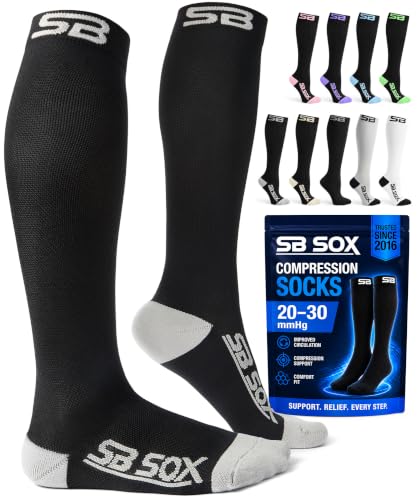
- BrandSB SOX
- Model02-0NIZ-QDLY-$P
- Dimensions5.0 inches x 5.0 inches x 0.7 inches
- Weight11.0 ounces
- Size / capacityLarge
- ColourBlack/Gray
Here’s the deal: The firm pick that explicitly addresses wider calves.
The listing states 20-30 mmHg with a wide calf fit, reinforced and cushioned heel and toe, in size Large, black and gray. Dimensions run 5.0 x 5.0 x 0.7 inches and weigh 11 ounces, but the data doesn’t say how many pairs that covers. Pack count is missing. The maker also claims Trusted since 2016, a claim that goes unverified.
Small covers calf 11-14 inches and Medium 13.5-16 inches. The listing advises upsizing if shoe size exceeds the range, and that’s useful. Material isn’t listed. So breathability can’t be judged. Compared with the Physix, this one’s the better pick for bigger calves.
Pros:
- 20-30 mmHg — firm graduated support.
- Wide calf fit — aimed at larger legs.
- Cushioned heel and toe — extra padding in wear spots.
- Calf and shoe-size chart — two checks for sizing.
- Several colours offered — more than plain black.
Cons:
- Fabric blend unlisted — breathability uncertain.
- Firm to put on — 20-30 mmHg takes effort.
- Pack count unclear — 11 ounces doesn’t say pairs.
Our Take
Wide calves: Larger-legged flyers wanting firm support. Not great if: mild compression or easy donning matters most.
How These Compression Socks for Flying Were Chosen
These picks come from comparing published specifications, materials, care instructions and documented features, plus patterns that recur in verified-buyer reviews. None were tested hands-on. The weighting favoured a stated mmHg level (15-20 versus 20-30), a calf-based size chart, left/right labeling, material and washability. A missing mmHg figure counted against a listing. Before ordering, measure the calf yourself and check it against the maker’s chart. Confirm the pack count when the listing doesn’t state it.
How to Choose Compression Socks for Flying
Pick the mmHg Level First
For most flights, 15-20 mmHg is the comfortable entry point, while 20-30 mmHg is firmer and harder to put on. Higher isn’t automatically better. The ACTINPUT, Musesox, Iambamboo and PULIOU state 15-20, and the Physix and SB SOX state 20-30.
Size by Calf, Measured Properly
Sizing is measured after lying flat on the back for fifteen minutes, before the legs swell from standing. Measuring late in the day gives a bigger number and a sock that’s too loose in the morning. Calf circumference beats shoe size. A loose sock gives no benefit, and a tight one digs in.
Knee-High Beats Thigh-High for Most Travelers
Data shows the likelihood of deep vein thrombosis is about 6% with knee-high stockings and 4% with thigh-high. That’s a small gap. Against that, skin itching and redness hit 41% of thigh-high wearers versus 27% for knee-high. Treatment was discontinued by 22% of thigh-high wearers versus 14% for knee-high. A pair that gets worn the whole flight beats one that gets pulled off. All eight products here are knee-high or comparable lengths.
Material and Durability
Nylon and spandex dominate. Merino adds temperature control. Elastic that stays springy across washes is what keeps compression honest, so follow the maker’s care line. Good travel compression socks double as everyday wear. A durable pair means fewer replacements headed to landfill. For hikes before or after the flight, the hiking sock picks cover a different job.
Who Should Talk to a Doctor First
People with severe peripheral arterial disease, advanced neuropathy, diabetes-related circulation problems or certain skin conditions should get medical advice first. Socks reduce swelling and may lower clot risk. They don’t replace walking the aisle, drinking water or care for anyone at high clot risk. The CDC publishes guidance on blood clot risk and travel. Copper claims shouldn’t count as extra protection.
Our Final Recommendation
The FuelMeFoot 3 Pack Copper Compression Socks take the overall win, with three pairs of nylon socks that name flying. Their mmHg rating isn’t listed. The ACTINPUT Copper Compression Socks are the best value, with four pairs, 15-20 mmHg and sizes up to 4XL. The Physix Gear pair is the recommended firm option at 20-30 mmHg. Wide calves point to the SB SOX, and cold cabins to the Iambamboo merino.
Frequently Asked Questions
Do compression socks actually help on a long flight?
They reduce swelling and may lower clot risk on long flights, but they’re no substitute for walking, hydration and medical care if clot risk is high. Fit decides the benefit. A loose sock does nothing, and a tight one can dig in over hours of sitting.
Should I buy 15-20 or 20-30 mmHg for flying?
Most travelers do fine with 15-20 mmHg, which is mild to moderate and easier to put on. The 20-30 mmHg range is firmer and suits those who already tolerate strong compression. Higher isn’t automatically better. Match it to need and comfort.
Are copper-infused socks better than regular ones?
Not on the evidence supplied. Compression level and fit do the work, and support for added copper benefits is limited. The FuelMeFoot and ACTINPUT are copper-labelled, but the details that help are the mmHg rating, the size chart and the fabric.
Why do my compression socks roll down or dig in?
Usually the size is off. Measure calf circumference after lying flat for fifteen minutes, then match it to the maker’s chart rather than shoe size alone. Between sizes, check the chart’s guidance before choosing, since a tourniquet-like cuff is a sizing problem.