Train From NYC To Las Vegas: How the Journey Works
Contents
Most travel guides will tell you that taking a train from New York City to Las Vegas is a simple, scenic lark across the country. Planning multi-day transits for motorcycles and people is a logistical operation that demands precision. The gear you skip buying to save money is almost always the gear you regret not having when you need it most. Invest once, invest right. That credo applies to every piece of this rail journey. Skimp on your planning or your in-transit kit, and you’ll feel every missing layer when the train’s AC freezes you in the Rockies or a missed connection leaves you stranded in Chicago with no backup plan. This isn’t just a trip; it’s a mission. And every mission deserves a proper briefing.
Key Takeaways
- A train from New York City to Las Vegas is never direct — it’s a multi-segment operation typically involving Amtrak’s Lake Shore Limited to Chicago, then the Southwest Chief to Kingman, AZ, followed by a Thruway bus.
- Scheduling precision is everything; allow at least 12 hours of buffer in Chicago for winter weather or freight train delays that routinely add 4–6 hours to the second leg.
- Your pack must function as a mobile base camp: layerable clothing for temperature swings from 15°F to 95°F, backup power bricks, and offline maps are non-negotiable.
- Leverage Amtrak’s long-distance sleeper cars strategically — they include meals, but book 5–6 months out to secure a roomette, especially on the Southwest Chief segment.
Route Reconnaissance: The Two Main Rail Arcs from New York to Las Vegas
Before you even glance at a ticket, you need to understand the geography of this transit. There is no single-seat ride from the East Coast to Sin City. The only practical Amtrak approach involves reaching a western gateway and then a bus connection into Las Vegas. You’re essentially executing a three-phase movement: East Coast to Chicago hub, Chicago to the Southwest, and final ground transport. This breaks down into two primary arcs, each with distinct advantages and threat assessments.
The Primary Arc: Lake Shore Limited + Southwest Chief (via Kingman)
This is the corridor most seasoned travelers use. Depart from New York Penn Station on Amtrak Train 49, the Lake Shore Limited, usually in the afternoon and arrive at Chicago Union Station the next morning — roughly 19 hours later. For those navigating the often chaotic pre-departure moments in Manhattan, our guide on getting from Penn Station to JFK covers the transit intricacies if you’re connecting from the airport.
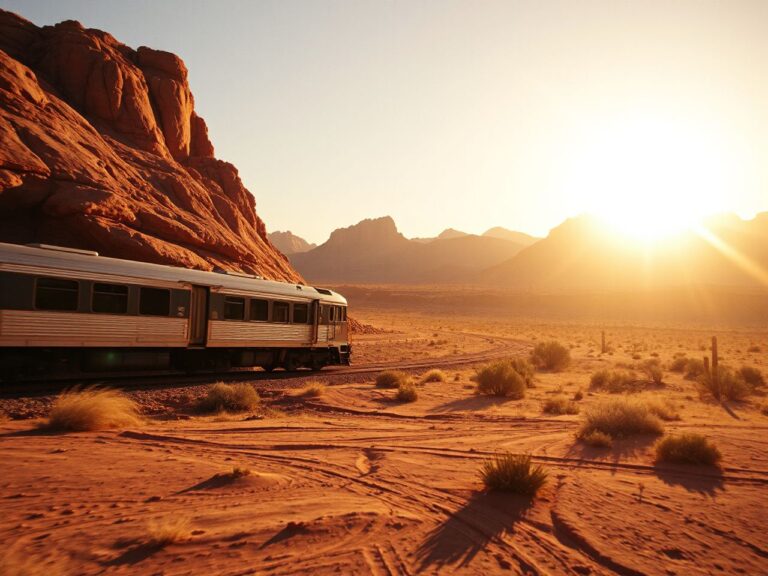
At Chicago, you’ll switch to the Southwest Chief (Train 3), which departs in the mid-afternoon. This train cuts through the heartland — across Illinois, Iowa, Missouri, Kansas, Colorado, New Mexico, Arizona — before reaching Kingman, AZ around midnight two days later. Total rail time from NYC to Kingman runs approximately 55–60 hours. From Kingman, Amtrak’s dedicated Thruway bus takes you into Las Vegas in about 2 hours, arriving at the South Strip Transit Terminal.
The Alternative Arc: Midwest Flex via California Zephyr (Omaha/Denver/Salt Lake)
If you value scenery over speed — and appreciate a strategic fallback point — the California Zephyr is worth considering. You’d still take the Lake Shore Limited to Chicago, then continue on the Zephyr (Train 5) to Salt Lake City. From there, a Greyhound or FlixBus connection can get you to Las Vegas in about 8 hours, crossing the Great Basin. This arc adds a full travel day but gives you views of the Rockies and Sierra Nevada that are unmatched. On the Zephyr, you’ll pass through Omaha, a city with growing rail connectivity; our Omaha train guide covers the best connections if you ever need to hold up for a night there. Should a blizzard disrupt the Zephyr in Denver, you can also reverse-route using intel from our train from Denver to New York briefing — helpful when plotting escape vectors.
Phase 1: Logistics & Timetable — Building Your Mission Brief
Now we get into execution. Planning a train from New York City to Las Vegas without a detailed timetable is like navigating the Rub’ al Khali without a compass. Every minute counts, especially when a missed connection in Chicago can cascade into a 24-hour delay.
Booking Windows and Fare Classes
Amtrak releases tickets 12 months in advance. For a journey of this length, you need to think in terms of fare buckets (Value, Flexible, Premium) but more critically, sleeper availability. Roomettes on the Southwest Chief often sell out 5–6 months ahead for summer travel. A roomette includes all meals on board, two seats that convert to a bed, and access to a private shower in the sleeper car. It’s worth every penny when you’re 36 hours from Chicago to Kingman. If you’re booking on a tight timeline, look for midweek departures (Tuesday or Wednesday) when inventory tends to linger.
Timetable Synchronization
Here’s a real-world timetable for the primary arc, built for a spring 2026 operation:
- Day 1, 3:40 PM: Board Lake Shore Limited at NYP. Depart 4:10 PM.
- Day 2, 9:50 AM: Arrive Chicago Union Station. You now have a 5-hour layover.
- Day 2, 2:50 PM: Board Southwest Chief. Depart 3:00 PM.
- Day 4, 11:30 PM: Arrive Kingman, AZ (Mountain Time — note time zone shifts).
- Day 4, 11:50 PM (or immediately after train arrival): Board Thruway Bus 4 to Las Vegas.
- Day 5, 1:30 AM: Arrive Las Vegas South Strip.
That’s roughly 72 hours of continuous travel if everything runs perfectly. In practice, the Southwest Chief can arrive Kingman up to 6 hours late, especially in winter. Plan a contingency overnight in Kingman or Las Vegas arrival buffer — never schedule a critical meeting or flight until the afternoon of Day 5 at the earliest.
Phase 2: Kit Assembly — What to Pack for a 3-Day Rail Transit
Crossing the country by rail means your bag is both luggage and survival pod. Temperatures can swing from the humid 85°F of a Chicago summer afternoon to a frosty 15°F early morning in the high desert of New Mexico as the train rolls at altitude. A good rail kit follows the same layering system used for long-distance motorcycle hauls: base, insulation, and shell.
Clothing Ladder
- Merino wool base layer top and bottom. Doesn’t hold odor, wicks moisture during the 19-hour initial leg.
- Lightweight fleece or down puffy jacket. Compressible and crucial for observation car drafts.
- Waterproof shell jacket. Handles air-conditioning blasts and any weather checks during bus segments.
- Stashable micro-towel. Sleeper showers are tiny; the towel Amtrak provides is the size of a bath mat.
- Wool socks (3 pairs). Rotate daily to prevent foot issues.
Power & Connectivity
Amtrak long-distance coaches have standard 120V outlets at each seat, but they’re often loose from years of use. Bring a small 3-outlet surge protector with USB — the one-piece cube style — and a 6-foot extension cord to reach the outlet if a fellow passenger has hogged the one between seats. Cellular coverage on the Southwest Chief is spotty in western Kansas and eastern Colorado, and completely absent for stretches through the Raton Pass and Arizona desert. Download offline maps covering Kingman to Las Vegas, the Chicago CTA map, and your hotel area before departure.
Sustenance & Hydration
The dining car serves decent meals, but you’ll want backup. Pack 2 liters of water in a refillable bottle — the tap water on trains isn’t always palatable. High-energy snacks: trail mix, protein bars, jerky. If you have a sleeper, meals are included, but the dining car hours (usually 6:30–9:30 AM, 11:30–2:00 PM, 5:00–9:00 PM) don’t always align with your body clock. A 24-hour ration of calories keeps you from getting hangry in the middle of Kansas at 2 AM.
Phase 3: Weather & Contingency Planning — The Tactical Overlay
Check weather patterns along every segment before a trip. A train from New York City to Las Vegas in February is a completely different animal than one in July. Understanding seasonal threats lets you choose the right departure window and pack accordingly.
Winter (November – March)
Lake-effect snow around Chicago can delay the Lake Shore Limited inbound, eating into your connection time. The Southwest Chief traverses Raton Pass at 7,834 feet where heavy snow can cause hours-long stoppages. Temperatures inside the cars can drop at night if heating systems struggle. Expect 15–25°F overnight lows in the observation car. Carrying a sleeping bag liner rated to 30°F provides supplemental insulation, even in a roomette. The Thruway bus from Kingman to Vegas might also encounter icy roads on I-40, though rare. Have a backup plan: identify a motel in Kingman (the Days Inn is a 5-minute drive) and bookmark the bus station’s live tracker.
Summer (June – August)
Heat becomes the enemy. The desert Southwest regularly hits 105°F in Kingman, and the air-conditioned train transitions to a non-air-conditioned bus. That temperature shock can cause heat exhaustion if you aren’t hydrating from Raton onward. Start increasing water intake 12 hours before arrival and carry electrolyte tablets. On the Southwest Chief, the air conditioning can be arctic — people layer up, then step off at a smoke stop in Albuquerque into blast-furnace heat. Rapid swings tax the body; pace yourself during these 10-minute platform breaks.
Shoulder Seasons (April – May, September – October)
These are the optimal windows. Delays are less likely, and temperatures moderate. However, spring thunderstorms on the Plains can cause flash-flood detours for freight trains that share the same tracks. Amtrak dispatchers prioritize freight traffic, so long waits on sidings, such as outside Hutchinson, KS, for a Union Pacific manifest to clear, are common. You can’t control the weather, but you can control your advance knowledge — check the National Weather Service’s 7-day outlook for cities along your route two days before departure. Note the Chicago forecast 24 hours out for any ground delay that might shrink your layover.
Phase 4: Executing the Transit — Tips from the Cockpit
By now you’ve built a waterproofed plan; execution is about situational awareness. Treat every transit leg as a movement order. Here’s how to maintain control once those wheels start rolling.
Chicago Layover Maneuvers
You’ll have roughly 5 hours at Union Station. Don’t wander far without accounting for re-boarding. The Metropolitan Lounge (for sleeper passengers) stores bags briefly, but keeping essentials and heading to the Walnut Room at Macy’s for a proper sit-down lunch is a good option — it’s a 15-minute walk each way, leaving a comfortable 2-hour window. Use the Amtrak app to track the inbound train’s status; if it’s running late, extend your meal. If you’re in coach, the Union Station food court has a solid Potbelly Sandwich Works, but bring your food to the boarding gate area early because queues can form 45 minutes before departure.
Onboard Intel: Observation Car Strategy
The observation car on the Southwest Chief fills quickly after major stops like Kansas City and Albuquerque. To get a seat for the most scenic segments (Colorado-New Mexico border through Raton Pass, and the high desert of Arizona at sunset), stake your claim 30 minutes before these waypoints. Bring a small laminated map with mile markers to follow along — it’s a great conversation starter. Avoid the observation car during late-night hours; noise from a handful of loud travelers can sabotage sleep. Retreat to your roomette by 10 PM with earplugs and a sleep mask.
The Kingman-to-Vegas Link: Final Approach
Arriving at Kingman at midnight local time can be disorienting. The station is a small platform in a quiet town. The Thruway bus is usually waiting on the platform side — it’s a dedicated Amtrak coach. If the train is severely late (past 2 AM), the bus still holds for passengers. Keep the Amtrak Guest Rewards Service Desk number saved: 1-800-307-5000. If the bus doesn’t show, call immediately. Once on the bus, the final 2 hours cross the Nevada border. You’ll arrive at the South Strip Transit Terminal on Gilespie Street and Sunset Road. Pre-arrange a rideshare in the app as you roll in, because the terminal area can be deserted at 2 AM on a Tuesday. If possible, have your hotel’s front desk number handy in case you need to notify them of a late check-in.
Return Logistics & Strategic Add-Ons
Most travelers focus on the outbound, but a mission always includes an extraction plan. The return train from Las Vegas to NYC involves the same Kingman bus connection in reverse. You’ll need to catch the Thruway bus departing Las Vegas around 10:30 AM, which arrives Kingman by noon, then board the eastbound Southwest Chief (Train 4) in the early afternoon. The reverse trip is slightly faster — about 65 hours — because you gain time zones. But the same rule applies: never book a tight connection on the same day as the arrival back at Penn Station. Allow a full rest day.
For those who want to extend the mission, the Southwest Chief connects to Flagstaff (Grand Canyon gateway) and Los Angeles. You could turn this into a western loop: train to Vegas, rent a motorcycle or car to explore the desert, then continue by rail to LA and fly home. That’s a tactical variant that suits travelers moving vehicles cross-country, using the train as the spine and a vehicle for the last-mile exploration.
Frequently Asked Questions
What is the fastest train route from New York City to Las Vegas?
The most direct combination is the Lake Shore Limited to Chicago and Southwest Chief to Kingman, then the Thruway bus. Total transit time is roughly 72 hours if connections hold. There is no high-speed rail on this corridor, so any train from NYC to Vegas will require at least two overnight segments.
Can I bring a motorcycle on the train from NYC to Las Vegas?
Amtrak does not offer vehicle transport on long-distance trains for motorcycles. You would need to ship your motorcycle separately via a transport service. A cross-country motorcycle shipment can align with your rail arrival in Las Vegas if you plan a 7–10 day lead time for ground transport.
How much does a sleeper cabin cost for the entire NYC to Las Vegas route?
A roomette for the combined Lake Shore Limited and Southwest Chief can range from $900 to $1,600 total per person if booked a few months in advance, including meals. Coach seats are often as low as $220–$400, but you lose the bed and shower. Prices spike during holidays and summer.
Is the train from New York City to Las Vegas reliable in winter?
Winter reliability drops to about 65% on-time performance for the Southwest Chief due to snow in Raton Pass and heavy freight congestion. The Lake Shore Limited also absorbs delays from lake-effect snow. Always plan a 24-hour buffer for critical events at your destination. The train is still safe, but the timetable is more of a suggestion from December through February.