Crash Pad Roundup: What to Buy in 2026
Contents
A crash pad that’s too small for the landing is the most common way buyers get this wrong. Thickness alone won’t fix it. Landing area, hinge layout and carry weight decide whether a pad does its job on a remote approach. This roundup compares four options on published specifications only, for climbers who hike to unmarked boulders and need coverage without a punishing carry.
As an Amazon Associate we earn from qualifying purchases. This does not affect the price you pay.
CERTAIN CONTENT THAT APPEARS ON THIS SITE COMES FROM AMAZON. THIS CONTENT IS PROVIDED ‘AS IS’ AND IS SUBJECT TO CHANGE OR REMOVAL AT ANY TIME.
The short answer is the Meister Boulder Beast XL: a 72″ x 44″ landing area with 5″ of layered open and closed cell foam.
| Product | Best for | Open size | Weight |
|---|---|---|---|
| Meister Boulder Beast XL | Best overall | 72″ x 44″ x 5″ | 20 lb |
| VEVOR Bouldering Crash Pad | Best value | 48.43″ x 35.63″ x 3.94″ | 9.7 lb |
| Metolius Session II | Backpack-ready mid-size | 122 x 91 x 10 cm | Not listed |
| DRKSBESTO Tri-Fold | Light tri-fold carry | 70″ x 38″ x 3″ (listing) | 10 lb |
RedSky Adventures is funded by affiliate commission. Our picks come from comparing published specifications and documented features against what matters in the category — no brand pays for a place on this page. If you buy through a link here we may earn a commission at no extra cost to you, and it pays for the research behind the next guide. Full disclosure.
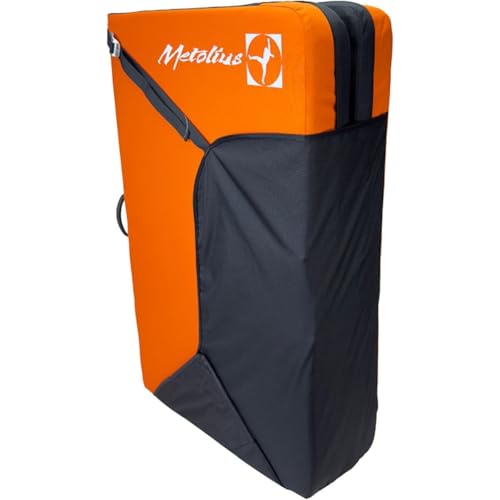
Metolius Session II Crash Pad (Backpack Carry, Two Foam Densities)
Meister Boulder Beast XL Tri-Fold (Oversized 72″ x 44″ Landing)

- BrandMeister
- Model1149RCBBBK
- Dimensions72.0 inches x 44.0 inches x 5.0 inches
- Weight20.0 Pounds
- Size / capacity72" Length x 44" Width x 5" Height
- ColourBlack
Quick take: the Boulder Beast XL suits climbers who prioritise landing coverage over pack weight, and who’ll accept a heavy carry to get it.
This crash pad opens to 72″ x 44″ x 5″. It weighs 20 lb. Each panel carries four layers of open and closed cell foam, and that’s how the 5″ total is built. The shell is reinforced all-weather polyester. The listing also includes a corner carpet square for wiping shoe soles. It comes with removable backpack straps with a waist belt and chest strap, duffel-style handles, and gear loops top and bottom.
Surface area is the point here. The manufacturer calls it the largest on the market. Nobody has verified that claim, but the 72″ x 44″ figure is the biggest open footprint among these four. Price is tied to carry. Folded it measures 44″ high x 24″ wide x 15″ thick, which is a lot of pad on a narrow, overgrown approach. Two hinges also mean two seams across the landing, so placement matters. Hook and loop flaps along the sides are there to link to other pads and close gaps, and gaps are where ankles get hurt.
Pros:
- Largest open footprint here — 72″ x 44″ covers far more landing than the bi-fold options in this roundup.
- Layered foam — four layers of open and closed cell foam per panel give 5″ of padding, the thickest on this list.
- Full suspension — removable shoulder straps with waist belt and chest strap spread the 20 lb across the hips.
- Side flaps — hook and loop closures let the pad connect to a second pad to reduce gaps.
- Extras that earn their place — the corner carpet square and gear loops mean fewer things to carry separately.
Cons:
- Heavy and bulky — 20 lb and a 15″ folded thickness make long, tight approaches tiring.
- Two hinge seams — a tri-fold has two lines where foam meets, and the listing doesn’t explain how gaps are managed there.
- Warranty not listed — nothing on the page says how long the shell, straps or hinges are covered.
Who Should Buy This
Ideal for: climbers who want one main crash pad with real landing coverage for short walls and uneven ground. Pass on this if: the approach is long or steep and pack weight matters more than footprint.
VEVOR Bouldering Crash Pad (Bi-Fold, Lighter Carry)

- BrandVEVOR
- ModelGL-A-01
- Dimensions48.43 inches x 35.63 inches x 3.94 inches
- Weight9.7 pounds
- Size / capacity48.4 x 35.6 x 3.9 in / 1230 x 905 x 100 mm
- ColourBlack
The short version: the VEVOR is a lighter bi-fold crash pad for buyers who want fall protection at a budget-friendly level and a pad that’s easy to haul.
It opens to 48.43″ x 35.63″ x 3.94″ (1230 x 905 x 100 mm). It weighs 9.7 lb, roughly half the Meister. The cover is 900D Oxford fabric, described as tear-resistant and waterproof, over a sandwich-structured foam core. Folded it measures 35.6″ x 24″ x 8.3″. Carry options include backpack straps, a waist belt and a side handle. The textured base is meant to grip slopes and gravel.
A bi-fold has one hinge. That means one seam to keep out from under a landing. The trade is size: the open area is much smaller than the Boulder Beast. It behaves more like a supplemental pad or a sit-start piece than a main landing on a tall problem. The manufacturer claims the foam avoids bottoming out, but the listing gives no foam densities. So that part stays a claim. Marketing also pitches it as a yoga or camping mat. That points to general-purpose design rather than climbing-specific use.
Pros:
- Light at 9.7 lb — easy to carry on rough approaches or stack with a second pad.
- Compact fold — 35.6″ x 24″ x 8.3″ fits a car boot more easily than the tri-fold options.
- 900D Oxford shell — a heavy-denier fabric chosen for rocks, dirt and repeated folding.
- Three carry modes — backpack straps, waist belt and side handle cover hiking and short repositioning.
- Textured base — meant to resist sliding on slopes and gravel, useful where the ground isn’t flat.
Cons:
- Small landing area — 48.43″ x 35.63″ leaves little margin if a fall drifts off line.
- Thinnest main pad here — at 3.94″ it gives up cushioning to the Meister’s 5″.
- Foam specs missing — no density or layer breakdown is given beyond the sandwich construction.
Final Thoughts
Great match for: budget-minded climbers, gym sessions and anyone adding a second pad to an existing setup. Think twice if: it will be the only crash pad under a taller or wider problem.
Metolius Session II Crash Pad (Backpack Carry, Two Foam Densities)
- BrandMetolius
- ModelMetolius
- Dimensions37.0 inches x 10.0 inches x 26.0 inches
- Size / capacityOne Size
- ColourRust/Black
In a nutshell: the Session II is a mid-size crash pad from a climbing-specific brand, built with two foam densities and a backpack carry system.
The listing gives an open size of 122 x 91 x 10 cm. It lists a folded size of 66 x 91 x 10 cm. The footprint is about the same as the VEVOR’s 1230 x 905 mm. The shell is 900D polyester, and the padding is high compression foam plus low compression foam. Carry mode is listed as backpack. A firmer layer resists bottoming out while a softer layer takes the initial impact, matching the layered logic used on the other pads.
The gaps in the listing matter. No weight is stated, and that’s the number a hiker most needs when comparing it against the 9.7 lb VEVOR or the 10 lb DRKSBESTO. No warranty is listed either, and the listing doesn’t describe strap or waist belt details. The dimensions field also disagrees with the marketing copy, so check the size on the product page before ordering. Wider-market names such as Black Diamond, Organic Climbing and Mad Rock compete in this tier, but that’s a shopping note, not a spec comparison.
Pros:
- Two foam densities — high and low compression foam is the right idea for absorbing impact without bottoming out.
- 900D polyester shell — matches the heavy-denier fabric class of the VEVOR.
- Backpack carry — listed as a backpack-style pad, so hands stay free on the approach.
- Roughly 10 cm thick — the listing gives 10 cm, thicker than the VEVOR’s 100 mm figure only in name, equal in practice.
- Compact folded footprint — 66 x 91 cm folded is a manageable size for a car or pack.
Cons:
- Weight not listed — a real gap for anyone deciding on carry comfort.
- Inconsistent dimension data — the spec table and the marketing copy don’t match, so sizing needs a second check.
- Sparse feature list — no carpet panel, gear loops or hook and loop flaps are mentioned.
The Real Deal
Perfect for: climbers who want a climbing-brand crash pad with dual-density foam in a mid-size footprint. Not great if: the weight figure and the strap details matter enough that missing data is a dealbreaker.
DRKSBESTO Tri-Fold Crash Pad (Light, 10 lb Tri-Fold)
- BrandDRKSBESTO
- Dimensions70.0 inches x 38.0 inches x 3.0 inches
- Weight10.0 pounds
- Colourblack
Why it earns a spot: the DRKSBESTO offers a wide tri-fold landing at about the weight of a bi-fold, with the trade-off of thinner foam.
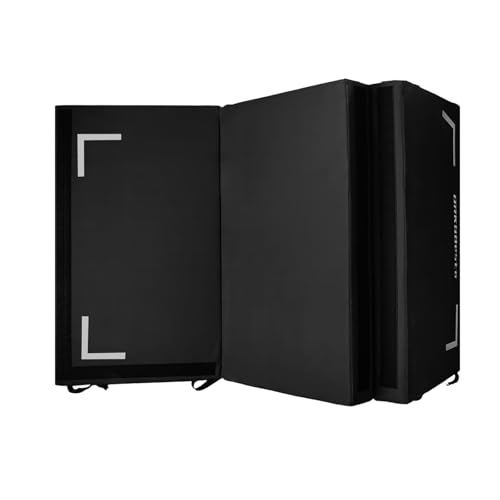
The Amazon spec table lists 70″ x 38″ x 3″ and 10 lb. The marketing copy says 71″ x 39″ x 4″ and 9.9 lb. Both put the open area well above the VEVOR’s 48.43″ x 35.63″. The shell is 600D Oxford fabric with an anti-slip surface. Over that sits 18D high-density pearl foam. Folded size is 39″ x 24″ x 12″. Wider, thicker shoulder straps and adjustable top and bottom bands are listed. An improved Velcro system is meant to keep the pad flat when unfolded.
Thickness is where it gives ground. At roughly 3″ to 4″, it’s the thinnest pad here, and the listing describes a single foam type rather than layered closed and open cell foam. That suits supplemental use, yoga or camping, which the copy pushes, better than a tall fall onto rocky ground. The 600D shell is also lighter-duty than the 900D fabrics on the VEVOR and Metolius, so hinges and strap points deserve a look after repeated approaches. Capacity or foam rating isn’t listed.
Pros:
- Large footprint for the weight — about 70″ x 38″ at 10 lb is a better area-to-weight ratio than the VEVOR.
- Compact fold — 39″ x 24″ x 12″ is much less bulky than the Meister’s 15″ thickness.
- Wider shoulder straps — described as thicker and wider, which helps spread weight on a long carry.
- Flat-lay Velcro — meant to stop the folds from bunching when opened.
- Anti-slip surface — the 600D Oxford top is textured for grip.
Cons:
- Thin at 3″ to 4″ — less foam to absorb a drop than the Meister’s 5″.
- Single foam type — 18D pearl foam alone doesn’t offer layered open and closed cell absorption.
- Lower shell denier — 600D is a step down from the 900D used on two rivals.
Our Take
Ideal for: climbers who want a wide, light supplemental crash pad and have modest fall heights. Pass on this if: the pad must serve as the main landing on rough, rocky ground.
How We Chose These Crash Pads
These picks come from comparing published specifications, materials, and documented features. Patterns that recur in buyer reviews matter too, since buyers often mention carry comfort and hinge wear. None of the pads were tested hands-on. The weighting favoured landing area against folded size. It then favoured foam construction, then fold design and gap risk. After that, it favoured the carry system and shell durability. Thickness and price alone weren’t allowed to decide anything. Before ordering, check the open dimensions on the product page. Also note that the Metolius listing has no weight. The Meister and DRKSBESTO don’t state warranty terms.
How to Choose a Crash Pad
Landing Area Versus Folded Size
A crash pad only protects where it lies under the climber. The Meister’s 72″ x 44″ open footprint covers more than the VEVOR’s 48.43″ x 35.63″. It folds to 44″ x 24″ x 15″. It weighs 20 lb. Remote approaches punish bulk, so decide how far you’ll hike before choosing the biggest pad.
Foam and Fold Design
Layering closed cell and open cell foam is what stops a pad bottoming out. The firm layer resists compression. The soft layer absorbs the initial hit. The Meister and Metolius both describe multi-density builds. The DRKSBESTO lists one foam type. A bi-fold has one hinge. A tri-fold has two. Every hinge is a potential gap or hard edge under a foot.
Injury Risk and What Pads Can’t Do
Ankle sprains and fractures are the typical lower-body injuries in bouldering. They often come from poorly executed or mistimed falls, not from a pad being too thin. That’s why the whole landing needs coverage without gaps. Clear roots and rocks matter too, and a spotter helps. A pad reduces risk but doesn’t remove it. Most bouldering injuries heal with rest and physical therapy. Surgery is seldom needed, but that’s no reason to fall carelessly. For technique, falling practice, and spotting, seek a qualified instructor. One option is through the American Alpine Club. None of the four listings cites a safety certification or test standard.
Carry Comfort and Shell Durability
Shoulder straps and a waist belt determine whether the pad gets used on repeat trips. Weight affects how it gets carried too. Shell denier counts as well. The VEVOR and Metolius list 900D, versus 600D on the DRKSBESTO. Hinges and strap anchors usually wear first. Keep the pad out of hot cars and damp storage.
Our Final Recommendation
The Meister Boulder Beast XL is the overall winner. It has the biggest landing here. It also has the thickest padding and a proper suspension system. The VEVOR Bouldering Crash Pad is the best value pick. It’s a lighter, smaller bi-fold that works well as a second pad or for gym use. The Metolius Session II is a sensible mid-size option if its missing weight figure doesn’t bother you. The DRKSBESTO suits light supplemental duty. Whatever the choice, a pad is no substitute for spotting and training.
Frequently Asked Questions
How thick should a crash pad be for outdoor bouldering?
The listings range from about 3″ on the DRKSBESTO to 5″ on the Meister. Thickness helps only if the foam is layered to avoid bottoming out, so check the construction too. Taller or rockier landings usually need the thicker, multi-layer build. Thin pads tend to work better for supplemental use.
Should I buy a bi-fold or a tri-fold crash pad?
A bi-fold, like the VEVOR, has one hinge and a smaller, lighter footprint. A tri-fold, like the Meister or DRKSBESTO, opens wider but has two seams across the landing. Choose a tri-fold if coverage is the priority and a bi-fold if weight and simplicity matter more.
Can a crash pad be used in a climbing gym or for indoor training?
The VEVOR listing explicitly markets itself for indoor bouldering and gym training. Still, any of these pads can work as a supplemental landing. Gym floors already have padding, so smaller, lighter pads are often enough. Don’t assume a gym pad is rated for outdoor landings on rough ground.
How should I store and clean a crash pad so the foam lasts?
Keep it dry, out of direct heat, and away from hot cars. Hot cars can degrade foam, fabric and closures over time. Wipe the shell clean, then let it dry before folding. The Meister’s carpet square is for shoe soles only, not pad cleaning.