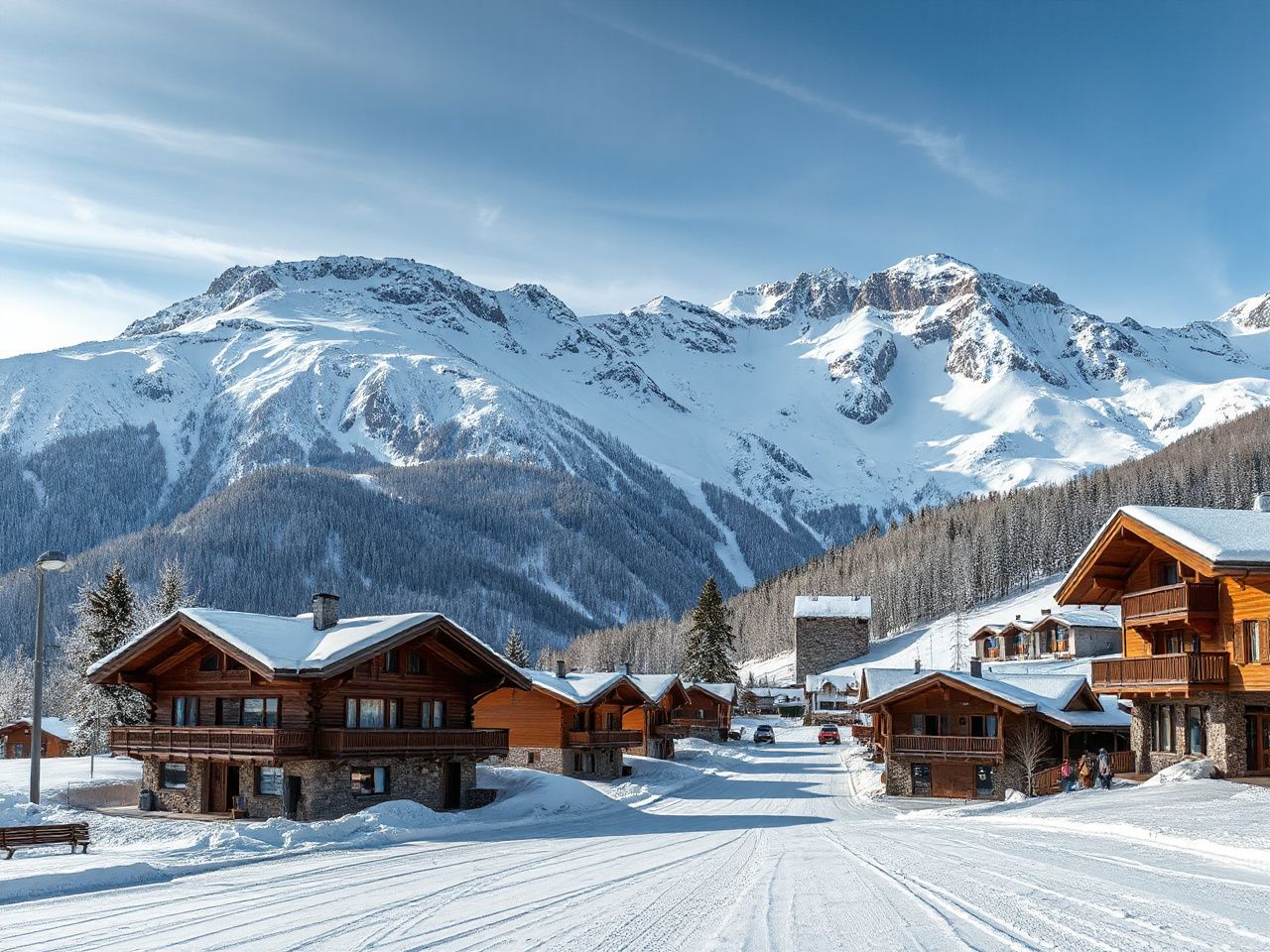
Best Austria Ski In Ski Out Resorts for 2026
Contents
“Ski in ski out” is not a defined term. Nobody certifies it, no tourist board audits it, and in Austria it gets attached to hotels that are a ten-minute walk and a gondola ride from the nearest piste. The phrase survives because it is doing marketing work, not descriptive work.
What decides whether you can actually click out of your bindings at the door is the shape of the valley, and Austria’s geography is unusually unkind to the idea. The famous names are mostly valley-floor villages served by a gondola, which means the ski home ends at a top station and continues by cable. The places where it genuinely holds up are a much shorter list, and they have one thing in common: the village itself is high.
Key takeaways
- The term is unregulated. Ask which piste ends at the building and what grade it is — a listing that cannot answer is telling you the answer.
- Austria’s biggest areas start low: Ski Arlberg’s base is 1,304 m and Saalbach’s is 830 m. Low base, late-season problem.
- Kühtai at 1,938 m is the highest village-based resort in Austria; Gurgl at 1,793 m is the highest with a large ski area attached.
- Oberlech is the clearest case in the country: car-free December to April, reached by cable car, with all hotels linked underground.
- Slopeside costs you evening choice. One village, one set of restaurants, and the valley is a cable car ride away after dark.
Why Austria makes this harder than it looks
Look at where the lifts start. Ski Arlberg — St. Anton, St. Christoph, Stuben, Lech, Zürs, Warth and Schröcken, and the largest interconnected ski area in Austria at 299.7 km of slopes across 85 lifts — runs from 1,304 m to 2,811 m. That base figure is the village of St. Anton, and it tells you what a St. Anton “ski in ski out” claim is usually worth: the skiing above the town is superb, but the town is at the bottom of it.
The Skicircus of Saalbach, Hinterglemm, Leogang and Fieberbrunn is the same story lower down: 270 km of slopes and 69 lifts, running from 830 m to 2,096 m. A 1,266 m vertical is a fine thing to ski. It is also 1,266 m of reasons why the last few hundred metres to your hotel might be grass in March.
This is not an argument against those resorts — they are two of the best ski areas in Europe. It is an argument for reading the altitude of the accommodation rather than the altitude of the summit, because the number that decides whether you ski to your door in April is the low one.
The three questions a listing has to survive
Before you book anything sold as slopeside, get answers to these. They are answerable in one email, and the answer arrives quickly if it is a good one.
Which piste ends at the building, and what grade is it? “Ski in ski out” with a red run to the door is not the same product for a family as for a group of confident skiers. If the last 200 metres are a narrow track, that is a hotel with a ski route nearby, not a hotel on the slope.
Is the return by piste, or by lift? Plenty of Austrian properties are genuinely ski-in — you can descend to them — and not ski-out, because getting back up in the morning means a shuttle or a gondola. That is a real and often good arrangement. It is not what the phrase promises.
Does it hold in late season? A north-facing run at 1,800 m and a south-facing one at 1,000 m behave completely differently in the second half of March. Ask what happens to the home run when the snow line rises, and whether the hotel runs a shuttle when it closes.
The high villages, where the layout does the work
Kühtai sits at 1,938 m and rises to 2,520 m, with 49.8 km of slopes and 12 lifts, running 27 November to 11 April. Only the glacier areas and the Zugspitze have higher base stations in Austria, and none of those is a village. Kühtai is small by Austrian standards and that is the trade — but the village is inside the ski area rather than beneath it, which is exactly the condition the phrase is supposed to describe.
Gurgl — Obergurgl and Hochgurgl is the version with a real ski area attached: a base of 1,793 m rising to 3,030 m, 112.2 km of slopes and 4.5 km of ski routes, served by 25 lifts, open from mid-November to early May. That combination of a high village and a long season is why it is one of the most snow-sure resorts in the Alps, and why slopeside claims there tend to survive April.
Obertauern is the one built for this. The resort runs from 1,630 m to 2,313 m with 100 km of slopes — 61 km easy, 35 km intermediate, 4 km difficult — served by 26 lifts arranged around the village rather than above it. The 2026–27 season runs 20 November to 2 May. When a village is ringed by its own lifts, “ski in ski out” stops being a claim and becomes a description of the street plan.
Oberlech: the clearest case in the country
If you want the phrase to mean something specific, Oberlech is where it does. It sits at 1,750 m above Lech, and the official Ski Arlberg guidance is unambiguous about how it works.
The Burgplateau is car-free from December to April. You reach it by the Bergbahn Oberlech cable car — cars stay in the valley, in the Anger underground car park, which has more than 600 spaces and is open 24 hours. Luggage is collected and personal tickets issued in the underground arrival area of the cable car, so your bags travel separately from you. And all the hotels are linked by an underground tunnel system, which means moving between them without going outside or crossing a piste.
The result is a small plateau where the front door genuinely opens onto snow, plugged into the 299.7 km of Ski Arlberg. It is also, unavoidably, a place you commit to for the evening: once the cable car stops, Lech is not a short walk away.
| Resort | Base – top | Slopes | Lifts | 2026–27 season |
|---|---|---|---|---|
| Kühtai | 1,938 – 2,520 m | 49.8 km | 12 | 27 Nov – 11 Apr |
| Gurgl – Obergurgl-Hochgurgl | 1,793 – 3,030 m | 112.2 km | 25 | Mid-Nov to early May |
| Obertauern | 1,630 – 2,313 m | 100 km | 26 | 20 Nov – 2 May |
| Ski Arlberg (incl. Oberlech) | 1,304 – 2,811 m | 299.7 km | 85 | 2 Dec – 18 Apr |
| Skicircus Saalbach etc. | 830 – 2,096 m | 270 km | 69 | 27 Nov – 4 Apr |
Pro tip
Ask the hotel for the piste map with the property marked on it, not a photograph of the view. A marked map answers all three questions at once — grade, direction and whether the return is a run or a lift — and a property that genuinely sits on the snow will send one without hesitating.
What the season dates are really telling you
Compare the published windows and the pattern is obvious. Obertauern runs 20 November to 2 May, Gurgl from mid-November to early May, while the much larger and much lower Skicircus closes on 4 April and Ski Arlberg on 18 April. Nobody closes a profitable lift early by choice; the closing date is an honest statement about how long the snow lasts at the bottom.
For a slopeside booking that matters more than for any other kind, because the part of the mountain that fails first is the part between the last pylon and your door. If you are travelling in the second half of the season, book the high village and accept the smaller ski area, or book the big area and accept that the last stretch home may be a bus.
Common mistake
Booking a high slopeside village with a hire car and no plan for it. In Oberlech the car stays in the valley car park for the week by design; in other car-free or lift-access villages the arrangement is similar. Check where the vehicle goes and what it costs before you book the flight-and-drive package, because in these places a car is a cost rather than a convenience.
What you give up
Slopeside is a genuine trade rather than a straight upgrade, and it is worth being clear about which side you are on.
You give up choice in the evening. A high village has a handful of restaurants, and after the last lift you are eating in one of them. You give up spontaneity — no wandering down to a different bar, no changing your mind about dinner at nine. You usually pay more per night for the same standard of room than you would in the valley below. And in the smallest villages you give up the non-skiing options entirely; there is no old town to look at on a bad-weather day.
What you get back is the thing the phrase is actually selling: first tracks without a queue, going back for lunch or a dry pair of gloves, and never once carrying skis. For a family with small children, or anyone whose day is shaped by the walk to the lift, that is worth the whole trade. For a group that wants nightlife, St. Anton at 1,304 m with a five-minute walk is the better booking, whatever the listing calls itself.
Frequently asked questions
Is “ski in ski out” a regulated term in Austria?
No. There is no certification or audit behind it, which is why properties that need a shuttle or a gondola still use it. Judge the claim on the piste map, not the phrase.
Which Austrian resort is best for genuine slopeside skiing?
Obertauern for a village encircled by its own lifts, Gurgl for the same idea with a much larger ski area, Kühtai for the highest resort base in the country outside the glaciers, and Oberlech for the most complete version of the concept anywhere in Austria.
Why is Oberlech different from the rest of Lech?
It sits at 1,750 m above the main village, is car-free from December to April, is reached by the Bergbahn Oberlech cable car with cars left in the valley, and has all its hotels linked by an underground tunnel system. Luggage is collected in the underground arrival area of the cable car.
Does St. Anton have ski-in ski-out hotels?
Some properties sit close to the runs, but St. Anton is a valley-floor town at 1,304 m at the foot of a 2,811 m ski area. Treat slopeside claims there with more scepticism than you would at 1,800 m, particularly late in the season.
How late in the season can I still ski to the door?
It depends on the altitude of the building, not the resort. The published closing dates are the clue: Obertauern runs to 2 May and Gurgl to early May, while the lower Skicircus closes on 4 April.
Is it worth paying more for slopeside?
It is if the walk to the lift is what shapes your day — with young children, with heavy gear, or if you want to go back at lunchtime. It is not if you want a choice of restaurants and bars in the evening, because that is precisely what a high, small village does not have.